

Niacinamide gets categorized in skincare as a brightening ingredient, an oil-regulating ingredient, or a barrier-supportive ingredient depending on what the marketing happens to lead with. All three categorizations are correct. They also obscure what may be niacinamide's most clinically useful function: it is one of the most evidence-backed anti-inflammatory ingredients in over-the-counter skincare, with effects measurable across a wide range of inflammatory skin presentations including the persistent low-grade redness that drives most reactive-skin complaints.
If you have visible redness in your cheeks that does not seem to correlate with any specific trigger, or if your skin reacts to products in ways that defy easy explanation, the inflammatory question is probably the most important variable you have not been treating. Niacinamide is the OTC tool with the strongest evidence base for that question. Here is what it does to the inflammatory cascade, why it works for rosacea-adjacent presentations, and what to expect when you commit to it.
The inflammatory cascade in skin
Skin inflammation is not a single phenomenon. It is the visible end-product of dozens of biochemical signaling pathways that involve cytokines, prostaglandins, leukotrienes, mast cells, vascular changes, and immune cell recruitment. Different inflammatory presentations — acne, rosacea, dermatitis, post-procedure recovery, generalized reactive redness — involve different mixes of these pathways, but several pathways are involved in nearly all of them.
The pathways most relevant to chronic low-grade redness are:
- Cytokine signaling. Interleukin-1 (IL-1), interleukin-6 (IL-6), and tumor necrosis factor alpha (TNF-alpha) are the dominant pro-inflammatory cytokines in skin. Elevation in any of these drives visible redness, sensitivity, and reactivity.
- Vascular response. Inflammatory signaling causes capillaries near the skin surface to dilate, increasing the volume of blood visible through the stratum corneum. This is the direct cause of flushing and persistent erythema.
- Mast cell activity. Mast cells in the dermis release histamine and other mediators that amplify inflammation. Their activity is elevated in many reactive skin presentations.
- Barrier compromise feedback. Inflammation damages the barrier. Barrier compromise allows more environmental insult, which triggers more inflammation. The feedback loop is one of the harder problems to break.
Treating redness effectively means intervening on multiple points in this cascade rather than just one. Single-pathway interventions usually produce partial improvement. Multi-pathway approaches produce meaningful change.
How niacinamide modulates the cascade
Niacinamide is one of the few topical ingredients that intervenes at multiple points in the inflammatory cascade simultaneously. The mechanisms are well-characterized:
Cytokine modulation. Niacinamide reduces the expression of IL-1, IL-6, and TNF-alpha in skin under inflammatory stress. The effect is direct and measurable, and it is one of the primary mechanisms behind niacinamide's broad anti-inflammatory utility.
Vascular regulation. Niacinamide has been shown in controlled studies to reduce the appearance of facial erythema even in the absence of specific triggers. The mechanism likely involves both reduced inflammatory signaling to vessels and direct effects on vascular tone.
Mast cell stabilization. Niacinamide reduces mast cell degranulation in response to inflammatory triggers, lowering histamine release and the cascade of secondary effects that follow.
Barrier reinforcement. Niacinamide upregulates ceramide synthesis in keratinocytes, strengthening the barrier and reducing the inflammation-driven feedback loop. We covered the ceramide story in our piece on ceramides as the building blocks of your barrier.
The breadth of the mechanism matters. Niacinamide is not a powerful single-pathway intervention. It is a moderate multi-pathway intervention, and across the inflammatory cascade as a whole, moderate-at-many-points consistently outperforms powerful-at-one-point.
Rosacea and rosacea-adjacent presentations
Rosacea proper is a chronic inflammatory condition characterized by persistent facial erythema, telangiectasia (visible small vessels), inflammatory papules and pustules, and a tendency toward triggered flushing. It is a medical condition with specific diagnostic criteria, and the most effective treatments are prescription (azelaic acid, ivermectin, brimonidine, sometimes oral medications).
However, a significant population of people present with rosacea-adjacent symptoms that do not meet full diagnostic criteria: persistent low-grade cheek redness, reactivity to environmental triggers, occasional flushing after spicy food or alcohol, generalized skin sensitivity. These presentations sit in a gray zone where prescription rosacea treatments may be unnecessary or unwanted, but where the inflammatory pathways involved are similar enough that anti-inflammatory interventions help.
Niacinamide is the OTC ingredient with the most evidence for this population. Multiple studies have shown reduction in facial erythema in subjects with sensitive or rosacea-adjacent presentations after 4–12 weeks of topical niacinamide use, with magnitudes of effect that are not as large as prescription interventions but are clinically meaningful for the population not requiring prescription care.
For people with full rosacea, niacinamide is often used adjunctively with prescription treatment. It does not interfere with prescription therapies and often improves their tolerability.
Why most niacinamide products underperform
The 2% niacinamide problem we covered in our piece on why most niacinamide products underdose is the dominant reason niacinamide has a reputation for “working sometimes” rather than “working consistently.” Clinical effects on inflammation, redness, and pigmentation are dose-dependent. The original Hakozaki 2002 studies used niacinamide at 2–5%. The follow-up work on barrier function and anti-inflammatory activity has typically used concentrations of 4–10%.
Mass-market niacinamide products often contain the ingredient at 0.1–1% — nowhere near the studied range. The product is technically “with niacinamide” but functionally inert at the concentrations that the clinical effects require. This is the same hero-ingredient-at-position-19 problem we covered in our piece on how to read a skincare ingredient list.
A serious niacinamide product contains 5–10% niacinamide — the upper end of the studied effective range, where the multi-pathway anti-inflammatory activity is robust enough to produce visible change in reasonable timeframes.
The flushing concern
One specific worry about higher-concentration niacinamide: a small percentage of people experience mild facial flushing when first using clinical-dose niacinamide. This is different from the inflammatory flushing the product is meant to treat — it is a histamine-mediated response to the niacinamide itself, similar in mechanism to the niacin flush some people get from oral B3 supplements.
For most people, the flush response is mild, lasts 15–30 minutes after the first few applications, and disappears within a week of consistent use as the skin acclimates. For a small subset, the flush is more persistent or uncomfortable, and a lower-concentration product (3–5%) may be a better starting point with gradual buildup.
Importantly, the niacinamide flush is not the same as nicotinic acid flush. The 1960s research that produced the “you cannot mix vitamin C and niacinamide” advice involved high-temperature laboratory conditions converting niacinamide to nicotinic acid — a different compound. Under normal cosmetic conditions, this conversion does not occur, and modern formulations combine vitamin C and niacinamide without problem.
The Sorrel approach
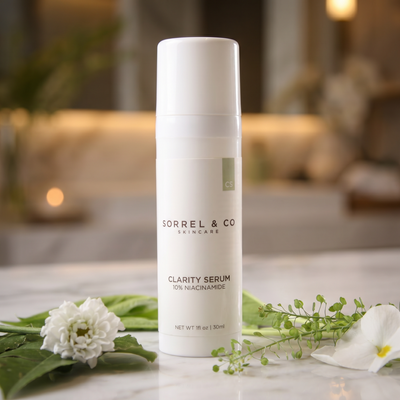
The Clarity Serum uses niacinamide at 10% — the upper bound of the studied effective range — in a short, fragrance-free base with hyaluronic acid and allantoin to keep it comfortable on reactive, often-combination skin. There is no zinc in it: we do not sell a zinc product, so the cascade above is the principle, not a claim we have replicated in a bottle.
For people new to niacinamide who want to start at a gentler concentration, the Dew Cream (which we covered in our piece on allantoin as the quiet workhorse) provides niacinamide at a lower concentration paired with additional soothing ingredients — useful as an acclimation step before moving to the higher concentration in the Clarity Serum.
The full ingredient list and the studies behind the formulation are linked from our Research page.
What to expect on timeline
Niacinamide's effects on redness build slowly. The mechanisms it engages are multi-step and the visible changes accumulate as the inflammatory cascade is repeatedly dampened over weeks.
Weeks 1–2. Possible mild flushing in the first few applications, resolving with continued use. Subjective sensitivity may decrease early — some users report a calmer feeling within days even before visible redness changes.
Weeks 3–6. The earliest visible reduction in baseline erythema. Skin may look less generally pink in the cheeks, with less reactivity to environmental triggers. The change is usually subtle and easier to see in photographs than in the mirror.
Weeks 7–12. The dominant visible improvement window. Persistent cheek redness should be measurably reduced, and reactivity to triggers should be noticeably lower. This is when the photo comparison with week zero becomes obvious.
Weeks 13+. Maintenance phase. Continued use prevents the inflammatory baseline from creeping back up. Discontinuation usually produces gradual return of the prior redness over 4–8 weeks.
If persistent redness has been the variable in your skin you have not been treating, niacinamide at clinical dose is the OTC tool with the most evidence behind it. The mechanism is multi-pathway. The effect is real but takes weeks to build. Compliance is the determinant.
Not sure whether redness is the variable to treat first, or whether another concern comes before it? The Skin Plan maps your routine in about thirty seconds — no email required.