

Niacinamide is the rare skincare ingredient with strong evidence behind a long list of claims. It reduces hyperpigmentation, calms redness, regulates sebum, and supports the skin barrier. The research is genuine, the mechanisms are documented, and dermatologists actually recommend it.
It's also one of the most consistently underdosed ingredients in cosmetic skincare.
The 2% niacinamide on the front of most product labels isn't a clinical dose. It's a marketing minimum — the smallest concentration a brand can put on a label and still claim niacinamide as an active ingredient. The studies that established niacinamide's actual effects used 4% to 10%. Here's the gap between what the marketing implies and what the research actually shows.
What niacinamide actually does
Niacinamide is a form of vitamin B3 that participates in over 200 enzymatic reactions in skin cells. When applied topically at clinical concentrations, four mechanisms are well-documented in the literature.
Melanosome transfer inhibition. Melanin is produced by melanocytes deep in the epidermis but causes visible hyperpigmentation only when it transfers to keratinocytes near the surface. Niacinamide interferes with that transfer. Hakozaki et al. (2002) demonstrated a measurable reduction in hyperpigmentation at 4% topical application over 8 weeks. Subsequent trials at higher concentrations showed proportionally stronger effects.
Ceramide synthesis. Niacinamide upregulates the production of ceramides — the lipid molecules that compose the skin barrier's lipid matrix. Compromised barrier? Niacinamide directly addresses the underlying cause, not just the symptoms.
Sebum regulation. Sebaceous gland activity is partially driven by NADPH-dependent enzymatic pathways. Niacinamide modulates these pathways, reducing sebum output without stripping or drying. People with oily or acne-prone skin see real change here.
Reduction in cytokine-mediated inflammation. Niacinamide downregulates several inflammatory pathways involved in redness, post-acne marks, and rosacea-adjacent presentations. The effect is modest but consistent across studies.
The combined effect of these four mechanisms is why niacinamide reads like a wonder ingredient. The catch is that each mechanism is concentration-dependent.
The studies and their concentrations
The most-cited niacinamide studies used the following concentrations:
- Hakozaki 2002: 4% niacinamide — significant reduction in facial hyperpigmentation over 8 weeks
- Bissett et al. 2005: 5% niacinamide — improvements in fine lines, hyperpigmentation, red blotchiness, and skin tone uniformity over 12 weeks
- Draelos et al. 2006: 4% niacinamide vs hydroquinone 4% — comparable hyperpigmentation reduction
- Berson 2006: 5% niacinamide — measurable barrier function improvement and TEWL reduction over 4 weeks
The pattern is consistent. Studies showing the effects niacinamide is famous for used 4-5% as the floor. Studies at 10% (more recent and less commonly cited) show stronger results, particularly for hyperpigmentation and sebum regulation.
Studies at 2%? They show modest barrier-support effects, but the dramatic before-and-after results that drive niacinamide marketing came from products at 4% or higher.
Why 2% is the marketing minimum
If 4-5% is the clinical floor, why do so many products use 2%?
Cost. Niacinamide at clinical concentrations changes the cost structure of a formulation meaningfully. A product at 2% niacinamide can hit a $20 retail price point and still produce comfortable margins. A product at 10% niacinamide either needs to retail higher or the brand absorbs the margin compression.
Stability. Niacinamide at higher concentrations can interact with other formulation components, requiring more sophisticated formulation work. 2% sits in an easier zone.
Marketing flexibility. A 2% product can claim niacinamide on the label and benefit from consumer awareness of the ingredient — without having to deliver clinical-dose results. It's a gentler tier of product that uses the ingredient's reputation without the cost of using the ingredient at its evidence-backed concentration.
None of this is wrong. It's just not what the marketing implies. The shopper who reads "10% niacinamide" on the front of a product is being told something materially different than the shopper who reads "with niacinamide" on a 2% product.
What to look for on a label
Reading niacinamide concentration from a product label requires three things.
Look for the explicit percentage on the front or back of the bottle. If the brand uses a meaningful concentration, they typically advertise it. Products that don't specify the percentage usually fall in the 2-3% range — if they were higher, they'd say so.
Check the ingredient list position. Niacinamide appears as "niacinamide" or sometimes "vitamin B3" in the INCI list. The closer to the top of the list, the higher the concentration. A niacinamide listed in position 3-5 (early in the list) likely indicates a clinical dose. Position 12-15 (deep in the list, after a long stretch of secondary ingredients) indicates a token amount.
Check the brand's stated rationale. A brand using niacinamide at a clinical concentration will typically cite the research behind their dosage choice. The absence of any concentration reference is a signal.
The Sorrel approach
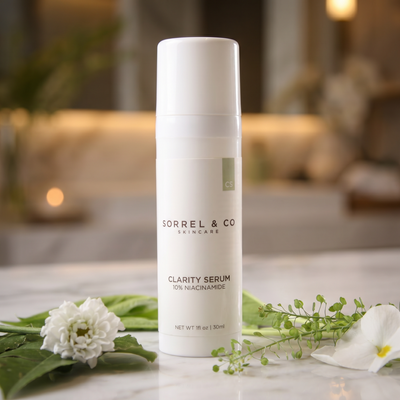
The Sorrel Clarity Serum uses 10% niacinamide. That's the lead. It's the concentration the Hakozaki, Bissett, and subsequent trials demonstrated meaningful effects at — and it's the concentration we wanted to deliver because the research is the reason to use the ingredient in the first place.
Around that 10% niacinamide, the Clarity Serum keeps a deliberately short, gentle supporting cast — hyaluronic acid, a bamboo ferment, chamomile, and allantoin — in a fragrance-free base. No zinc, no added fragrance; the concentration is the point, and the rest is there to keep it comfortable. The full ingredient list, and the studies behind each active, are on the Clarity Serum product page.
The same evidence-led approach runs through our research blog. If you want to see how we think about formulations more broadly, our retinol piece covers a parallel concept: the variable most products skip, and what changes when you don't skip it.
How to use niacinamide
Niacinamide is unusually well-tolerated. It pairs cleanly with most other actives, including retinol, vitamin C, and AHAs — despite long-running internet folklore claiming it inactivates vitamin C. That claim was based on outdated research using a different vitamin C derivative and unstable formulations. Modern niacinamide-and-vitamin-C formulations work together without issue.
Apply niacinamide to clean skin, before heavier creams and oils. Twice daily is fine. There's no acclimation period or tolerance issue — at clinical doses, niacinamide can be used immediately at full frequency.
Expected timeline:
- Week 2-3: Reduction in visible redness and uneven tone, particularly post-acne marks
- Week 4-6: Sebum regulation effects become visible (less midday shine, fewer breakouts)
- Week 8-12: Hyperpigmentation begins to fade measurably
- Beyond week 12: Cumulative barrier function improvements
Niacinamide is one of the few ingredients where you can use a product daily for 12 weeks and have measurably better skin than before. The condition is that the product has to contain enough niacinamide to do the work. At 2%, it doesn't. At 10%, it does.
If you've been skeptical of niacinamide because the products you tried didn't seem to do much, the variable most worth changing is the concentration — which is the one number we put on the front of the bottle.
Not sure whether niacinamide is the gap in your routine, or which concern to start with? The Skin Plan maps your routine in about thirty seconds — no email required.