

You bought the retinol. You used it nightly for two weeks. Your face peeled in sheets. You stopped.
This isn't a personal failure. It's a delivery problem — and most retinol products on the market are sold to consumers without ever explaining the difference between retinol that's been formulated to work with your skin and retinol that's been formulated to fit into the marketing budget.
The mechanism behind retinol's irritation is well-documented in the dermatology literature. So is the solution. Here's what's actually happening on your face, why most products get it wrong, and what to look for if you want the proven benefits of retinol without the three-week initiation period most people quit before completing.
What retinol actually does — and why it irritates
Retinol is a vitamin A derivative. When applied topically, it's converted inside skin cells to retinoic acid, the active form that binds retinoid receptors and drives the cellular changes you actually want: faster keratinocyte turnover, upregulated collagen synthesis, reduced melanin overproduction, normalized desquamation.
These mechanisms are among the most rigorously studied in cosmetic dermatology. The RCT literature spans decades. Retinol works. The question isn't whether — it's how to use it without destroying your barrier in the process.
The irritation problem is essentially a kinetics problem. Conventional retinol formulations deposit a high concentration of active ingredient on the skin surface at once. Your skin metabolizes a fraction of that, and the rest sits there, producing a localized concentration spike that overstimulates the keratinocytes you can see — surface cells. That overstimulation accelerates desquamation past the point where it can happen invisibly. The dead surface cells slough off faster than they can be replaced. You see this as flaking, redness, and the tight, raw feeling that defines week two and three of most retinol journeys.
This is sometimes called the retinization period. The conventional wisdom is to push through it. Buffer with moisturizer. Apply less frequently. Wait it out.
That advice is partially right and entirely incomplete. The retinization period exists because the delivery system is mismatched to how skin actually metabolizes retinol. A better delivery system reduces or eliminates the irritation while preserving the same therapeutic signal. This isn't a workaround — it's a real chemistry improvement, and it's been available since the early 2000s.
The liposomal delivery difference
A liposome is a microscopic spherical structure made from phospholipids — the same molecules that compose your cell membranes. Liposomes can be engineered to encapsulate small molecules like retinol, protecting them during topical application and releasing them gradually as the liposomes interact with your skin's lipid matrix.
The mechanism is elegant. When liposomal retinol is applied to skin, the liposomes don't immediately rupture and dump their cargo at the surface. They migrate into the stratum corneum, interact with native lipids, and release their retinol payload progressively over hours rather than all at once. The total retinol dose delivered is the same. The peak concentration at any single moment is much lower. The cumulative metabolic signal to retinoid receptors is preserved. The surface irritation is dramatically reduced.
This has been documented in controlled studies. Randhawa et al. published a 2015 paper that compared stabilized retinol formulations against conventional retinol and found that encapsulated delivery moderates the irritation profile without compromising efficacy. The retinol is doing the same work. It's just doing it on a different timeline.
For consumers, the practical consequence is significant. Liposomal retinol produces noticeably less peeling, redness, and irritation. Compliance increases — meaning people actually keep using the product long enough to see results, instead of quitting at week three. And because consistent use is the single biggest predictor of retinol outcomes, better compliance translates directly to better outcomes.
What to look for on a label
Most retinol products on the market do not use liposomal delivery. Conventional retinol is cheaper to formulate and faster to manufacture, so the majority of products at every price point — from drugstore to prestige — use it.
Here's how to tell the difference when you're reading a label.
Look for the words "encapsulated" or "liposomal" near the retinol listing in the ingredients or product description. If neither word appears, assume the formulation is conventional. Some brands will use words like "stabilized" or "time-released" — these are encouraging but vaguer. Without explicit mention of encapsulation, you can't be certain the delivery system has been engineered.
Check the brand's product page or research documentation for citation. A brand using a meaningful delivery system will typically cite it. The absence of any technical reference is a signal that the formulation is conventional and the marketing is doing the work the chemistry isn't.
Be skeptical of percentage claims that aren't paired with delivery information. A 1% retinol in a conventional formulation will produce more irritation than a 0.5% retinol in a liposomal formulation, despite "containing more retinol." Concentration without delivery context is incomplete information.
Look for the supporting cast. A serious retinol formulation will pair the active with ingredients that support barrier function during use. Ceramides, niacinamide, peptides, and bisabolol are common and useful additions. Their presence suggests the formulator was thinking about the user's skin, not just the active ingredient list. Their absence suggests a thinner product strategy.
The Sorrel approach
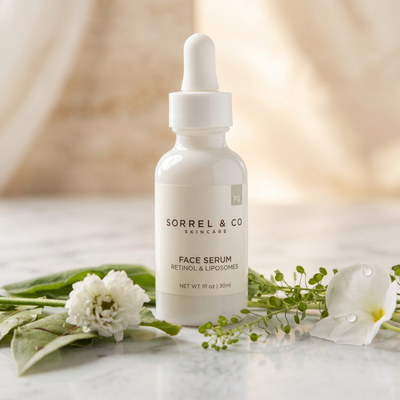
The Sorrel Face Serum uses liposomal retinol. That's the lead. It also includes hexapeptide-11, a signal peptide that supports extracellular matrix production through a pathway separate from retinol's direct stimulation — meaning the formulation drives collagen synthesis through two independent mechanisms rather than one. And it includes bisabolol, an anti-inflammatory sesquiterpene from chamomile that tempers any residual irritation response.
The full ingredient list, concentrations where relevant, and the studies behind each active are published on the Face Serum product page. The Randhawa 2015 paper on stabilized retinol delivery, along with the other studies that informed the formulation, are linked on our research page.
This isn't a complicated product. It's just one that was formulated by someone who read the chemistry literature first and the marketing playbook second.
How to start retinol — a 12-week framework
Even with liposomal delivery, retinol is a meaningful intervention, and the introduction matters. Here's the framework that minimizes irritation and maximizes long-term tolerance.
Weeks 1 and 2 — Acclimation. Apply the serum two evenings per week, to dry skin after cleansing. Follow with a barrier-supportive moisturizer (ideally one with ceramides). Skip nights you've used any other active — no acids, no benzoyl peroxide, no vitamin C on retinol nights. If you experience any redness or tightness, drop to one night per week for two more weeks before progressing.
Weeks 3 and 4 — Frequency increase. If tolerance is good, increase to three nights per week. Same protocol. Continue to avoid stacking other actives on retinol nights. Daytime SPF use is non-negotiable — accelerated cell turnover makes skin more photo-sensitive even when you don't feel any irritation.
Weeks 5 through 8 — Routine integration. Most people can move to four or five nights per week by week six. By this point, your skin has acclimated to the retinol signal and the cellular turnover rate has stabilized at a higher baseline. You should notice the first visible improvements during this window: smoother texture, less prominent fine lines, more uniform tone.
Weeks 9 through 12 — Evaluation. This is the earliest point at which you can meaningfully evaluate results. Retinol's collagen synthesis effects are slow because collagen synthesis itself is slow. Take a photograph in consistent lighting at week zero, week four, and week twelve. Compare. The differences are usually more dramatic than people remember while living through them day by day.
What to expect — and what not to
Skin texture changes are the first thing most users notice, typically by week three or four. Fine lines soften next, usually by week eight. Tone evenness and brightening accumulate over months rather than weeks because melanin redistribution is itself a slow process.
Don't expect:
- Overnight changes. Skincare ingredients with real RCT evidence are slow. Skincare ingredients with fast claims usually don't have real evidence.
- Linear improvement. Skin has good weeks and bad weeks. Don't quit during a bad week.
- Equivalent results to prescription tretinoin. Retinol is converted in skin to retinoic acid, which is the prescription active. The conversion is incomplete, which means retinol is meaningfully less potent than tretinoin at equivalent percentages. This is also why retinol is gentler and available without prescription.
If you've tried retinol before and stopped because of irritation, a liposomal formulation is the variable most worth changing. Concentration, frequency, and supporting ingredients all matter, but delivery is the single largest determinant of tolerance.
If you've held off on retinol because past attempts went poorly, a liposomal formulation is the variable most worth changing — delivery, not willpower.
Not sure whether retinol is the right next step for your skin, or whether something should come first? The Skin Plan maps your routine in about thirty seconds — no email required.