The most important word in barrier-focused skincare is one most people have never heard pronounced correctly. Ceramides — the “c” is soft, like “serra-mides” — are the lipid molecules that hold your skin barrier together. They are not a marketing ingredient. They are not an active. They are the structural material that determines whether your skin keeps water in, keeps irritants out, and looks the way you want it to look.
Understanding ceramides is the difference between a moisturizer that temporarily makes skin feel better and a moisturizer that actually repairs the barrier producing the problem. Here is what ceramides are, how they hold the barrier together, and why a ceramide-rich formulation shows measurably different outcomes than a moisturizer relying on humectants alone.
The brick-and-mortar model of the barrier
The standard model for understanding the stratum corneum — the outermost layer of your skin — is the brick-and-mortar model. The keratinocyte cells are the bricks. The lipid matrix between them is the mortar. Together they form a continuous barrier that is roughly 15–20 micrometers thick.
What the brick-and-mortar model gets right is the role of the mortar. If the lipid matrix between cells is intact, the barrier functions — water stays in, irritants stay out, microbes do not penetrate, and the skin you can see looks calm and even. If the lipid matrix is compromised, the barrier fails. Trans-epidermal water loss (TEWL) increases. Irritants reach deeper into the skin. Inflammation increases. You see this externally as redness, tightness, flaking, sensitivity to products that did not used to bother you, and reactive responses to environmental triggers like cold or wind.
The lipid matrix is approximately 50% ceramides, 25% cholesterol, and 15% free fatty acids by weight, plus smaller amounts of other lipids. The exact ratio matters — a barrier with adequate ceramides but inadequate cholesterol is still compromised. But ceramides are the dominant component, and ceramide deficiency is the most common barrier dysfunction pattern in dry, sensitive, and aging skin.
What ceramides actually do
Ceramides are a class of lipid molecules built from a fatty acid attached to a sphingoid base. There are at least nine distinct ceramide species in human skin (numbered 1 through 9), and each has slightly different physical properties — some are longer-chain, some shorter, some more rigid, some more flexible. Together they form a multi-lamellar structure between the keratinocytes that acts as a near-impermeable membrane to water while remaining flexible enough to accommodate normal skin movement.
The barrier needs all of them, in roughly the right proportions, to function. A skin barrier with only Ceramide 1 will not work — the molecular geometry is wrong. A barrier with all nine in the right ratios is the gold standard.
Skin produces ceramides on its own through a series of enzymatic steps in the deeper layers of the epidermis. Production declines with age. It declines further with chronic barrier insult — over-exfoliation, harsh cleansers, retinol acclimation, environmental damage. By the time you can see barrier dysfunction in the mirror, ceramide depletion has typically been ongoing for months.
Topical ceramides supplement the depleted supply. They do not replace endogenous production, but they fill the gaps in the lipid matrix while the skin's own production recovers. This is the mechanism behind ceramide-containing moisturizers showing measurably faster barrier repair than humectant-only formulas in controlled studies.
The cholesterol and fatty acid context
One detail most marketing skips: ceramides alone do not rebuild the barrier. The lipid matrix needs ceramides, cholesterol, and free fatty acids in roughly correct proportions. Applying pure ceramides without the other lipids can actually slow barrier repair in some cases — the matrix needs the supporting lipids to organize correctly.
The Elias 1996 work established the 50/25/15 ratio (ceramide/cholesterol/fatty acid) as the target for barrier-repair formulations. Later work refined this and showed that the proportions can vary depending on the type of barrier insult being repaired, but the principle holds: a serious barrier-repair product contains a balanced lipid mix, not just ceramides.
What this means practically: look for cholesterol (often listed as “cholesterol” or “phytosterol” or “sterol”) and free fatty acids (often listed as “linoleic acid,” “oleic acid,” or as part of a triglyceride blend) in the same ingredient list as the ceramides. Products that list ceramides alone, without the cholesterol and fatty acid supporting cast, are formulating to the marketing word rather than the science.
Reading ceramide ingredient lists
Ceramides are listed on labels in several different ways. Here is how to decode them.
Ceramide NP, AP, EOP, NS, AS, EOS, NH, AH, EOH. These are the modern naming conventions. The letters indicate the structure: N, A, or E for the fatty acid type, and P, S, or H for the sphingoid base type. NP is one of the most common in cosmetic formulations — it is structurally similar to the dominant ceramide species in healthy skin.
Ceramide 1, 2, 3, 6-II, etc. Older numerical naming. These map to the lettered names — Ceramide 3 is the same as Ceramide NP, for example.
Phytosphingosine, sphingosine. These are sphingoid bases that the skin uses to build its own ceramides. Topical application can support endogenous ceramide production in addition to whatever ceramides are directly supplied.
Pseudo-ceramides. Synthetic molecules designed to mimic ceramide function in formulations where cost or stability prevents the use of real ceramides. Some pseudo-ceramides work reasonably well; others do not. The science is mixed.
A serious formulation typically contains multiple ceramide species, not just one. A product listing “Ceramide NP” alone is less likely to mirror the natural skin lipid composition than one listing Ceramide NP, AP, and EOP. More species, more accurate barrier reconstruction.
Ceramides and retinol
The single best argument for ceramides in skincare is what they do alongside retinol. Retinol drives cellular turnover. Faster turnover means a barrier that is constantly being reconstructed — and one that, during retinol acclimation, is genuinely compromised. We covered the irritation mechanism in our piece on why most retinol serums cause peeling.
Pairing retinol with ceramides addresses the barrier-disruption side of the retinol equation. The retinol does its work driving cellular turnover and collagen synthesis. The ceramides supplement the lipid matrix while the skin adapts. The result is better tolerance, faster acclimation, fewer barrier emergencies during the first 8 weeks, and — because compliance is the single biggest predictor of retinol outcomes — better long-term results.
This is also why a retinol product and a ceramide product paired together typically outperform either one used alone. The mechanisms are complementary. The barrier is being rebuilt as fast as the retinol is challenging it.
The Sorrel approach
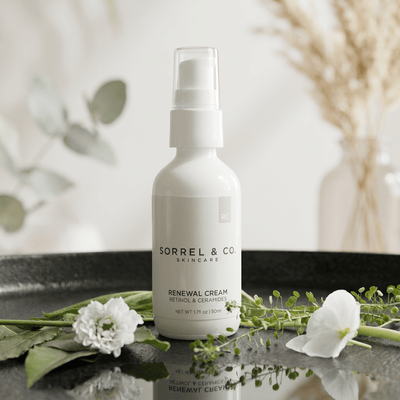
The Renewal Cream is built around the retinol + ceramide combination. It pairs liposomal-encapsulated retinol with a balanced ceramide complex (multiple species, not just one), supporting cholesterol, and barrier-friendly fatty acids. The intent is single-product convenience for people who want retinol and ceramides but do not want to layer two separate products every night.
For people running a more elaborate stack, the Face Serum (liposomal retinol) plus a ceramide-rich moisturizer is functionally equivalent. The Renewal Cream is the combined convenience version.
The full ingredient list, the ceramide complex specifically, and the studies behind the formulation are linked from our Research page.
How to use ceramide products
Ceramides go in the moisturizer step — after serums, before any occlusive layer or SPF. They benefit from being applied to slightly damp skin (water as the substrate) but do not require it the way humectants do.
Frequency: twice daily, AM and PM. Ceramide depletion is constant; the supplementation should be too.
What to pair them with: anything that challenges the barrier. Retinol nights, acid exfoliant nights, post-procedure recovery, seasonal cold exposure, periods of high stress that affect skin reactivity — all of these are situations where ceramide products earn their place.
What to expect: ceramide-supported barrier repair shows measurable TEWL improvements within 2–4 weeks of consistent use in most controlled studies. Visually, you should notice less tightness after cleansing, fewer reactive responses to products you have always used, and more even tone as low-grade inflammation subsides. These are not dramatic changes — they are the foundation that makes everything else in your routine work better.
If you have a compromised barrier, or if you are about to start retinol, the Renewal Cream is the foundation that determines how the rest of your routine performs.
Not sure whether barrier repair is your priority right now, or whether another concern comes first? The Skin Plan maps your routine in about thirty seconds — no email required.