If you turn over any reputable barrier-repair moisturizer, gentle cleanser, or post-procedure cream, you will almost certainly find allantoin somewhere in the ingredient list. Usually quietly. Rarely on the front of the box. Almost never as the headline active. And yet it is one of the most useful ingredients in cosmetic chemistry — a quiet workhorse that does two distinct jobs at once and pairs well with nearly everything else you might be using.
Allantoin gets overlooked because it is not glamorous. It does not have a marketing story like retinol or a Korean-beauty cult following like snail mucin. It just shows up in formulations that work, does its job without drama, and is well-tolerated even by skin types that react to almost everything else. Here is what allantoin actually does, why the dual mechanism matters, and where it fits in a routine that takes barrier health seriously.
What allantoin is
Allantoin is a small organic molecule produced naturally by many plants and animals as a metabolic byproduct. In cosmetics, it is typically synthesized in a laboratory to ensure purity and consistency — the synthetic version is chemically identical to the plant-derived version and avoids the contamination issues that can accompany plant extracts.
It has been used in topical formulations for more than a century. It appears in pharmacopoeias as a regulated active ingredient in wound care, in many countries' OTC skincare regulations, and in cosmetic chemistry textbooks as a baseline soothing ingredient with broad utility. There is more clinical history behind allantoin than behind most of the trendier ingredients on your shelf.
The reason it is not more widely marketed: it does not produce dramatic single-ingredient effects that look good in before/after photos. It produces small, consistent improvements in barrier function, comfort, and tolerability that compound over time. Marketing teams have a hard time selling “makes everything else work slightly better.” Formulators value it precisely because it does exactly that.
The first mechanism: keratinolytic
Allantoin is mildly keratinolytic — it loosens the bonds between dead skin cells in the outermost layer of the stratum corneum, supporting gentle desquamation. The effect is subtle. It is nothing like an acid exfoliant. It does not produce visible flaking, irritation, or any of the responses that more aggressive exfoliating ingredients can trigger.
What it does instead is normalize turnover. If your skin is shedding dead cells too slowly — which can happen with age, with dehydration, with retinol acclimation, after sun damage — the dead cells accumulate at the surface and the result is dullness, rough texture, and the appearance of dehydration even when underlying hydration is adequate. Allantoin loosens that accumulation just enough to support normal renewal without overshooting into irritation.
The practical implication: in a product that contains allantoin alongside humectants like glycerin and hyaluronic acid, the humectants reach the skin more effectively because the dead-cell barrier between formulation and living skin is thinner and more permeable. Same active ingredient, better delivery. The whole formula performs above its theoretical maximum.
The second mechanism: soothing and barrier-supportive
The second job allantoin does is anti-inflammatory and barrier-supportive. The exact mechanism is incompletely characterized, but the effects are well-documented: allantoin reduces erythema, decreases the irritation response to other actives applied alongside it, and supports the healing of compromised stratum corneum.
This is why allantoin appears in post-procedure creams, sensitive-skin moisturizers, and barrier-repair products. It is doing repair-adjacent work — not driving repair directly the way ceramides do, but reducing the inflammatory signaling that slows repair when skin is irritated.
The two mechanisms together — gentle keratinolytic action plus anti-inflammatory soothing — are unusual. Most exfoliating ingredients are inflammatory. Most soothing ingredients are not exfoliating. Allantoin does both at once, which is the basis of its reputation as the “quiet workhorse” ingredient that improves formulations without taking center stage.
Why allantoin is well-tolerated
Few ingredients in cosmetic chemistry have allantoin's safety record. It is non-comedogenic, non-sensitizing in essentially all skin types studied, and tolerated by pregnant and breastfeeding people. It does not interact poorly with retinol, acid exfoliants, or any of the more aggressive actives that have their own irritation profiles — it actually mitigates the irritation those ingredients can cause when paired with them.
This makes allantoin uniquely useful in formulations targeting reactive or sensitive skin types. It is one of the very few ingredients where the question “is this safe to add to a sensitive-skin formula?” has a confident yes.
Allantoin alongside niacinamide
The most common formulation pairing for allantoin is with niacinamide. The two ingredients address different problems but reinforce each other:
- Niacinamide reduces inflammation through cytokine modulation. Allantoin reduces inflammation through a separate, less-understood pathway. Two parallel anti-inflammatory mechanisms.
- Niacinamide supports barrier function by upregulating ceramide synthesis. Allantoin supports barrier function by improving the comfort and tolerability that lets you use barrier-supportive products consistently.
- Niacinamide can occasionally cause flushing or mild irritation at higher concentrations. Allantoin mitigates that response.
We covered the broader niacinamide mechanism in our piece on why most niacinamide products underdose. The relevant point here: allantoin is the most common formulation partner for clinical-dose niacinamide, and the combination is more useful than either ingredient alone.
How to read an allantoin claim
Allantoin is one of the easier ingredients to verify on a label, because the concentration range is narrow and well-established.
Effective concentration: 0.1–2%. Most cosmetic formulations use allantoin in the 0.5–1% range. Above 2%, the molecule's poor solubility makes formulation difficult; below 0.1%, the effect is minimal.
Position on the ingredient list. At 0.5–1%, allantoin typically appears in the middle of an ingredient list — often near other low-concentration actives like panthenol, bisabolol, and similar supporting ingredients. If allantoin is listed at the very end (after multiple preservatives), it is likely present at a token concentration.
Supporting cast. A formulation that uses allantoin intentionally usually pairs it with other supporting ingredients in the same category: panthenol, bisabolol, glycerin, hyaluronic acid. These ingredients work better together than alone, and seeing them stacked is a signal that the formulator was thinking about the supporting cast as carefully as the headline active.
Where allantoin fits in your routine
The most useful applications:
Daily moisturizer. Allantoin in your daily AM/PM moisturizer makes the moisturizer perform better and improves your tolerance to whatever actives you are using in the layer underneath.
Post-procedure recovery. After chemical peels, microneedling, or laser, an allantoin-containing product accelerates the comfort phase of recovery without compromising the procedure outcome.
Retinol acclimation support. During the first 6–8 weeks of retinol use, an allantoin-containing barrier moisturizer paired with the retinol product can dramatically reduce the irritation phase — not by blocking the retinol's effect, but by repairing the barrier between retinol nights.
Sensitive or reactive skin types. Anyone whose skin reacts to a new product even when they expected it to be well-tolerated should look for allantoin in everything they apply. The forgiveness margin is wider with allantoin in the formula.
The Sorrel approach
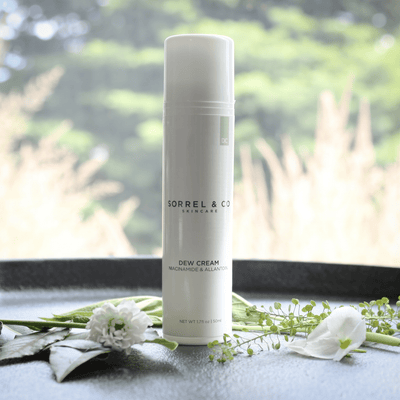
The Dew Cream pairs allantoin with niacinamide as the two anchor actives, along with glycerin and hyaluronic acid for hydration and a small complement of barrier-supportive lipids. The intent is a daily-driver moisturizer that does specific work — not a heavy occlusive, not a humectant-only gel, but a balanced formulation that earns its place in both AM and PM routines.
Allantoin sits in the formulation around 1% — a clinical dose, well within the effective range, paired with the supporting ingredients that make it perform.
The full ingredient list and the studies behind the formulation are linked from our Research page.
If your current routine has lots of actives but no quiet workhorse ingredient holding it all together, allantoin is the unglamorous addition that makes everything else work better.
Not sure what your routine is missing, or which concern to start with? The Skin Plan maps it in about thirty seconds — no email required.