

Bisabolol is the ingredient you have probably used dozens of times without knowing it. It is in baby skincare. It is in post-shave balms. It is in nearly every serious sensitive-skin moisturizer. It is the quiet calming agent that lets demanding formulations stay demanding without crossing into irritation, and the reason gentle products feel as comfortable as they do on reactive skin.
The name is awkward. The plant source is more familiar: bisabolol is the dominant active compound in chamomile. The same flower whose tea your grandmother drank to settle a stomach has, in its essential oil, one of the most useful soothing molecules in cosmetic chemistry. Here is what bisabolol actually does, why it pairs so well with stronger actives, and where it fits in a routine that takes reactive skin seriously.
What bisabolol actually is
Bisabolol is a sesquiterpene alcohol — a particular class of small organic molecules characterized by a 15-carbon skeleton and an alcohol group. It is one of dozens of compounds in chamomile essential oil and accounts for roughly 50% of the oil's content by weight in higher-quality chamomile sources.
Two forms exist: alpha-bisabolol (the natural form found in chamomile and in candeia trees from Brazil) and beta-bisabolol (a synthetic isomer with similar properties). Both work. Alpha-bisabolol is more common in skincare formulations because the natural source has a longer history of use and the regulatory profile is well-established.
The molecule has been used in topical preparations for centuries through chamomile extracts, but isolated bisabolol entered cosmetic chemistry in the mid-20th century when extraction and synthesis methods improved. It is now one of the standard tools for formulators trying to make a product tolerable without compromising on the actives that do the heavy lifting.
What the research shows
In laboratory studies, bisabolol acts on several of the pathways skin uses to escalate a reaction, rather than on any single one:
- It inhibits 5-lipoxygenase, an enzyme involved in producing leukotrienes — signaling molecules that contribute to the flushed, swollen look of irritated skin.
- It reduces the expression of certain cytokines (interleukin-1, interleukin-6, TNF-alpha) in skin models placed under stress.
- It shows mild antimicrobial activity against several common skin bacteria in culture.
- It appears to lower the reactive background that skin has to work against, rather than driving any repair process directly.
The breadth matters, because a reactive episode is rarely single-pathway. The same skin may be reacting to an irritant, a temperature shock, a hormonal trigger, and an active ingredient that is otherwise doing useful work — all at once. A compound acting on several pathways addresses more of that at the same time than one acting on a single mechanism.
Two honest limits, because that honesty is the point of this page. First, most of this work is done in cell cultures and animal models rather than on human faces over months — which is why, on our own evidence scale, we grade bisabolol Strong rather than Strongest. What human data exists points to good tolerance on sensitive skin, and the mechanism is well characterized. Second, bisabolol is not an active in the sense that retinol or vitamin C is. It does not remodel skin or drive visible change on its own. Expecting it to produce results by itself will disappoint. Expecting it to make a retinol routine more wearable, or a vitamin C application less stingy, or a reactive-skin moisturizer more broadly comfortable — those are the correct expectations.
Bisabolol and demanding actives
The most useful application of bisabolol is alongside actives that have meaningful efficacy but uncomfortable side effects. The list is long:
Retinol. The most common pairing. Bisabolol takes the edge off the flaking and redness phase without compromising the retinol's underlying cellular work. We covered the broader retinol mechanism in our piece on why most retinol serums cause peeling.
Vitamin C. L-ascorbic acid at effective concentrations (10–20%) can sting and leave skin looking pink on its own. Bisabolol softens that without lowering the active concentration of the vitamin C.
Acid exfoliants. AHA and BHA exfoliants work in part by provoking a controlled reaction. Bisabolol keeps that toward the lower, more tolerable end — same exfoliating effect, less downstream discomfort.
Niacinamide at higher concentrations. The 10% niacinamide that produces strong clinical results can occasionally cause flushing in sensitive skin. Bisabolol in the same formulation softens that response.
The recurring pattern: bisabolol is the “forgiveness margin” ingredient. It does not change what the active does. It changes what the skin around the active does in response.
Bisabolol and green tea
One particularly useful pairing is bisabolol with green tea polyphenols, especially EGCG. The two address different drivers of the same visible problem:
- Green tea polyphenols are antioxidants — they reduce the oxidative stress that sits behind some reactivity.
- Bisabolol acts on the signaling cascade itself.
Used together, they cover the two main contributors to a low-grade reactive look: oxidative damage and overactive signaling. We covered the broader topical antioxidant case in our piece on what topical antioxidants actually do. The bisabolol layer complements that work.
What to look for on a label
Bisabolol is relatively easy to verify on a label because the effective concentration range is narrow.
Effective concentration: 0.1–1%. Most formulations use bisabolol in the 0.2–0.5% range. Above 1%, the formulation cost becomes prohibitive without proportional benefit. Below 0.1%, the effect is minimal. This is also why bisabolol appears near the end of an ingredient list — for a potent ingredient used at its effective dose, that placement is exactly right, not a sign of tokenism.
Source matters slightly. Alpha-bisabolol derived from candeia tree (Vanillosmopsis erythropappa) is the most common high-purity source in cosmetic chemistry. Chamomile-derived bisabolol is equally effective but more variable in purity. Both work; the candeia-derived version is more reliable for formulators.
Read the neighbors, not just the star. Bisabolol typically appears alongside other soothing ingredients: allantoin, panthenol, niacinamide, centella asiatica. Several of them together is a signal of careful formulation. Bisabolol sitting next to denatured alcohol high on the list, or menthol, or a long block of fragrance, is a formula hedging its bets. We covered the allantoin pairing specifically in our piece on why allantoin shows up in every barrier-repair formula worth using.
Caution flag. Some formulations list “chamomile extract” without specifying bisabolol concentration. Chamomile extract can contain bisabolol at meaningful levels, but it depends entirely on the extraction method and source. Products that specify bisabolol directly are more reliable than products listing whole extracts of varying purity.
Where our own label lands
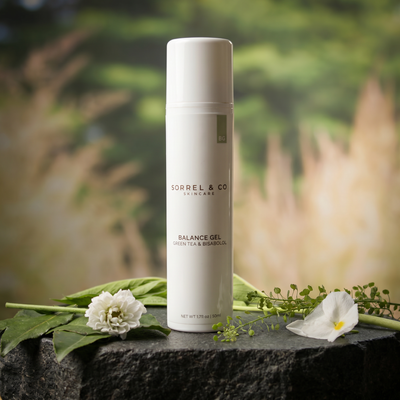
We chose bisabolol for several of our formulas. The Balance Gel is the one built around calming: it pairs bisabolol with green tea and chamomile to settle the look of redness, alongside a lilac-leaf ferment for the look of oil balance. It is a light, oil-free layer aimed at combination skin — the kind that breaks out in some places and flushes in others.
Now the caveat, because an article about reactive skin owes it. The Balance Gel is not fragrance-free. It contains mandarin and orange peel oils and a small amount of denatured alcohol, which are exactly the kinds of ingredients the most reactive, fragrance-sensitive skin should approach carefully. Bisabolol being present does not neutralize that. If your skin flares at citrus or fragrance, patch-test this one first. By the “read the neighbors” test two sections up, our own gel is a formula you should read closely rather than take on trust — which is the habit this whole page is trying to build.
Bisabolol also appears in our Dew Cream, Face Serum, and Face Oil, so calming skin is not a one-product decision. The full ingredient list for each sits on its product page, which is where this kind of question should always start.
For the longer version of this argument — what separates calming from numbing, and why that distinction matters for skin that reacts — see our piece on bisabolol and reactive skin.
Who bisabolol is for
Bisabolol makes sense for nearly every skin type, but the people who benefit most are:
- Anyone running a demanding active routine (retinol, vitamin C, exfoliating acids) who has hit a tolerability wall
- Skin that flushes easily or reacts to more products than it tolerates
- People in the first 8 weeks of any new active routine, when tolerance is still establishing
- Anyone whose skin responds to environmental triggers — cold, wind, heat — more strongly than expected
It is not a hero ingredient and does not need to be marketed as one. It is the kind of ingredient that, when present at a meaningful dose in a thoughtfully formulated product, makes the whole routine more sustainable. That sustainability — the “will I still be using this in 6 months” question — is the largest determinant of skincare outcomes, larger than any single active's potency.
If your current routine has the right actives but your skin keeps reacting in ways you cannot quite explain, a calming layer is the variable worth changing.
Not sure whether calming is what your skin needs most, or whether another concern comes first? The Skin Plan maps your routine in about thirty seconds — no email required.
References
- Kim S, et al. Inhibitory effects of (−)-α-bisabolol on LPS-induced inflammatory response in RAW264.7 macrophages. Food Chem Toxicol. 2011. https://www.sciencedirect.com/science/article/abs/pii/S0278691511003206
- Maurya AK, et al. α-(−)-bisabolol reduces pro-inflammatory cytokine production and ameliorates skin inflammation. Curr Pharm Biotechnol. 2014. https://pubmed.ncbi.nlm.nih.gov/24894548/
- Elmets CA, et al. Cutaneous photoprotection from ultraviolet injury by green tea polyphenols. J Am Acad Dermatol. 2001. https://pubmed.ncbi.nlm.nih.gov/11209110/