

If your skin runs reactive, you have probably been burned by a product that promised to calm it. Something that cooled or tingled on contact, felt like relief for an hour, and left your skin pinker than before by evening. That is the difference between calming and numbing, and it is worth understanding, because a lot of “soothing” skincare is quietly doing the second thing.
Bisabolol is one of the ingredients that does the first. It is a chamomile-derived compound — a sesquiterpene alcohol, if you want the chemistry — and it has been used as a cosmetic soothing agent for decades. What makes it worth a closer look is how it calms, and why that matters for skin that reacts.
What bisabolol actually does
Numbing works by interfering with sensation. A topical anesthetic dulls the nerves so you stop feeling the discomfort; a cooling agent like menthol tricks the same nerves into reading “cold” instead of “irritated.” In both cases the underlying reaction is unchanged — you have just turned down the alarm, not the fire. Sometimes the cooling agent is itself a mild irritant, which is how a product can feel soothing and leave skin more reactive at the same time.
Bisabolol works further upstream. In laboratory studies, it dampens the signaling that drives an inflammatory response — quieting the messengers (COX-2, iNOS, and the NF-κB pathway that switches them on) that skin uses to escalate a reaction. In plainer terms, it acts on some of the machinery behind the flushed, irritated look, rather than on your ability to feel it. That is the mechanistic case for “calming without numbing”: nothing about bisabolol masks sensation. It just gives skin fewer reasons to react in the first place.
We should be honest about the evidence, because that honesty is the whole point of this page. Most of the bisabolol research is done in cell cultures and animal models, not on human faces over months — which is why, on our own evidence scale, we grade it Strong rather than Strongest. What human data exists points to good tolerance on sensitive skin, and the mechanism is well characterized. It is a genuinely soothing ingredient with a real basis. It is not a miracle, and anyone selling it as one is overreaching past what the studies support.
Why bisabolol sits near the bottom of the label
Here is a small piece of label literacy that saves a lot of confusion. Bisabolol is used at low concentrations — often a fraction of a percent — so on an ingredient list it appears near the end, after the water, the humectants, and the bulk of the formula. People sometimes read that placement as “barely in there,” and for a filler ingredient that would be a fair worry. For a potent active used at its effective dose, it is exactly where it belongs.
The tell of a thoughtfully soothing formula is not bisabolol's position on the list. It is the company it keeps. Bisabolol paired with chamomile, allantoin, panthenol, or green tea is a formula built to calm. Bisabolol sitting next to denatured alcohol high on the list, or menthol, or a long block of fragrance, is a formula hedging its bets — soothing on one line, potentially irritating on another. Read the neighbors, not just the star.
Where we use it, honestly
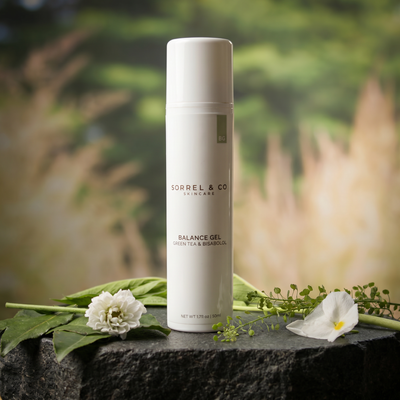
We chose bisabolol for several of our formulas, and the Balance Gel is the one built around calming. It is aimed at combination skin — the kind that breaks out in some places and flushes in others — and it pairs bisabolol with green tea and chamomile to settle the look of redness, plus a lilac-leaf ferment to balance the look of oil. It is a light, oil-free layer for skin that cannot decide whether it is oily or sensitive.
Now the honest caveat, because reactive skin deserves it. The Balance Gel is not fragrance-free — it contains mandarin and orange peel oils and a small amount of denatured alcohol, which are exactly the kinds of ingredients the most reactive, fragrance-sensitive skin should approach carefully. Bisabolol being present does not neutralize that. If your skin flares at citrus or fragrance, this is a patch-test-first product — read the Repair Serum and Calming Mist labels alongside it and see which one your skin can live with. Bisabolol also appears in our Dew Cream, Face Serum, and Face Oil, so calming skin is not a one-product decision.
That is the difference between an ingredient story and a product recommendation. Bisabolol is a good calming ingredient for reactive skin. Whether a specific bisabolol product suits your specific skin depends on everything else on the label — which is the habit we are always trying to build.
How to use it, and what to expect
If you are trying a bisabolol-based product on reactive skin, introduce it the way you would any new thing: patch-test on the inner forearm or behind the ear for a couple of days, then a small area of the face, then the whole face. Give it a couple of weeks before you decide. Calming is a cumulative, gradual look — a slow settling of the pinkness and reactivity — not the instant cool of a numbing agent. If a product feels dramatic on contact, that is worth a second, skeptical look, not a reason to trust it.
And if you are not sure which of our calming formulas fits your skin, the Skin Plan will match you to the right one. It maps your routine in about thirty seconds — no email required.
References
- Kim S, et al. Inhibitory effects of (−)-α-bisabolol on LPS-induced inflammatory response in RAW264.7 macrophages. Food Chem Toxicol. 2011. sciencedirect.com
- Maurya AK, et al. α-(−)-bisabolol reduces pro-inflammatory cytokine production and ameliorates skin inflammation. Curr Pharm Biotechnol. 2014. pubmed.ncbi.nlm.nih.gov/24894548
- Elmets CA, et al. Cutaneous photoprotection from ultraviolet injury by green tea polyphenols. J Am Acad Dermatol. 2001. pubmed.ncbi.nlm.nih.gov/11209110