

Every skincare brand claims to sell antioxidants. The word appears on more than half the products in any beauty aisle. It is also one of the most misused words in the industry — applied to ingredients that don't have meaningful antioxidant activity, used at concentrations too low to matter, and formulated in ways that destabilize the active before it ever touches your skin.
The chemistry behind antioxidants is straightforward. The marketing of antioxidants is not. Here is what is actually happening when a topical antioxidant works, what to look for in a formulation that delivers on the claim, and how green tea EGCG — one of the best-characterized antioxidants in the cosmetic literature — fits into a routine that takes free radical damage seriously.
What free radicals actually do to skin
A free radical is a molecule with an unpaired electron. That instability makes it highly reactive — it will grab electrons from whatever is nearby to stabilize itself. In skin, the “whatever is nearby” includes cellular membranes, mitochondrial DNA, collagen fibers, and elastin.
The damage is mostly invisible day to day. Over years it accumulates into the cluster of changes we call photoaging: thinning skin, loss of elasticity, uneven pigmentation, broken capillaries, and the deeper textural changes that no moisturizer reverses.
Free radicals come from three main sources. UV radiation is the biggest — every minute of unprotected sun exposure generates measurable oxidative stress at the cellular level, and the damage continues hours after exposure ends. Air pollution is the second. PM2.5 particles deposit on skin and generate free radicals through a slow oxidative process documented in multiple controlled studies. Cellular metabolism itself is the third — your mitochondria produce free radicals as a byproduct of energy production, and production rate increases with age and environmental stress.
You cannot eliminate free radical production. Skin has built-in antioxidant defense systems — vitamin E in the lipid layer, vitamin C in the aqueous phase, glutathione inside cells — but these systems are depletable. Heavy UV exposure or sustained pollution exposure exhausts them. That is when an external antioxidant supply becomes meaningful.
How a topical antioxidant actually works
A topical antioxidant has one job: donate an electron to a free radical before the free radical can grab one from your skin's structural proteins or DNA. Different antioxidants do this through different chemistries, but the end result is the same — the free radical gets stabilized, the antioxidant becomes a stable byproduct, and the cellular damage that would have followed does not happen.
This sounds simple. Three things make it complicated in practice.
First, the antioxidant has to actually reach the cells where free radicals are being generated. Topical delivery through the stratum corneum is the bottleneck for most active ingredients, and antioxidants are no exception. Molecular size, lipid solubility, and formulation all affect whether the active reaches dermal cells in a meaningful concentration.
Second, the antioxidant has to be stable in the formulation. Vitamin C is famously unstable in water and oxidizes on shelf — which is why so many vitamin C serums turn brown by month two and lose activity entirely by month four. We covered the stability problem in detail in our piece on stable vitamin C formulations. The same shelf-stability problem affects most antioxidants to varying degrees.
Third, the antioxidant has to be there at the time of insult. Antioxidants do not store well in the skin — they are consumed when they neutralize free radicals, and the supply runs out. A morning application of antioxidants protects the morning. By afternoon, much of the protective layer has been spent. This is the argument for a layered antioxidant approach rather than a single active.
The “antioxidant” marketing problem
Walk down any beauty aisle and you will see “antioxidant” on cleansers, moisturizers, masks, serums, body washes, and shampoos. Almost none of those products contain antioxidants in concentrations meaningful enough to do real work. Here is how to spot the difference.
Concentration matters more than presence. Most well-studied antioxidants need to reach a specific concentration on skin to produce measurable protection. Green tea EGCG, for example, has been studied at concentrations between 0.5% and 5% in topical formulations. Below 0.5%, the effects are inconsistent. Above 5%, irritation can become limiting. A product that lists green tea extract eleventh in its ingredient list almost certainly contains it well below the effective range.
Stability matters more than potency. A 15% vitamin C serum that has oxidized to its inactive form is functionally a 0% vitamin C serum. A 5% stable derivative of vitamin C in a properly formulated airless pump delivers more usable antioxidant than the 15% L-ascorbic acid serum that turned brown two months ago.
Packaging matters more than people realize. Antioxidants degrade in the presence of light and air. A clear glass jar with a wide-mouth opening is the worst possible packaging for an antioxidant product. An opaque or amber bottle with an airless pump or dropper is the right packaging. If a brand has invested in real actives, they have invested in real packaging.
Synergy matters more than singularity. A single-antioxidant product is usually less effective than a multi-antioxidant stack at lower individual concentrations. The reason is chemistry: when one antioxidant donates an electron to a free radical, it becomes a mildly reactive species itself, which a second antioxidant can then stabilize. The classic example is the vitamin C + vitamin E + ferulic acid stack, studied for decades and showing synergistic photoprotection.
Where green tea EGCG fits
EGCG — epigallocatechin gallate — is the dominant polyphenol in green tea, accounting for roughly half of green tea's catechin content. It is also one of the best-characterized antioxidants in the cosmetic dermatology literature.
The mechanism is broad. EGCG scavenges multiple types of free radicals (superoxide, hydroxyl, peroxyl), chelates pro-oxidant metals (iron, copper), and modulates inflammatory pathways through downregulation of NF-κB signaling. The breadth matters because skin does not face one type of oxidative stress — it faces several simultaneously.
The trial evidence is solid. Topical EGCG has been shown in controlled studies to reduce UV-induced erythema, decrease the expression of matrix metalloproteinase enzymes that degrade collagen, and reduce DNA damage markers after UV exposure. None of these studies claim EGCG replaces sunscreen — it does not, and should not be marketed as if it does. They consistently show that topical EGCG adds a measurable protective layer beyond what SPF alone provides.
Practical considerations: EGCG is most active in the 0.5–5% range. It pairs well with other antioxidants (vitamin C, vitamin E, niacinamide). It is stable in well-formulated products with appropriate packaging. And it works in the AM routine before SPF — not as a sunscreen replacement, but as the cellular-level defense layer that catches the free radicals SPF does not.
The Sorrel approach
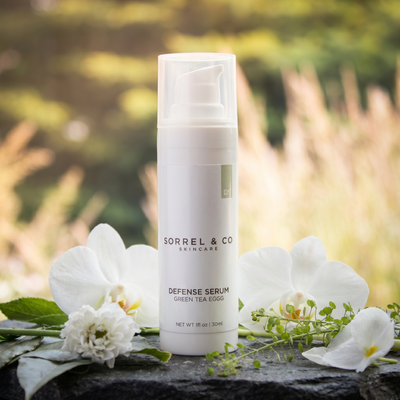
The Defense Serum is built around EGCG at a clinical dose, formulated alongside complementary antioxidants and barrier-supportive ingredients. We chose EGCG as the lead active because it has the deepest evidence base of any single-source plant antioxidant in cosmetic chemistry, because its mechanism is broad enough to address multiple types of oxidative stress, and because it pairs well with the other actives most people benefit from layering.
The full ingredient list, concentrations where relevant, and the studies behind each active are linked from our Research page.
How to use a topical antioxidant
The protective effect is greatest when antioxidants are applied before insult, not after. Practically, this means an AM application — cleanse, antioxidant serum, moisturizer, SPF. The antioxidant layer is doing work between when you walk out the door and when you reapply SPF four hours later.
Layering rules: antioxidant serums go on damp-but-not-wet skin after cleansing. They sit underneath moisturizer and SPF. You do not need to wait between layers — the older “60-second wait” advice is based on a misunderstanding of how absorption works for water-soluble actives. Apply, gently press in, move to the next layer.
Frequency: daily, ideally year-round. Pollution-driven oxidative stress happens regardless of season, and the indoor environment has its own free radical sources (cooking fumes, secondhand smoke, even some cleaning products). The protective layer matters even on days when you do not see the sun.
What to pair it with: a stable vitamin C serum is the most evidence-backed second antioxidant. Vitamin E in your moisturizer (look for tocopherol or tocopheryl acetate near the middle of the ingredient list) is the third leg of the classic antioxidant stack. Niacinamide complements all of them — it is not technically an antioxidant but reduces inflammation through a separate pathway.
What to evaluate over time: you will not see immediate visible changes from an antioxidant routine. The benefit is preventive — fewer broken capillaries five years from now, less photoaging ten years from now, a measurably stronger barrier under environmental stress today. The before/after photos that matter are taken years apart.
If you have felt the antioxidant claim was always a little too vague to act on, the Defense Serum is the formulation that earns the claim.
Not sure whether antioxidant defense is the gap in your routine, or you have that covered and need something else? The Skin Plan maps your routine in about thirty seconds — no email required.