

The brown bottle problem
If you've ever bought a vitamin C serum that turned amber or brown within a few weeks of opening, you weren't watching the formula mature. You were watching it oxidize. By the time the serum has visibly darkened, the active ingredient — usually L-ascorbic acid — has converted to dehydroascorbic acid and its downstream byproducts. It no longer does what you bought the bottle to do.
Vitamin C is, on paper, one of the best-studied actives in skincare. It quenches free radicals, inhibits tyrosinase, supports collagen synthesis as a cofactor, and meaningfully reduces UV-induced photodamage when paired with sunscreen. The problem isn't whether it works. The problem is whether it works in your bottle, by the time you actually apply it.
Why L-ascorbic acid is so unstable
L-ascorbic acid is the most-studied and most-bioactive form of vitamin C in topical use. It's also the most fragile. Three things degrade it:
- Oxygen. Air exposure oxidizes the ascorbate ring almost immediately. A bottle opened daily is being insulted by air every single morning.
- Light. UV and visible light both catalyze oxidation. Clear bottles in bathroom sunlight are particularly vulnerable.
- Water and pH. L-ascorbic acid is only stable in aqueous solution at pH below about 3.5. At neutral pH, in the presence of trace metals (iron, copper), it oxidizes in days.
This is why a stable L-ascorbic acid formulation looks specific: low pH (typically 2.5–3.5), an opaque or amber bottle, often an airless pump, and frequently the addition of vitamin E and ferulic acid as antioxidants that protect the C until it reaches your skin.
The Lin 2003 stack
The single most-cited paper in topical vitamin C is from Dr. Sheldon Pinnell's lab at Duke (Lin et al., 2003). They showed that combining 15% L-ascorbic acid with 1% alpha-tocopherol (vitamin E) and 0.5% ferulic acid produced photoprotection roughly four times greater than vitamin C alone, with measurable effects on UV-induced erythema and thymine dimer formation.
This is the C + E + ferulic stack that you see referenced everywhere now. The science is real. The execution, in most products, is not — because once that stack is formulated into a serum and put on a shelf, you're back to the oxidation problem. Unless the packaging and pH protect it, you're applying degraded ingredients.
The derivative alternative
For most formulators, the answer to L-ascorbic acid's fragility is to use a vitamin C derivative. Derivatives are vitamin C molecules with a small chemical modification (often a phosphate or glucoside) that keeps them stable in solution. Once on the skin, enzymes cleave the modification and the active vitamin C is released. The trade-off: less peak potency per unit, but dramatically more stability in the bottle.
Three derivatives you'll see on labels:
- Sodium ascorbyl phosphate. Stable at neutral pH, mild, well-tolerated by sensitive skin. Studied for acne and antioxidant effects. Slower-acting than L-ascorbic acid.
- Ethyl ascorbic acid. A newer derivative with high stability and good penetration. Effective for brightening at 1–3%.
- Ascorbyl glucoside. Very mild. Converts slowly to L-ascorbic acid on skin. Common in Asian formulations and well-tolerated.
Stability isn't a small concern. A vitamin C product that's 30% oxidized at point of sale, then sitting on a counter for another six weeks, isn't delivering anywhere close to its labeled potency. A derivative-based formula that's stable for 18 months will, in most real-world conditions, outperform a 'more potent' L-ascorbic acid product that oxidized in week three.
How to read a vitamin C label
If you're trying to evaluate a vitamin C product on the shelf, check four things:
- The form of vitamin C. 'Ascorbic acid' or 'L-ascorbic acid' is the gold-standard active form but the most fragile. If you see it, also check pH and packaging.
- The packaging. Opaque bottle, ideally airless. Clear glass droppers in clear cartons are a red flag for L-ascorbic acid formulas.
- Antioxidant co-formulation. Look for vitamin E (tocopherol) and ferulic acid alongside the vitamin C. They protect it in the bottle and synergize on the skin.
- A concentration that's plausible. A product claiming '20% vitamin C' without any of the stabilizers above is making a claim it almost certainly can't deliver six months in. A product using 5–10% of a stable derivative is often a more honest deal.
What Sorrel does
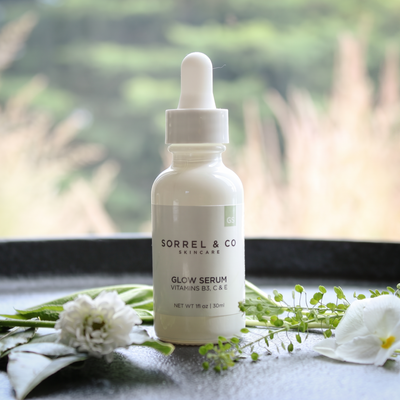
Our Glow Serum uses stable vitamin C derivatives alongside niacinamide (vitamin B3) and vitamin E (tocopherol). The combination follows the Lin 2003 antioxidant-synergy logic but uses the stability profile of derivatives rather than the higher-peak-but-fragile L-ascorbic acid route. The packaging is opaque to protect the formula from light, which keeps the formula's potency consistent from week one to month six.
The B3 + C combination, incidentally, is the same pairing that 1960s-era research mistakenly flagged as 'incompatible.' Modern formulations using either niacinamide and vitamin C derivatives, or niacinamide and properly buffered L-ascorbic acid, don't have the compatibility issue — we covered the underdosing of niacinamide in The 2% Niacinamide Trick, and we'll cover the compatibility myth specifically in a future post.
How to use vitamin C in your routine
Vitamin C is an AM ingredient. Apply it after cleansing, before moisturizer, and crucially: before sunscreen. The antioxidant effect of topical vitamin C is most useful as a layer underneath SPF, where it reduces UV-induced free-radical damage that gets through your sunscreen anyway. SPF blocks most UV. Vitamin C neutralizes free radicals from what gets through.
What to pair vitamin C with:
- Niacinamide. Despite the persistent myth, modern formulations using both are fine.
- Hyaluronic acid. No interaction. Apply HA on damp skin, then vitamin C, then moisturizer.
- Sunscreen. The single most important pairing. Vitamin C without SPF is leaving most of its work on the table.
What to be careful with:
- Retinol. L-ascorbic acid and retinol both work, but stacking them in the same routine can be too much for some skin types. Easiest: vitamin C in the AM, retinol in the PM. We covered retinol acclimation in Why Most Retinol Serums Cause Peeling.
- Benzoyl peroxide. Oxidizes L-ascorbic acid on contact. Don't apply them at the same time of day.
When you'll see results
Vitamin C's antioxidant effect is immediate (it starts neutralizing free radicals on contact), but the visible effects compound over time:
- Weeks 2–4: Subtle improvement in skin tone luminosity. Some users notice fewer acne marks lingering.
- Weeks 6–8: Measurable improvement in post-inflammatory hyperpigmentation. Sun spots and dark marks begin to fade.
- Months 3–6: Visible improvement in fine lines and skin texture, partly via collagen-cofactor effects.
If you're using vitamin C and not seeing results after eight weeks of consistent use, the most common reason is that the product itself oxidized before you got it home, or it's been stored in a sunny bathroom, or the form of vitamin C in the formula isn't delivering at the concentration the label suggests.
The honest summary
Vitamin C is one of the few skincare actives with strong, repeated clinical evidence. The hard part isn't the molecule. It's getting the molecule onto your skin in active form. Most products fail at packaging, formulation pH, or stabilizer co-formulation. The brown bottle isn't aesthetic — it's a warning. Buy products designed for stability, store them away from light and heat, and use them within their labeled shelf life.
Not sure which vitamin C — or which active — your skin would benefit from most? The Skin Plan builds your routine in about thirty seconds, no email required.