

The skeptic's argument against eye creams is well-rehearsed and partially correct: eye cream is often just regular moisturizer in a smaller, more expensive jar. Many products marketed for the eye area use formulations that differ in no meaningful way from the brand's face cream, charge a premium for the smaller size, and produce no specific benefit that the face cream would not also produce.
The skeptic's argument is also partially incorrect. The skin around the eye is genuinely different from facial skin in several structural ways, and those differences create both specific problems (the kind eye area shows that the rest of the face does not) and specific opportunities (formulation choices that address the differences rather than ignoring them). The question is not whether eye creams matter — it is whether the eye cream you are using was formulated to those differences or whether it is just face cream in a smaller jar.
What is structurally different about eye skin
Five differences matter for skincare formulation:
The stratum corneum is thinner. The skin around the eye has approximately 40% the thickness of cheek skin. This means actives penetrate faster and reach deeper layers more efficiently — which is useful for delivery, but problematic for irritation. An active that is well-tolerated on the cheek can be significantly more irritating around the eye, where the same concentration produces a higher effective dose at the keratinocyte level.
There are far fewer sebaceous glands. Most of the face has dense sebaceous gland coverage, which provides natural lipid replenishment to the stratum corneum. The eye area has very few. The skin there relies on what it can hold in the lipid matrix without ongoing replenishment, which makes it more susceptible to barrier disruption and slower to recover from damage.
The skin moves more. Eyelids open and close approximately 15,000–20,000 times per day. Crow's-feet and the lateral periorbital area accumulate mechanical stress that other facial regions do not experience. This contributes to the early appearance of fine lines in the eye area — they are not just signs of aging, they are signs of motion accumulation that other facial skin does not face.
Vascularity is more visible. The thinner stratum corneum sits closer to the underlying vascular network. Dilated or congested vessels show through more readily, contributing to the appearance of dark circles. This is why some people have visibly purple or bluish under-eye color regardless of pigmentation status — the vessels themselves are what is showing.
Lymphatic drainage is different. Lymphatic flow around the eye area is more responsive to gravity, body position, sodium intake, and sleep quality than lymphatic flow elsewhere on the face. Morning under-eye puffiness is largely a lymphatic phenomenon — not a hydration problem, not a fat-pad issue, but a temporary accumulation of fluid that the lymphatic system clears over the course of the day.
The four eye-area concerns
Eye-area complaints generally fall into four distinct categories, each with different underlying mechanisms and different intervention strategies. Conflating them is the most common mistake in eye-cream marketing and in eye-cream choice.
1. Fine lines and crow's feet. Driven by the combination of intrinsic aging (collagen and elastin decline) and motion accumulation. Responds to retinol, peptides, and antioxidants — the same actives that work elsewhere on the face, but at lower concentrations and with gentler delivery to accommodate the thinner stratum corneum.
2. Under-eye puffiness. Mostly a lymphatic and vascular phenomenon. Responds to cold application (which constricts vessels), peptides with vascular activity, caffeine (which constricts vessels and reduces fluid retention locally), and lifestyle factors that affect lymphatic flow (sleep, salt intake, head elevation overnight). Topical interventions help but lifestyle modifications often help more.
3. Dark circles. The hardest category because there are at least four distinct causes: vascular show-through (treated with vasoactive ingredients), pigmentary (treated with brightening actives), hollowing (a structural problem that topical products cannot address — requires fillers or surgical intervention), and shadowing (treated with concealer rather than skincare). Diagnosis matters. A pigmentary dark circle treated with a vascular product will not improve.
4. Loss of firmness and laxity. The deeper structural change that accumulates over years. Driven by collagen and elastin decline. Responds slowly to peptides, retinol, and supportive antioxidants, but the magnitude of topical improvement here is real but modest.
Why generic face cream often fails the eye area
Three reasons:
Concentration mismatched to barrier sensitivity. A retinol product that is well-tolerated on the cheek may cause persistent irritation around the eye. The same is true for vitamin C at high concentration, salicylic acid, and other actives that work fine on thicker facial skin but overshoot on the thinner eye skin.
Formulation density mismatched to delicate skin. Heavy occlusive moisturizers can migrate into the eyes and cause irritation. Fragrance compounds, common in face creams, are more likely to cause contact reactions on the thinner periocular skin. The fragrance question is a big one — we covered it in detail in our piece on what the research says about fragrance in skincare.
Mechanism mismatched to the dominant complaint. Generic anti-aging face cream targets fine lines and texture. It does little for under-eye puffiness (a vascular and lymphatic problem) or for vascular dark circles (a structural problem). Using face cream for an eye-area problem it cannot address is a category error, not just a sizing one.
What a meaningful eye cream actually contains
The differentiating ingredients fall into four functional categories:
Peptides with vascular activity. Acetyl tetrapeptide-5 is the best-characterized of these. We covered the mechanism in our piece on acetyl tetrapeptide-5 and under-eye puffiness. Other useful peptides in eye-area work include palmitoyl tripeptide-1, palmitoyl tetrapeptide-7, and copper peptides, each with slightly different mechanisms.
Caffeine. Constricts local vasculature and reduces fluid retention. Particularly effective for morning puffiness when applied AM. Effective at 1–3% in topical formulations.
Brightening actives at gentle concentrations. Niacinamide at 5% works for the melanosome transfer step we covered in our piece on brightening vs whitening. Vitamin C derivatives at lower concentrations than full-face serums. Licorice root extract.
Barrier-supportive ingredients. Allantoin, panthenol, ceramides, hyaluronic acid. The eye area's reduced sebaceous gland coverage means it needs ongoing barrier support more than thicker facial skin does.
What you do not want: high concentrations of retinol, alcohol denat, fragrance, aggressive surfactants, or other ingredients that work elsewhere but overshoot on eye skin.
The Sorrel approach
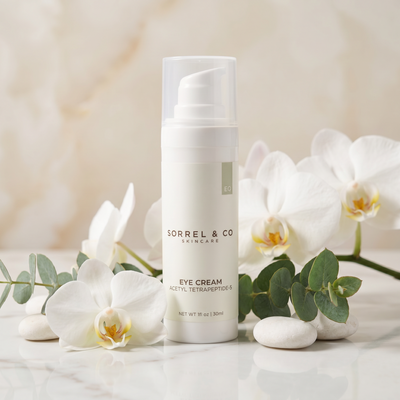
The Eye Cream is built around acetyl tetrapeptide-5 as the peptide anchor, paired with niacinamide for the gentle brightening layer and barrier-supportive ingredients for the eye area's specific lipid needs. The formulation density is calibrated for eye skin — not so heavy that it migrates into eyes, not so thin that it provides no occlusive support.
It is intentionally fragrance-free. It uses a gentle preservative system. The concentration of every active is calibrated to the thinner stratum corneum, so the effective dose at the cellular level matches what would be appropriate for facial skin even though the applied concentration is lower.
The full ingredient list and the studies behind the formulation are linked from our Research page.
How to use eye cream well
Application technique. Use the ring finger — it is the weakest finger and applies the least pressure. Pat, do not rub. Apply from the outer corner inward along the orbital bone, then up to the brow bone. Avoid applying directly to the upper eyelid unless the product is specifically formulated for it.
Frequency. Twice daily, AM and PM. The eye area's barrier needs ongoing support; once-daily is insufficient for most people.
Timing in the routine. After serums, before face moisturizer. Apply when serums have fully absorbed but before the heavier moisturizer in case any of that moisturizer might migrate into the eye area.
Pairing with the rest of the routine. If you use retinol at full concentration on your face, apply eye cream first to create a buffer layer in the periocular area. This significantly reduces retinol migration into eye skin and the associated irritation.
What to expect over time. Puffiness changes can be visible within days when caffeine and peptides are part of the formula. Pigmentary changes take 8–12 weeks. Fine line softening takes 12 weeks or longer. Structural laxity changes take 6 months and are modest even then.
If you have used eye creams that produced no specific effect, the variable most worth changing is whether the formulation was built for the eye area or whether it was the brand's face cream in a smaller jar.
Not sure whether the eye area is where to start, or which concern deserves the first move? The Skin Plan maps your routine in about thirty seconds — no email required.