The vocabulary of skin tone in beauty marketing is a mess. “Brightening,” “lightening,” “whitening,” “evening,” “correcting” — these words appear interchangeably on products that do entirely different things to the skin's pigment-producing system. The conflation is not accidental. It lets brands market interventions that affect tone uniformity using language that softens the cultural baggage of older “skin lightening” products.
The chemistry behind these products is more interesting than the marketing. Once you understand how melanin actually gets made and where in that process you can meaningfully intervene, the distinction between brightening and whitening becomes clear — and so does why the most useful products in this category are the ones targeting specific intervention points rather than promising overall skin lightening.
How melanin gets made
Melanin is produced in specialized cells called melanocytes, which sit in the basal layer of the epidermis. Each melanocyte has projections that connect to roughly 30–40 surrounding keratinocytes — the workhorse cells that make up most of the visible skin. Melanin synthesis and distribution happens through a multi-step pathway:
- Trigger. UV exposure, inflammation, hormones, or genetic signaling activate melanocytes to ramp up production.
- Synthesis. Inside the melanocyte, the amino acid tyrosine is converted to melanin through a series of enzymatic steps. The rate-limiting enzyme is tyrosinase.
- Packaging. The newly synthesized melanin gets packaged into vesicles called melanosomes.
- Transfer. The melanosomes get transferred from melanocyte projections into surrounding keratinocytes.
- Display. As keratinocytes migrate toward the skin surface as part of normal turnover, the melanin they contain becomes visible as skin pigmentation.
Hyperpigmentation — dark spots, melasma, post-inflammatory marks — happens when this pathway is overactive at one or more of these steps. The strategy for visibly evening tone is to slow down one or more of those steps. Different actives intervene at different points.
The three intervention points
Intervention 1: Reduce the trigger. The most effective “brightening” ingredient in the world is SPF. Daily sunscreen does not lighten existing pigment — but it prevents new triggering and gives the rest of your routine room to work. Every meaningful melasma and hyperpigmentation protocol in dermatology pairs the topical intervention with strict daily SPF use. We will come back to this.
Intervention 2: Block synthesis at the tyrosinase step. Tyrosinase is the rate-limiting enzyme in melanin production. Inhibit it and you slow new melanin synthesis at the source. The major topical tyrosinase inhibitors are kojic acid, arbutin, hydroquinone (prescription in most countries, banned in some), licorice root extract (specifically the glabridin compound), and to a lesser extent vitamin C and certain peptides.
Intervention 3: Block melanosome transfer. Even if a melanocyte is producing melanin, that melanin only becomes visible if it gets transferred into the surrounding keratinocytes. Niacinamide has been shown in controlled studies to interfere with melanosome transfer — reducing the amount of melanin reaching the visible skin surface without affecting melanin synthesis itself. We covered the broader niacinamide mechanism in our piece on why most niacinamide products underdose.
An effective brightening routine acts on multiple intervention points simultaneously. A tyrosinase inhibitor plus niacinamide plus SPF addresses three steps of the pathway and produces measurably faster results than any single ingredient.
Tyrosinase inhibitors: a comparison
Three tyrosinase inhibitors are dominant in OTC products: kojic acid, alpha arbutin, and licorice root (glabridin). Each has slightly different properties.
Kojic acid is the most-studied OTC tyrosinase inhibitor. Derived from fermentation of certain fungi, it chelates copper in the active site of tyrosinase — directly inhibiting the enzyme. Effective concentrations are typically 1–2%. The trade-off is that kojic acid can be irritating at higher concentrations and is somewhat unstable to light and oxidation, requiring careful formulation.
Alpha arbutin is a glycosylated form of hydroquinone. The glycoside delivers the active slowly through cleavage in the skin, producing a gentler tyrosinase-inhibiting effect than hydroquinone itself. Effective concentrations are typically 1–2%. Tolerability is generally better than kojic acid; the effect is also slower.
Licorice root (glabridin) is the gentlest of the three. The glabridin compound inhibits tyrosinase plus has anti-inflammatory activity — which matters because inflammation itself is a trigger for melanocyte activation. Often paired with the harder-working actives as the tolerability layer.
Practical rule: a serious brightening formulation usually combines a primary tyrosinase inhibitor (kojic or alpha arbutin) with a secondary one (glabridin or vitamin C) for synergy, plus niacinamide for the transfer step.
The niacinamide transfer story
Niacinamide is the most underrated ingredient in the brightening category because it works through a mechanism nothing else in the OTC toolkit uses. The Hakozaki 2002 study established the effect: niacinamide at 2–5% applied for 8 weeks measurably reduced the appearance of hyperpigmentation in a controlled trial, with the mechanism attributable to reduced melanosome transfer.
The implication: niacinamide does not block synthesis like tyrosinase inhibitors do. It works downstream. Which means it stacks productively with tyrosinase inhibitors rather than overlapping with them. A combined routine — kojic acid serum or brightening bar in the AM, niacinamide layered in the same routine, SPF on top — hits three pathway steps at once.
This is also why niacinamide is a useful starting point even for people who are not chasing specific dark spots. It is a foundation active. It does work that other brighteners do not, at concentrations that are well-tolerated, with a strong safety profile.
Why SPF is non-negotiable
Every meaningful brightening protocol assumes daily SPF use. Without it, the rest of the routine is fighting an ongoing trigger — each unprotected UV exposure activates more melanocytes, undoing the work of your tyrosinase inhibitor.
The practical math: a moderate tyrosinase inhibitor reduces melanin synthesis by some percentage. A moderate niacinamide application reduces visible pigment by some percentage. A single sunburn-level UV exposure can multiply melanin output severalfold for weeks afterward. The size of the variables is wildly different. SPF is not a complement to a brightening routine — it is the foundation that makes the brightening routine worth doing.
Mineral broad-spectrum SPF 30 or higher, applied daily, reapplied every 2–3 hours of meaningful sun exposure. This is not optional.
Brightening vs whitening: why the words matter
Older “whitening” products targeted overall skin lightening — reducing baseline melanin output across the entire face, not just at hyperpigmented spots. The chemistry that does this most aggressively is hydroquinone, often paired with potent retinoids and corticosteroids in compounded prescription formulations.
Modern “brightening” products typically target uniformity rather than overall lightening — reducing the appearance of specific dark spots and post-inflammatory marks while leaving baseline tone alone. The chemistry is gentler. The goal is even tone, not lighter skin.
The distinction is meaningful. A brightening product is a tone-evening intervention. A whitening product is a tone-shifting one. They are not the same goal and not the same chemistry. The word choice on a label does carry information — brands that use “brightening” intentionally are usually signaling the more conservative, evening-toward-uniform approach.
The Sorrel approach
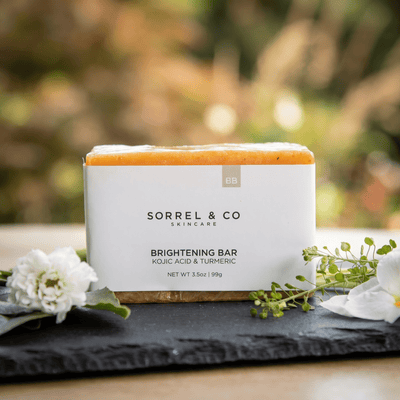
The Brightening Bar combines kojic acid as the primary tyrosinase inhibitor with turmeric extract (curcumin, anti-inflammatory plus a secondary brightening effect) and supporting actives that maintain barrier function during the brightening protocol. The intent is the multi-pathway approach — not a single-ingredient hammer, not a marketing-driven blend.
It is designed to layer with niacinamide (from the Clarity Serum) for the melanosome transfer step, and it assumes daily SPF use. Without SPF, the formulation cannot do its job. With SPF and niacinamide stacked on top, it addresses the three intervention points in the melanin pathway simultaneously.
The full ingredient list, the studies behind the actives, and the routine builder for stacking brightening interventions are on our Research page.
What to expect
Pigment changes are slow. Melanin turnover follows the keratinocyte migration cycle, which is roughly 28 days. Even with an effective stacked routine, meaningful visible change typically requires 8–12 weeks. Some types of hyperpigmentation (melasma in particular) are notoriously stubborn and can require 16–24 weeks of consistent intervention.
What changes first: post-inflammatory hyperpigmentation from acne or minor irritation. Typically responds within 4–8 weeks of stacked treatment.
What changes slower: sun-driven melasma. Can require 12–24 weeks. Even then, melasma is prone to recurrence with any UV exposure, which is why SPF stays mandatory after visible improvement.
What changes slowest: deep dermal pigmentation. Often does not respond to topical-only routines and may require in-office procedures (gentle peels, laser) to address fully.
The honest framing: brightening routines work, they work slowly, and they require commitment to a daily protocol over months. People who quit at week 4 because they do not see results are quitting before the data point is meaningful.
If you have tried single-ingredient brighteners and been underwhelmed, a multi-pathway routine — SPF, tyrosinase inhibitor, niacinamide — is the intervention worth trying instead.
Not sure whether uneven tone is where to start, or which step your routine is missing? The Skin Plan maps your routine in about thirty seconds — no email required.