

Why under-eye puffiness is harder than it looks
People talk about under-eye puffiness like it's a single problem. It isn't. It's at least four different mechanisms, often happening simultaneously, and the eye cream you choose will only help if it addresses the mechanism you actually have.
The four mechanisms:
- Vascular. Fluid leaking from capillaries into peri-orbital tissue. Worse in the morning, often improves over the day. Common with allergies, sleep loss, alcohol, and high salt intake.
- Lymphatic. Insufficient drainage of fluid out of the eye area. Often co-occurs with vascular puffiness.
- Structural. Tissue laxity. The orbital septum weakens with age, allowing the orbital fat pad to bulge forward. This is the classic 'fat herniation' appearance and it's mostly a surgical concern (lower blepharoplasty).
- Pigmentary. Not actually puffiness — but often grouped with it. Melanin hyperpigmentation in the lower lid creates a shadow that reads as 'darkness,' which the brain often interprets as 'tired' or 'puffy.'
A peptide-based eye cream meaningfully addresses #1 and #2. It does almost nothing for #3 (which is structural) or #4 (which is pigmentary). Knowing which problem you have is more useful than reading any product label.
What acetyl tetrapeptide-5 actually does
Acetyl tetrapeptide-5 is a synthetic four-amino-acid peptide developed by Lipotec (now part of Lubrizol) in the early 2010s. The mechanism is specific: it inhibits the angiotensin-converting enzyme (ACE) pathway in vascular endothelial cells.
That sounds technical, so here's what it means practically. ACE is part of the renin-angiotensin system, which regulates blood pressure and vascular permeability. When ACE is active, capillaries are more 'leaky' — fluid passes more easily from the bloodstream into surrounding tissue. In the eye area, where capillaries are dense and the tissue is thin, this leakiness shows up as morning puffiness, fluid retention, and that 'your face looks like a different shape today' feeling after a salty meal or poor sleep.
By inhibiting ACE locally in skin, acetyl tetrapeptide-5 reduces vascular permeability. Fluid stays in the capillaries rather than leaking out. Less leakage means less peri-orbital fluid accumulation.
What the studies show
The original Lipotec clinical trial (published in 2012, with later expanded data) tested a 4% acetyl tetrapeptide-5 formulation against a placebo cream in women aged 41–67 over 56 days. The active arm showed measurable reductions in eye bag volume and puffiness graded by 3D image analysis. Reported reductions in the literature are in the 20–30% range over the 56-day window.
That's not dramatic, but it's consistent and clinically measurable, which is more than most 'eye cream' claims can substantiate. The peptide isn't going to fix a structural problem (orbital fat herniation) or a pigmentary one (melanin) — but for the vascular-and-lymphatic mechanism, which is the most common cause of under-eye puffiness in adults under 50, the data is solid.
Why eye skin is different
The skin under your eyes isn't the same skin that covers the rest of your face. It's structurally and functionally distinct:
- Five times thinner. The stratum corneum under the eye is roughly one-fifth the thickness of the cheek. Active ingredients penetrate faster and irritate more readily.
- Fewer sebaceous glands. Almost no natural oil production. This is why under-eye skin dries out so quickly and shows lines so prominently.
- Dense capillary network. More blood vessels per square millimeter than most other facial skin, which is why vascular issues (darkness, puffiness) are amplified there.
- Distinct lymphatic drainage. The peri-orbital region has its own lymphatic pattern, which is why fluid pooling shows up here rather than redistributing.
- Constant movement. The orbicularis oculi muscle activates with every blink. Repetitive folding contributes to dynamic wrinkles.
This is why using regular face cream around the eye area is often a disappointment — and sometimes counterproductive. Heavy occlusives can cause milia (small white cysts) in this thin skin. Active retinols at full face concentrations can cause irritation that takes weeks to settle.
What belongs in a real eye cream
Not 'anti-aging' buzzwords. Specific actives for specific mechanisms:
For vascular puffiness (the leaking-capillary problem):
- Acetyl tetrapeptide-5 (ACE inhibition)
- Caffeine (vasoconstriction, reduces visible vessel dilation)
- Escin (from horse chestnut, supports vascular tone)
- Ruscus aculeatus extract (similar venotonic effect)
For dark circles from pigmentation:
- Niacinamide (inhibits melanosome transfer)
- Vitamin C derivatives (tyrosinase inhibition)
- Tranexamic acid (interrupts melanocyte activation)
For fine lines from dynamic movement and thinning:
- Palmitoyl tripeptide-1, palmitoyl tetrapeptide-7 (signal peptides, collagen support)
- Retinol — at lower concentration than face products, with ceramide buffering
- Ceramides + cholesterol + free fatty acids (barrier rebuild)
For overall comfort and barrier protection:
- Squalane, jojoba esters (lipid mimetics, lightweight)
- Arnica (anti-inflammatory)
- Centella asiatica (calming, barrier-supportive)
Almost no single product covers all of these. A good eye cream is honest about which mechanism it targets. A bad one promises to 'reduce dark circles, eye bags, wrinkles, puffiness, and crow's feet' — and probably contains none of the actives at meaningful concentration.
What Sorrel does
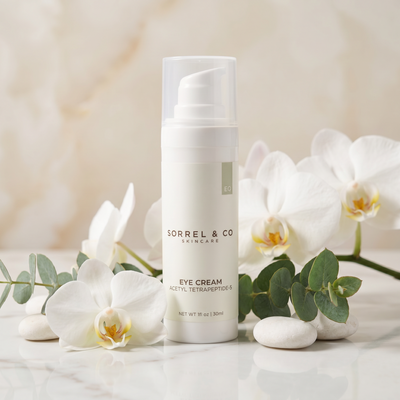
Our Eye Cream is built around acetyl tetrapeptide-5 — the peptide that addresses vascular permeability, the morning-puffiness mechanism — in a deliberately light base with grape seed oil, hyaluronic acid, and bamboo extract for comfort on thin under-eye skin. It is a single-peptide product aimed at one mechanism, not a caffeine-and-botanical decongesting blend; the actives listed above are what the category offers generally, and ours is transparent about running just the peptide.
What we don't claim: this is not a product for structural fat herniation, which is surgical. It's not a primary tool for pigmentary darkness, which is better served by tyrosinase-inhibiting brighteners. It's a vascular-and-lymphatic-mechanism product for the most common type of under-eye puffiness.
How to use it
The application matters as much as the product. Eye cream is one of the few cases where technique meaningfully changes outcomes:
- Use your ring finger. It's your weakest finger and applies the least pressure, which matters in skin this thin.
- Three to four dots. Place along the orbital bone (the bone that frames the eye socket), not on the lid itself.
- Tap, don't rub. Gentle tapping motions move the product without dragging delicate skin. Rubbing accelerates the dynamic creasing problem.
- Inner corner outward. Following the natural lymphatic flow direction.
- Twice daily. AM and PM. Cumulative effect — daily use for six to eight weeks is when most of the published trials see their results.
One small note: cold helps. Storing eye cream in the fridge gives you a mild vasoconstrictive effect on application, which compounds with the peptide's mechanism. Not necessary, but some users notice the difference.
What to expect, realistically
- Week 1–2: Subtle morning improvement in puffiness. Skin feels more comfortable, less crepey.
- Week 3–4: Measurable reduction in habitual puffiness. Skin texture improves.
- Week 6–8: Where the published trial data lands. Most users see clearly visible improvement in vascular puffiness and morning eye bags.
- Beyond: Maintained with consistent use. Stopping usually returns puffiness to baseline within four to six weeks.
If you're not seeing results at week eight of consistent use, the most likely explanation is that your under-eye issue isn't primarily vascular. Structural fat herniation doesn't respond to topicals. Pigmentary darkness needs a tyrosinase inhibitor. Allergies need their own treatment.
The honest summary
Eye cream is a category bloated with vague promises and underwhelming formulas. The vast majority of products in this category are face moisturizer in smaller jars at higher prices. The minority that actually deliver are built around specific actives addressing specific mechanisms — and they're transparent about what they do and don't do.
If your under-eye concern is vascular puffiness or lymphatic congestion, a peptide-based formula like acetyl tetrapeptide-5 is well-supported by clinical data. If your concern is pigmentary darkness, you need a different approach. If your concern is structural fat herniation, you need a different practitioner.
Not sure whether the eye area is where to start, or which concern to tackle first? The Skin Plan maps your routine in about thirty seconds — no email required.