

Most retinol failures are not formulation failures. They are usage failures. The user bought a reasonable product, started using it with reasonable hope, and ran into one of the five most common over-application patterns that compromise the barrier faster than retinol can produce results. Then they either quit (the most common outcome) or doubled down (the more damaging outcome), and the product gets a bad reputation it does not deserve.
Retinol is one of the most-studied actives in cosmetic dermatology. We covered the irritation mechanism in our piece on why most retinol serums cause peeling and the structured introduction in our 12-week beginner's guide. Both pieces describe what to do. This piece is the inverse: the five things people do that go wrong, why each one compromises the barrier, and how to recover when you have made one.
Mistake 1: Starting at nightly use
The most common retinol mistake is treating retinol like every other skincare product — apply at night, every night, from day one. Nightly use of clinical-dose retinol from week one virtually guarantees the three-week peeling phase that drives most quitters out of the protocol.
What is happening: retinol drives keratinocyte turnover. The cells at the surface shed faster than they would naturally. If the turnover rate is dialed up to maximum before the skin has acclimated, the surface cells slough off faster than they can be replaced, resulting in visible peeling, redness, and barrier compromise.
How to recover: stop retinol entirely. Use only ceramide-rich moisturizer and gentle cleanser for 10–14 days. Once the visible peeling has resolved and skin no longer feels tight, restart retinol at twice-weekly application, not nightly. Build frequency over 6–8 weeks rather than 1.
Mistake 2: Stacking retinol with other actives on the same night
The second most common mistake is layering retinol with acid exfoliants, vitamin C, benzoyl peroxide, or aggressive cleansers in the same evening routine. Each of these is fine on its own. Each disrupts the barrier through a different mechanism. Together, the aggregate disruption is too much.
What is happening: retinol drives cellular turnover. Acid exfoliants accelerate desquamation. Vitamin C is mildly inflammatory at effective concentrations. Benzoyl peroxide is an oxidizing agent. The cumulative barrier load — retinol's cellular work, plus acid's surface exfoliation, plus vitamin C's inflammatory signal, plus benzoyl peroxide's oxidation — is more than the skin can repair between applications.
How to recover: separate the actives across nights. Retinol on Monday/Thursday. Vitamin C in the AM. Acid exfoliant on Tuesday/Friday only after the barrier has recovered. Benzoyl peroxide only as a spot treatment, not a full-face application alongside retinol. The principle: one major active per night during acclimation, and even after acclimation, no more than two.
Mistake 3: Increasing concentration mid-acclimation
A specific failure pattern: someone starts on a 0.25% retinol product, tolerates it well for 4–6 weeks, sees mild visible improvement, and concludes “it must be working, so a higher concentration will work better.” They switch to 0.5% or 1%, and the barrier collapses within a week.
What is happening: the “tolerance” built during 4–6 weeks of 0.25% retinol is concentration-specific. Doubling the concentration is not the same as adding a week of nightly use — it is a categorically larger insult to the barrier, and the previous tolerance does not transfer linearly. The new acclimation period has to start over.
How to recover: if you have already made this switch and the barrier is compromised, drop back to the lower concentration entirely for 2–3 weeks to repair. Then if you still want to move to higher concentration, treat it as a new acclimation: twice weekly to start, build frequency over 4–6 weeks. The 2x concentration step is a fresh beginning, not an extension.
Mistake 4: Buffering with the wrong moisturizer
The “buffer” technique — applying moisturizer before or mixed with retinol to reduce irritation — is widely recommended and often works. It works less well when the moisturizer chosen is wrong for the job.
What is happening: humectant-only moisturizers (glycerin, hyaluronic acid in a thin gel base) do not actually reduce the retinol delivery effectively — the retinol still penetrates at roughly normal rates and the irritation profile is similar. Heavy occlusive moisturizers reduce retinol delivery too aggressively — the active sits on top of the barrier and produces little effect. The right buffer is a ceramide-rich, balanced-lipid moisturizer that moderates delivery without blocking it.
How to recover: if your retinol routine is producing too much irritation, switch the buffering moisturizer to one with ceramides, cholesterol, and fatty acids in roughly balanced proportions. If your retinol routine seems to be producing very little visible effect even at adequate concentrations, the moisturizer may be too occlusive — switch to a lighter formulation and let the retinol deliver directly.
Mistake 5: Using retinol on damp skin
The opposite of the buffer mistake, and equally common: applying retinol immediately after cleansing while skin is still damp. The wet skin dramatically increases retinol absorption — sometimes to the point of significant overshoot — and the irritation can become severe within days.
What is happening: water carries actives more efficiently than dry application allows. This is great for humectants like hyaluronic acid, which we covered in our piece on why HA works better on damp skin. It is a problem for retinol, because the enhanced absorption produces a concentration spike at the keratinocyte level that the skin is not yet prepared to handle.
How to recover: always wait 10–20 minutes after cleansing before applying retinol. The skin should feel dry to the touch, not damp. This single change reduces the irritation profile of most retinol routines significantly.
Recovery protocols when you have already overshot
If you are reading this with a visibly compromised barrier from one of the mistakes above, here is the structured recovery:
Days 1–7 — Stop everything. No retinol. No acid exfoliants. No vitamin C at high concentration. Cleanse with a barrier-friendly cleanser, apply a ceramide-rich moisturizer twice daily, use SPF in the AM. Nothing else. The barrier needs the repair window.
Days 8–14 — Add gentle actives back. Niacinamide is the first active to reintroduce. It is well-tolerated, supports barrier repair through ceramide synthesis upregulation, and is unlikely to delay healing. Hyaluronic acid in the AM is also fine.
Days 15–28 — Reintroduce retinol carefully. Start at twice weekly, on dry skin, with a ceramide-rich moisturizer on top. Do not return to your previous frequency immediately even if the barrier feels recovered. The acclimation has to rebuild from this lower baseline.
Days 29+ — Resume building. Add frequency over the next 4–6 weeks. Reintroduce other actives one at a time, on separate nights from retinol, with adequate spacing. Treat the recovery as if it were a new beginning, not a return to where you were.
The Sorrel approach
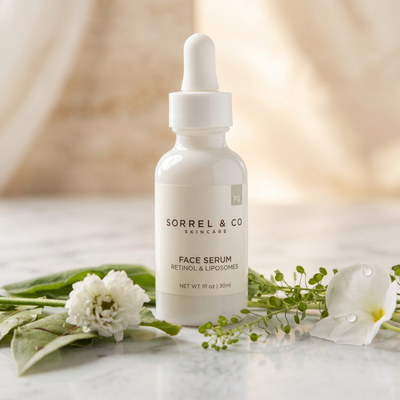
The Face Serum uses liposomal-encapsulated retinol, which produces less irritation at equivalent concentrations than conventional retinol formulations. This does not make the mistakes above impossible — you can still over-apply, stack incorrectly, or buffer poorly with any retinol product — but it does mean the margin for error is wider, and the recovery from a mistake is faster.
The full ingredient list, the delivery system specifically, and the studies behind the formulation are linked from our Research page.
If you have made one of the mistakes above and given up on retinol, the variable most worth changing is not whether retinol works — it does — but the protocol you use to get there.
Not sure whether retinol is the right next step for your skin, or whether something should come first? The Skin Plan maps your routine in about thirty seconds — no email required.