

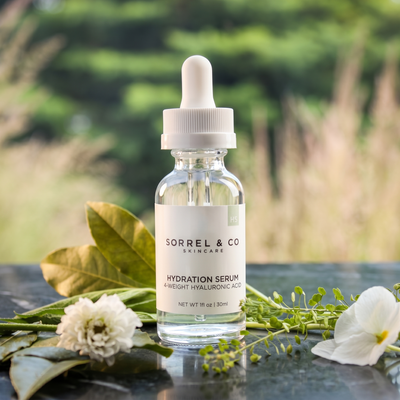
Hyaluronic acid shows up in nearly every skincare product line, often as a flagship hydrating ingredient. Most of the time, it's also misformulated and frequently misused.
The misformulation isn't that brands use bad hyaluronic acid. It's that they use one molecular weight when the molecule actually works in a hierarchy — large molecules stay near the surface, smaller molecules penetrate deeper layers of the skin. A product with one molecular weight does one job. A product with multiple molecular weights does layered work.
The misuse is on the consumer side: hyaluronic acid is a humectant, meaning it pulls water toward itself. Applied incorrectly in a dry environment, it can pull water out of your skin instead of into it. The product feels lovely going on, then leaves your skin tighter than before.
Both problems are solvable. Here's how the molecule actually works, why molecular weight is the variable most products skip, and the application protocol that determines whether HA hydrates you or dehydrates you.
What hyaluronic acid does
Hyaluronic acid (HA) is a glycosaminoglycan — a long-chain sugar molecule that occurs naturally in your skin, joints, and connective tissues. Its defining property is its capacity to bind water. A single HA molecule can hold up to 1,000 times its weight in water. In skin, HA functions as a structural water reservoir, maintaining hydration and giving skin its plump, resilient texture.
Topical HA in skincare products works by binding water at the application site, plumping the visible layers of the skin, supporting the skin barrier, and (in lower molecular weights) signaling some collagen-supporting and wound-repair pathways.
The mechanism is real. The question is whether your HA product is engineered to actually reach the layers where the water-binding produces visible and functional effects.
Molecular weight: the variable most products skip
Hyaluronic acid isn't a single molecule of fixed size. It's a polymer that exists at a wide range of molecular weights, from below 50 kDa (low) to over 1,000 kDa (high). The molecular weight determines what the molecule does in skin.
High molecular weight HA (above 1,000 kDa) sits on the surface of the skin. It binds water at the stratum corneum, creating an immediate plumping effect, smoothing fine lines, and forming a hydrating film. Because the molecules are too large to penetrate deeper, the effect is surface-level. Wash your face and the effect is gone.
This is the kind of HA most "hydrating serum" products use. It gives the immediate plump that makes people love HA products on first application. It does not deliver deeper or longer-lasting hydration.
Medium molecular weight HA (100-500 kDa) penetrates into the upper epidermis. It binds water in the layers just below the skin surface, producing a more durable hydrating effect that persists past initial washing. Less immediate plump, more lasting effect.
Low molecular weight HA (below 100 kDa) penetrates more deeply into the epidermis. It binds water in the lower epidermal layers and signals fibroblast activity, supporting collagen and elastin production. The hydration effect is the most durable; the molecules are also more difficult to formulate stably.
Multi-weight HA includes a blend of all three. Each weight goes to its natural depth, hydrating multiple layers of skin progressively. The visible plump is delivered by the high-weight component. The lasting hydration comes from medium and low weights. The structural support comes from the lowest weights.
The functional difference is significant. A product with multi-weight HA delivers visible immediate effects and underlying durable hydration. A product with single-weight HA delivers one or the other.
The dehydration trap
Humectants — substances that attract water — are only useful when there's water available to attract. In a humid environment, ambient humidity is the water source. In a dry environment (winter heat, air conditioning, low ambient humidity, certain climates year-round), there's not enough atmospheric water for the humectant to draw from. So it draws from the only other water source available: deeper layers of your own skin.
Applied to dry skin in a dry environment, a hyaluronic acid product can pull water from the lower epidermis to the surface, where it evaporates. Net effect: your skin is drier than before.
This is why HA products often feel amazing in the bottle, going on, and for the first hour — and then leave skin feeling tight by mid-day. The product worked exactly as designed. The application context was wrong.
Two practical fixes:
Apply HA to damp skin. The water on your skin's surface becomes the moisture source the HA binds to, instead of your underlying skin layers. Mist your face or apply HA immediately after cleansing while skin is still damp.
Always seal with an occlusive layer. HA binds water; an occlusive ingredient (squalane, jojoba, ceramides, simple oils) traps the bound water before it can evaporate. Apply HA → wait 60 seconds → apply moisturizer with occlusive components. The HA does its hydration job, and the moisturizer prevents the bound water from escaping back into the environment.
HA applied to dry skin without an occlusive seal in a dry environment is the worst-case scenario, and it's how a lot of people use the ingredient.
The Sorrel approach
The Sorrel Hydration Serum uses four molecular weights of hyaluronic acid: high (above 1,000 kDa), medium-high (around 500 kDa), medium-low (around 100 kDa), and low (below 50 kDa, including hydrolyzed HA fragments). Each weight does its layer-specific work. The combination produces visible immediate plumping plus durable underlying hydration plus structural signaling.
Around the four HA weights, the formulation leans on propanediol, glycerin, and pentylene glycol as supporting humectants. It is deliberately a humectant serum rather than a sealed cream — which is exactly why the application protocol below (damp skin, then an occlusive moisturizer over the top) matters so much. Applied that way, it produces meaningfully different results than a single-weight HA serum.
The full ingredient list, concentrations where relevant, and the studies behind each active are published on the Hydration Serum product page. Our broader formulation perspective is published on our research page.
How to use HA correctly
The application protocol determines whether HA hydrates you or dehydrates you. Here's the version that works.
Step 1: Cleanse, but don't fully dry. Leave your skin damp after rinsing.
Step 2: Apply HA serum to damp skin. Press into skin rather than rubbing. The HA binds to the surface water immediately.
Step 3: Wait 60 seconds. Let the HA fully absorb and bind water.
Step 4: Apply moisturizer with occlusive ingredients. Ceramides, squalane, jojoba, or simple petrolatum. The occlusive seals the bound water in.
If you skip Step 4, the product will partially work but leave you drier than expected by mid-day. In low-humidity environments (winter, air conditioning, certain climates), the occlusive seal isn't optional.
Twice daily — morning and evening — is the right frequency for most skin types. HA pairs cleanly with all other actives (retinol, vitamin C, niacinamide, AHAs) and has no acclimation period.
What to expect — and what not to
HA is one of the fastest-acting skincare ingredients. The immediate plumping and softening is visible on first application. The longer-term hydration becomes obvious within 2-3 days of consistent twice-daily use. The structural effects (from lower-weight HA signaling fibroblasts) accumulate over weeks but are harder to attribute to HA alone, since they overlap with the effects of any well-built routine.
What you should not expect:
- Dramatic anti-aging effects from HA alone. HA is foundational, not transformative. It hydrates, it supports texture, it primes skin for other actives. It doesn't reverse photoaging or dramatically smooth deep wrinkles. That's retinol's work.
- Equal effects from any HA product. Single-weight HA at 1% in an otherwise minimal formula will produce noticeably less effect than multi-weight HA at the same concentration in a fuller formulation.
- Continued effect when used incorrectly. Applied to dry skin without occlusion in a dry environment, HA can leave skin drier than baseline. The product isn't broken — the protocol is wrong.
If you've used HA products and found them disappointing, the most likely fix is either the molecular-weight blend or the application protocol — and we built the Hydration Serum to address both.
Not sure whether hydration is the gap in your routine, or which step is missing? The Skin Plan maps your routine in about thirty seconds — no email required.