

The 3-week dropout problem
Most people who buy their first retinol product don't make it past week three.
The pattern is consistent: excited purchase, twice-weekly application, irritation by day 10, peeling by day 18, the bottle pushed to the back of the cabinet by week four. They conclude that 'retinol doesn't work for my skin' and move on.
The retinol almost certainly does work for their skin. They started it wrong.
Retinol is among the best-studied actives in dermatology. The clinical literature on retinoids stretches back to the 1970s, with consistent evidence for collagen stimulation, photoaging reversal, acne management, and improvement in skin texture and tone. None of that benefit reaches you if you abandon the product in week three.
The fix isn't a different product. It's a slower start.
What retinol actually does to your skin
When you apply retinol, your skin converts it (via retinaldehyde) to retinoic acid, the active form that binds to retinoid receptors inside skin cells. Those receptors trigger a cascade: accelerated cellular turnover, increased collagen synthesis, normalized keratinization (smoother skin texture), and reduced melanin transfer (more even tone over time).
The benefits are real and well-documented. But the same cellular acceleration that produces those benefits also creates the side effects beginners experience as failure:
- Transepidermal water loss increases for 4–6 weeks while the barrier adjusts
- Cellular turnover speeds up, exposing newer, thinner skin to the environment
- The barrier itself is temporarily compromised as the skin 'learns' to tolerate retinoid signaling
This adjustment period is called retinization. It typically lasts 6–12 weeks. Skin that's been on retinol for longer than that no longer experiences the dryness, flaking, or sensitivity that beginners do. The product works the same; the skin has adapted.
Why beginners get this wrong
Almost every retinol mistake traces back to one of three things:
- Starting too strong. Buying a 1% retinol because higher numbers feel more effective.
- Applying too often. Twice daily, or nightly from day one.
- Stacking too many actives. Layering retinol on top of an AHA, BHA, or vitamin C the same day they buy it.
All three accelerate the irritation curve past what their barrier can tolerate. The dropout happens not because retinol is harsh but because the protocol was wrong.
We covered the formulation side of this in detail in Why Most Retinol Serums Cause Peeling — the encapsulation chemistry that meaningfully changes the irritation profile. This piece is the user side: how to actually use whatever bottle you've bought.
The 12-week beginner's schedule
This is conservative. It works for almost every skin type, including sensitive skin. If you're starting at 0.25% retinol or below, you can compress the schedule slightly. If you're starting at 0.5% or above, follow it exactly.
Weeks 1–2: Twice a week, PM only. Apply a pea-sized amount to dry skin (wait 15 minutes after cleansing to apply). Follow with moisturizer. Apply Monday and Thursday nights. Skip the rest.
Weeks 3–4: Every other night, PM only. Monday, Wednesday, Friday, Sunday. Same application: pea-sized, dry skin, follow with moisturizer.
Weeks 5–6: Four nights a week. Mon, Tues, Thurs, Sat. Continue with moisturizer. Skin should be visibly more even-toned by now; flaking should be minimal.
Weeks 7–8: Five nights a week. Most users settle here permanently. Two skip nights per week give the barrier time to recover.
Weeks 9–12: Nightly if tolerated. Many people stay at 5x/week indefinitely with no loss of benefit. Daily use is fine for most acclimated skin but not necessary.
The whole schedule is conservative on purpose. Aggressive ramp-ups produce dramatic week-six results and dramatic week-eight quits.
The pairing rules
Almost every 'retinol made my skin terrible' story involves a pairing mistake.
Pair retinol with:
- Ceramides and barrier lipids. Cushion the irritation curve.
- Hyaluronic acid. No interaction. Apply HA on damp skin before retinol, or use it in your morning routine.
- Peptides. Compatible, complementary mechanism.
- Moisturizer. Always. A good barrier-supportive moisturizer over retinol is the single biggest determinant of tolerance.
Do not pair retinol (in the same routine) with:
- AHAs (glycolic, lactic acid). Double exfoliation. Use AHAs on non-retinol nights only.
- BHAs (salicylic acid). Same logic. Alternate nights.
- Benzoyl peroxide. Deactivates most retinoids on contact. Different products, different times of day.
- High-concentration vitamin C. L-ascorbic acid and retinol both work, but stacking them is too much for many skin types. Easier: vitamin C in AM, retinol in PM. We covered the C stability question in Stable Vitamin C: Why Most Vitamin C Serums Lose Potency in Weeks.
The cleanest beginner stack: retinol PM (with ceramide moisturizer over the top), hyaluronic acid serum + vitamin C + SPF in AM. That's it. No exfoliating acids, no benzoyl peroxide, no other actives. Add complexity only after retinization is complete (week 8+).
The retinization checkpoints
How to tell if you're acclimating correctly:
Week 1–2: Subtle dryness, possibly mild flaking around the mouth or chin. Manageable with moisturizer. If your skin is stinging when you apply retinol or red for hours afterward, you started too aggressively — drop to once a week for a fortnight.
Week 3–4: Less flaking, possibly some mild congestion as deeper sebum reaches the surface (this is normal and resolves in 1–2 weeks). Skin texture may feel slightly rougher temporarily.
Week 5–6: Most acclimation symptoms gone. Skin tone visibly more even. Some users notice fewer breakouts; others notice the breakout patterns shifting before improving.
Week 7–8: Stable. Skin tolerates retinol without redness or flaking. Texture noticeably smoother.
Week 9–12: Visible improvement in fine lines, post-inflammatory hyperpigmentation, and overall skin clarity. Sun spots fading slowly.
Beyond 12 weeks: The compounding phase. Most published clinical-trial data on retinol shows measurable improvement at 12 weeks and continued improvement through 24–48 weeks of consistent use.
What to do if it goes wrong
Persistent redness or burning sensation two weeks in: you started too strong. Stop for a week. Restart at half frequency, with double the moisturizer over the top.
Massive purge breakout in weeks 3–5: this happens and usually resolves. The accelerated turnover surfaces existing comedones. If it's painful or cystic, consult a dermatologist.
Persistent flaking past week 6: usually a moisturizer problem, not a retinol problem. Layer a ceramide cream over your retinol every night, not just on dry nights.
Stinging when applying any other product: the barrier is compromised. Pause retinol for 5–7 days, focus on barrier rebuild (gentle cleanser, ceramides, no actives), then restart at lower frequency. The cleanser piece is in The Cleanser Mistake That Breaks Your Skin Barrier — most retinol failures start there.
What Sorrel does
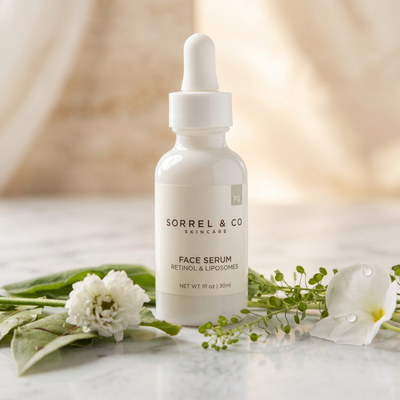
Our Face Serum uses encapsulated retinol — the active is delivered inside liposomal carriers that release it gradually rather than dumping the full dose onto the skin at once. The kinetics are different from conventional retinol: lower peak irritation, similar cumulative effect over 12 weeks.
The formulation also includes barrier-supportive ingredients (ceramides, squalane) in the same product, which reduces the 'stacking' requirement most beginners face when they try to layer retinol with a separate barrier cream.
For a beginner with no prior retinol exposure, our recommended protocol is the 12-week schedule above, starting twice weekly in PM, with moisturizer over the top. After week 8, most users can move to 5x/week comfortably.
The honest summary
Retinol works. The published clinical data is among the strongest in topical skincare. The reason it fails for so many people is not that the molecule is wrong but that the protocol was. Most retinol failures are protocol failures.
The 12-week schedule above is conservative on purpose. Following it slowly produces the same results as a fast ramp-up, with none of the dropout rate. The patient skin is the skin that gets the benefit.
If you've quit retinol before because of irritation, you can restart now with this schedule. Most second attempts succeed where first attempts didn't, because the protocol's better.
Not sure whether retinol is your next step, or whether something should come first? The Skin Plan maps your routine in about thirty seconds — no email required.