

Niacinamide and zinc show up together so often — on cleansers, serums, and gels for breakout-prone skin — that the pairing can look like a marketing habit. It is not. The two ingredients work on different parts of the same problem, and that is exactly why they belong side by side.
What each one does
Niacinamide works on oil and barrier. Topical niacinamide has been shown to lower sebum output (Draelos et al., 2006) while supporting the skin barrier — a combination that helps breakout-prone skin look calmer without stripping it. We cover the dosing detail in the niacinamide piece.
Zinc works on the look of congestion and on microbial balance. A systematic review of zinc in acne concluded that the weight of evidence points to antibacterial and anti-inflammatory effects, and that zinc may also reduce sebum production (Journal of Drugs in Dermatology, 2013; Zinc Therapy in Dermatology review, 2014). Those are the studies' findings and the studies' language — we are reporting what the literature says about zinc, not making that claim for any product we sell.
Why the combination is more than the sum
The mechanisms barely overlap. Niacinamide is mostly about oil regulation and barrier support; zinc is mostly about calming the look of irritation and microbial balance. Stacking two ingredients that hit different pathways means each can stay at a gentle, well-tolerated level while the pair still covers more ground than either alone. For reactive, breakout-prone skin, gentle-but-broad usually beats strong-but-narrow.
How to read the pairing on a label
Niacinamide is typically effective from around 2% upward, with many formulas in the 4–10% range. Zinc usually appears as a chelated form like zinc PCA, chosen for skin compatibility, at low single-digit percentages. Seeing both, reasonably high on the list, is a sign the formula was built for oil-prone skin rather than decorated with a trendy name.
Where it fits
This pairing suits combination and breakout-prone skin, and sits comfortably in a short daily routine. It pairs well with a calming botanical layer — the logic behind combining it with green tea, which we cover in green tea for oily skin.
Where our own label lands
Worth saying plainly, since this article is about reading labels: we do not sell a zinc product. Nothing in our catalog contains zinc, and the section below is about the principle behind the pairing, not a claim that we have replicated it.
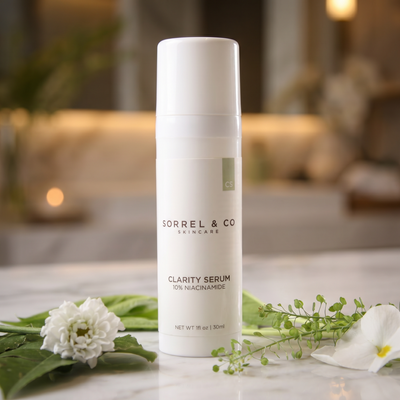
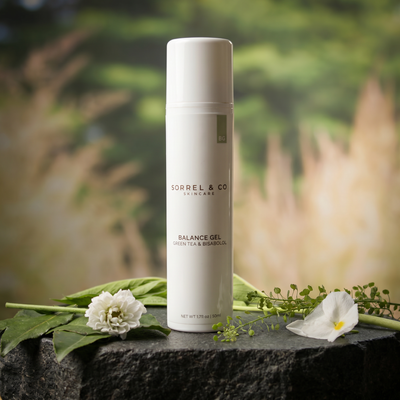
Our Clarity Serum leads with 10% niacinamide for oil balance and barrier support, and our Balance Gel brings the calming, sebum-aware side with green tea and bisabolol. Together they reflect the same principle as the niacinamide-and-zinc logic — cover oil, barrier, and calm with gentle ingredients rather than one harsh one — by a different route, using the ingredients we actually chose. If a zinc pairing is specifically what you are looking for, ours is not it, and the label checks above are how to find one that is.
Not sure whether oil or barrier is your real issue? The Skin Plan maps your routine in about thirty seconds — no email required.
References
- Draelos ZD, et al. The effect of 2% niacinamide on facial sebum production. Journal of Cosmetic and Laser Therapy. 2006. https://www.tandfonline.com/doi/abs/10.1080/14764170600717704
- The clinical effects of zinc as a topical or oral agent on acne: a systematic review. Journal of Drugs in Dermatology. 2013. https://pubmed.ncbi.nlm.nih.gov/23652948/
- Zinc Therapy in Dermatology: A Review. Dermatology Research and Practice. 2014. https://pmc.ncbi.nlm.nih.gov/articles/PMC4120804/