

Strongest evidence
The most well-established concern about a still-ubiquitous ingredient
If you've ever finished washing your face and felt that immediate "squeaky clean" tightness — followed an hour or two later by a strange oiliness that wasn't there before you cleansed — you've experienced one of the most documented physiological responses in cosmetic dermatology.
That cycle has a name. It's called the rebound effect, and it's not anecdotal. It's the predictable consequence of a specific, well-studied mechanism: barrier disruption from sulfate-based surfactants.
What sulfates are and why they're everywhere
Sodium lauryl sulfate (SLS) and its slightly milder cousin sodium laureth sulfate (SLES) are surfactants — molecules that grab onto oil and dirt on one end and water on the other, allowing both to rinse away together. They're effective at their job, which is why they've been in nearly every shampoo, body wash, and foaming cleanser for fifty years.
The reason brands keep using them comes down to two things: cost and lather. SLS in particular is cheap to produce in industrial quantities and creates the rich foam most people associate with "thoroughly cleaned." That foam is largely cosmetic — it has almost nothing to do with whether your skin is actually clean — but consumer expectations for foam are deeply ingrained.
How sulfates affect the skin barrier
Your stratum corneum — the outermost layer of your skin — is held together by a matrix of lipids: ceramides, fatty acids, and cholesterol arranged in tightly packed bilayers. This lipid matrix is what lets your skin retain water, repel irritants, and stay structurally intact under daily stress.
Sulfates dissolve those lipids. They don't distinguish between the oily debris on your skin and the lipids that hold your barrier together. The mechanism is simple solubilisation: the same chemistry that lets SLS lift sebum off your face also lifts ceramides and cholesterol out of your barrier.
The result is increased trans-epidermal water loss, an inflammatory response in the skin, and a barrier that takes longer to recover than the 24-hour interval between cleanses. Daily SLS use creates a perpetual state of sub-optimal barrier function, where the damage compounds rather than resets.
Key studies
Nassif et al. 1994, British Journal of Dermatology. SLS at standard cosmetic concentrations produced significant skin barrier disruption, increased trans-epidermal water loss, and induced an inflammatory response. The disruption was measurable with instruments and persisted for days after a single exposure. The foundational study on SLS and barrier function. → PubMed
Agner 1991, Acta Dermato-Venereologica. SLS exposure produced significant disruption to stratum corneum lipids. The mechanism is direct solubilisation of the lipid matrix — SLS does not discriminate between sebum and barrier lipids, removing both. → PubMed
Loffler et al. 2001, Skin Pharmacology and Physiology. Repeated SLS exposure produced cumulative barrier disruption significantly greater than single exposure — directly relevant to a daily-use cleanser where the damage compounds over time. → PubMed
Imokawa et al. 1989, Journal of Investigative Dermatology. SLS disrupts the intercellular lipid bilayer of the stratum corneum. Recovery after disruption takes significantly longer than the 24-hour application cycle of most cleansers, meaning daily SLS use creates a perpetual state of sub-optimal barrier function. → PubMed
The "tight then oily" cycle, explained
Many people who use harsh cleansers describe the same pattern: skin feels uncomfortably tight immediately after washing, then becomes unexpectedly oily within an hour or two. This is sometimes dismissed as "just how my skin is," or attributed to skin type.
It's actually a documented physiological response to barrier disruption. When the barrier is compromised, the skin compensates by overproducing sebum to seal the breach. The tight feeling is barrier damage. The subsequent oiliness is your skin trying to repair it. The cycle continues for as long as the disruption continues.
Where our own label lands
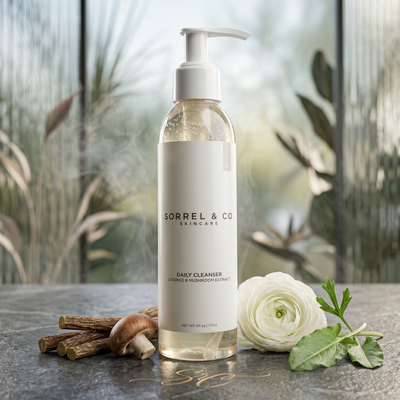
Neither of our cleansers contains SLS, SLES, or any other sulfate surfactant. Here is what they use instead, named rather than described in the vague language this category usually gets.
The Daily Cleanser is built on cocamidopropyl betaine and decyl glucoside — an amphoteric coconut-derived surfactant and a sugar-derived non-ionic one. The Clearing Cleanser uses coconut oil ethers alongside cocamidopropyl betaine, in an aloe base. These lift dirt and sebum without the aggressive lipid solubilisation the studies above describe.
Worth being precise about one of them: cocamidopropyl betaine is itself a recognised contact allergen for a minority of people, generally attributed to manufacturing impurities rather than the molecule. It is far gentler than SLS and it is not nothing. Both full ingredient lists are on their product pages, which is where this kind of decision should be made.
The tradeoff is that our cleansers don't foam as aggressively as a sulfate-based product. Lather is largely cosmetic. Effective cleansing is not the same thing as aggressive cleansing, and skin that's been cleansed without barrier damage is more capable of retaining its own moisture, regulating sebum, and tolerating the rest of your routine.
Last reviewed: May 2026. Sources: Nassif et al. 1994, Agner 1991, Loffler et al. 2001, Imokawa et al. 1989.