

Strong evidence
One of the most confusing ingredients on a label, and one of the most worth understanding
If you've ever read an ingredient list and seen "alcohol" alongside "cetyl alcohol" or "stearyl alcohol," you may have wondered why the label lists what looks like the same ingredient three times.
It doesn't. Those are three different categories of ingredient with completely different effects on your skin — and the difference matters more than almost any other distinction in cosmetic chemistry.
Fatty alcohols vs. denatured alcohol
The "alcohols" in cosmetics fall into two very different families.
Fatty alcohols — cetyl alcohol, stearyl alcohol, cetearyl alcohol, behenyl alcohol, and others — are wax-like emollient ingredients derived from plant or animal sources. They function as moisturisers, thickeners, and emulsifiers. They're not drying. They're often actively beneficial for the skin barrier. If you see one of these on a label, it's not the kind of alcohol you've been told to avoid.
Denatured alcohol — listed as "alcohol denat," "SD alcohol," or sometimes just "alcohol" — is a completely different category. This is ethanol with denaturing agents added to make it undrinkable for tax-classification purposes. In skincare, it's used as a preservative, an astringent that creates an immediate "matte" feeling, and a penetration enhancer that helps active ingredients absorb more deeply.
The barrier disruption literature is about denatured alcohol, not fatty alcohols. Confusing the two is one of the most common mistakes in clean beauty discussion.
How denatured alcohol affects the skin
The mechanism is similar to sulfates: direct solubilisation of stratum corneum lipids. Ethanol is a solvent. Applied to skin, it dissolves some of the lipid matrix that holds your barrier together, leading to increased trans-epidermal water loss and (over repeated exposures) cumulative barrier disruption.
What makes denatured alcohol particularly tricky is that the disruption isn't always obvious in the moment. The immediate sensation is often pleasant — a clean, tightened, "less oily" feeling that's actually the skin compensating to a barrier insult. The longer-term effects are what produce the dryness, sensitivity, and reactivity that often show up months into using a product containing high concentrations of alcohol.
Key studies
Lachenmeier 2008, Food and Chemical Toxicology. Topical alcohol application disrupts the stratum corneum by dissolving lipids in the lipid bilayer. The mechanism is similar to SLS — direct solubilisation of barrier lipids — but through a different pathway. Repeated application compounds the disruption. → PubMed
Wilhelm et al. 1991, Dermatologica. Alcohol application reduced stratum corneum water content measurably within hours of application. The short-term drying effect is well-established and directly relevant to moisturising products containing alcohol. → PubMed
Ahlstrom et al. 2014, Contact Dermatitis. The authors report that denatured alcohol in topical products is a common cause of contact dermatitis and irritant reactions in individuals with compromised barrier function, and that populations with impaired barriers showed significantly increased reactivity in their data. → PubMed
Where the evidence is and isn't strong
The case against denatured alcohol depends heavily on concentration.
At high concentrations — above 20%, which is common in toners, hairspray, and many "matte finish" products — the evidence is unambiguous. Direct barrier disruption, cumulative damage with repeated use, and clear elevated risk of irritation and sensitivity, particularly in already-compromised skin.
At low concentrations — under 5%, where alcohol is typically functioning as a penetration enhancer for active ingredients — the picture is less definitive. Some well-formulated products use small amounts of alcohol as a delivery vehicle for actives without producing measurable barrier disruption.
If your barrier is already compromised, or your skin is reactive and easily irritated, the prudent position is avoidance at any concentration. The downside is essentially zero — alcohol provides no functional benefit to that population — and the potential upside is meaningful.
Where our own label lands
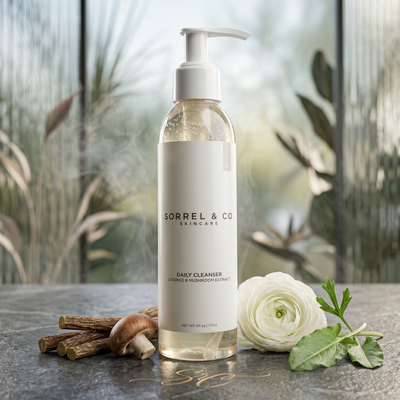
Sixteen of our seventeen formulas contain no denatured alcohol. One does: our Balance Gel lists alcohol denat, used deliberately as a fast-evaporating carrier so a green-tea gel absorbs and dries to a matte finish rather than sitting wet on oily, breakout-prone skin — the skin type that formula is built for. (Our Daily Cleanser also lists alcohol, low on the list, but it rinses off in seconds, so the leave-on barrier concern above doesn't apply to it the same way.)
Here's the honest read using our own evidence: the barrier concern is strongest for leave-on products at high concentrations on already-compromised skin. If your skin is reactive and easily irritated, our Calming Mist — rose water and aloe, no alcohol — is built for exactly that, and it's the one we'd point you to over the Balance Gel. If your skin is oily and resilient and you want that matte finish, the Balance Gel does its job, and the alcohol is part of why. Same principle as everywhere on this site: we'd rather tell you where it is and what it's for than pretend it's not on the label.
Last reviewed: May 2026. Sources: Lachenmeier 2008, Wilhelm et al. 1991, Ahlstrom et al. 2014.