

Mixed evidence
The difference between sealing your skin and nourishing it
Mineral oil is the one ingredient on this shelf whose case isn't primarily about safety.
We're going to be upfront about that. Mineral oil at cosmetic grades is not a toxicological concern. The contamination arguments you sometimes see in clean beauty content — about polycyclic aromatic hydrocarbons in less rigorously refined mineral oil — apply to industrial-grade petroleum products, not the highly refined cosmetic grades used in commercial skincare. Cosmetic-grade mineral oil is well-tolerated, rarely implicated in congestion at standard concentrations, and doesn't carry the safety profile that gets parabens or phthalates flagged for concern.
So why don't we use it? The honest answer is that mineral oil is a functional choice, not a safety one. Plant-derived oils do a meaningfully different job. And the difference matters for the kind of long-term skin health we're trying to support.
What mineral oil is and what it does
Mineral oil is a colourless, odourless liquid distilled from petroleum. In skincare, it functions as an occlusive — it forms a film on the skin's surface that physically blocks water from evaporating out. This reduces trans-epidermal water loss and creates the immediate "moisturised" feeling that mineral-oil-based products are known for.
Why brands use it: it's exceptionally cheap compared to plant-derived alternatives; it's chemically stable — it doesn't go rancid, oxidise, or develop off-smells; it's odourless and colourless, so it doesn't interfere with formulation; almost no one is allergic to it. These are real functional advantages. Mineral oil has been a workhorse cosmetic ingredient for over a century for good reasons.
What mineral oil doesn't do
Loden 2001, American Journal of Clinical Dermatology. Mineral oil functions as a pure occlusive — it seals the skin surface and reduces trans-epidermal water loss but does not contribute any active benefit to the barrier or the skin's intrinsic function. Unlike plant-derived oils, it does not provide fatty acids the skin can use. → PubMed
Rawlings & Lombard 2012, International Journal of Cosmetic Science. Occlusive agents that do not support barrier lipid synthesis produce only temporary hydration improvement. The moisture benefit disappears when the occlusive layer is removed — contrasting with humectants and barrier-active ingredients that produce durable improvement. → PubMed
The clinical implication: mineral oil seals water in. It doesn't help your skin retain water on its own. Remove the mineral oil, and you're back to baseline.
Plant-derived oils, by contrast, can contribute fatty acids — linoleic acid, oleic acid, alpha-linolenic acid, and others — that the skin's barrier can incorporate into its own lipid matrix. That is the mechanism the functional argument rests on, and it is worth knowing that not every ingredient sold as a "plant oil" actually delivers it.
Why this distinction matters
If you've ever used a mineral-oil-heavy moisturiser and found that your skin feels great while you're using it but reverts to dryness immediately when you stop, you've experienced the limit of pure occlusion. The product was working. It just wasn't building anything underneath.
What you actually want for long-term skin health is a moisturising approach that provides immediate hydration (what mineral oil does) and supports the barrier's intrinsic ability to hold water (what mineral oil doesn't do).
Where the evidence is and isn't strong
The functional case for fatty-acid-bearing plant oils over mineral oil is well-established at the mechanistic level. Those oils contribute fatty acids to barrier lipid synthesis. Mineral oil does not. This is uncontroversial chemistry.
The clinical evidence that this functional difference produces meaningfully better long-term skin outcomes is reasonable but not as strong as you might want for a definitive claim. Most studies are short-term. Long-term comparative trials of plant-oil moisturisers vs. mineral-oil moisturisers in healthy populations don't really exist at the rigour level we'd want.
So our position is calibrated: we don't claim mineral oil is harmful. It isn't. We don't claim plant oils are categorically safer. They're roughly equivalent on the safety front. What we do claim — and what the mechanistic evidence supports — is that fatty-acid-bearing plant oils do more for the skin barrier than a pure occlusive does.
Where our own label lands
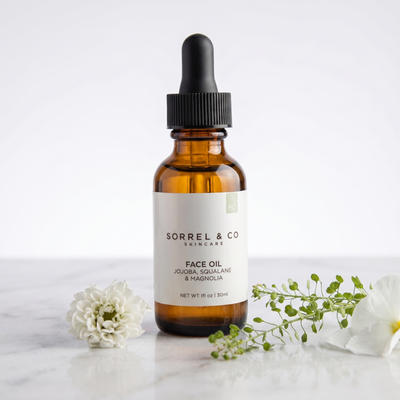
We use no mineral oil, paraffinum liquidum, or petrolatum in any of our seventeen formulas. That part is simple. The rest deserves more precision than "we use plant oils instead," because our own Face Oil is a good example of why the category is messier than the marketing.
The Face Oil is seven ingredients: jojoba seed oil, squalane, magnolia bark extract, caprylic/capric triglyceride, bisabolol, prickly pear stem extract, and frankincense oil. Run the article's own test on that list and you get an honest split.
Squalane is the closest thing on our own label to the ingredient this article is about. It is a saturated hydrocarbon. It carries no fatty acids, contributes nothing to barrier lipid synthesis, and works by exactly the mechanism described above — a light, elegant, extremely stable occlusive. Plant-derived rather than petroleum-derived, which is a sourcing difference, not a functional one. We chose it for tolerability and feel, not for barrier building, and it would be dishonest to file it under the argument we just made.
Jojoba is a liquid wax ester, not a triglyceride — chemically closer to your own sebum than to an olive or sunflower oil, which is why it sits so well on skin, but also why it isn't a rich source of the linoleic acid the fatty-acid argument leans on. Caprylic/capric triglyceride is the one that straightforwardly does deliver fatty acids. Magnolia bark extract, bisabolol, and prickly pear stem extract are extracts, not oils — they are in the formula for their own graded evidence, not for lipid contribution.
So the accurate version: we prefer plant-derived emollients to petroleum-derived ones, and where a formula needs fatty acids it gets ingredients that actually carry them. But we are not going to tell you that every oil-shaped ingredient on our label is feeding your barrier, because the label says otherwise and you can read it.
Last reviewed: May 2026. Sources: Loden 2001, Rawlings & Lombard 2012.