

Mixed evidence
Where intellectual honesty about ingredient research really pays off
If you've spent any time in clean beauty content online, you've likely seen confident claims that silicones are bad for your skin — that they suffocate it, cause breakouts, prevent moisture absorption, or create long-term damage.
Most of those claims overstate what the dermatology research actually shows.
This is the post where being honest about the evidence matters most. Sixteen of our seventeen formulas are silicone-free, and the reasons are not the ones most "clean beauty" sources put forward. The seventeenth is named further down, because pretending otherwise would betray exactly the kind of customer trust we want to build.
What silicones are and why they're in everything
Silicones — dimethicone, cyclopentasiloxane, cyclomethicone, and many others — are synthetic polymers based on chains of silicon and oxygen atoms. In skincare, they serve several functional roles: they create the silky-smooth feel that conventional moisturisers and primers are known for; they form an occlusive film on the skin that reduces water loss; they're chemically stable across a wide range of temperatures and formulation conditions; they play well with most other ingredients.
This combination of properties is why silicones became ubiquitous in cosmetics starting in the 1990s. They're cheap, effective at what they do, and reliable to formulate with. Most conventional creams, foundations, and primers contain them.
The skin claim — what the evidence actually shows
The most common claim in clean beauty content is that silicones are harmful to the skin barrier. This claim is mostly not supported by the dermatology literature.
Rizer et al. 1997, Journal of the Society of Cosmetic Chemists. Dimethicone is non-comedogenic at standard cosmetic concentrations and does not produce barrier dysfunction in studied populations. The primary criticism that emerged from later research was contextual rather than mechanistic.
The contextual concern: while silicones aren't comedogenic on their own, the occlusive film they create can trap sebum, dead skin cells, and other debris on the skin surface in individuals with congestion-prone skin. The functional outcome can resemble comedogenicity even if the underlying mechanism is different.
For most skin types, this isn't a major concern. For congestion-prone or reactive skin, it can be — and in those cases, silicone-free formulations are often preferable. But for the typical consumer with reasonably healthy skin, the dermatological case against silicones is weaker than clean beauty marketing suggests.
The environmental case is much stronger
Where the evidence really lines up against silicones is environmental rather than dermatological.
Fiedler et al. 2010, Environmental Science & Technology. Cyclic silicones (D4, D5, D6) are persistent in aquatic environments and bioaccumulate in organisms. D4 and D5 are classified as substances of very high concern (SVHC) under EU REACH regulation. The EU has restricted D4 and D5 in wash-off products above 0.1%. → PubMed
The mechanism: silicones don't biodegrade. They accumulate in soil, water, and sediment. Aquatic organisms accumulate them in body tissues. The compounds have been detected in waterways downstream of populated areas, in fish, and in marine sediment cores going back decades. Once silicones are in the environment, they don't leave.
This is a real concern. It's also a structurally different concern than the skin-health argument. It's not about whether silicones harm you when you put them on your face. It's about whether silicones harm the ecosystems they accumulate in once washed off your face down the drain.
Where the evidence is and isn't strong
To summarise honestly: the case that silicones harm your skin barrier at standard cosmetic concentrations is weak. The studies don't generally support the strongest claims made about them.
The case that silicones can contribute to congestion in already-congested skin is moderate. Real for some populations, less relevant for others.
The case that silicones are environmentally persistent and accumulating in aquatic ecosystems is strong. Confirmed by independent research, regulatory action, and ongoing monitoring data.
If you're an environmentally-minded consumer, that third reason is sufficient to drive a silicone-free choice. If you're solely concerned about your own skin and you don't have congestion-prone skin specifically, the case is more mixed.
Sorrel & Co's formulation position
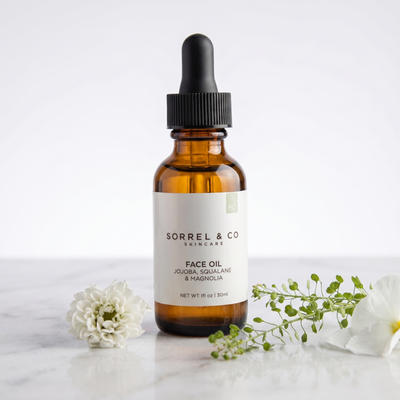
Sixteen of seventeen formulas are silicone-free, built instead on plant-derived emollients — squalane, jojoba, magnolia oil — and gum-based texturizers.
One exception, disclosed because that's the deal here: our Repair Serum uses two silicone derivatives, dimethicone crosspolymer and amodimethicone, which give snail mucin a smooth glide instead of a sticky one. Worth being precise about: these are large, non-cyclic polymers — not the D4/D5 cyclic silicones at the center of the environmental evidence above. That doesn't make them biodegradable, and if you're avoiding silicones entirely, the Repair Serum isn't your product — the other sixteen are. The full ingredient list is on the page either way.
What we use across the rest of the line: plant-derived emollients (squalane, jojoba, magnolia oil), naturally-derived film-forming agents, and texturisers like xanthan gum, sclerotium gum, and gellan gum that provide slip and stability without the persistence profile of silicones.
We're not going to claim our products feel exactly like silicone-based competitors. They don't. The texture is different — typically a touch lighter, less of the "instant smoothing" effect, and closer to the natural feel of plant oils on skin. For most of our customers that's a feature rather than a bug.
Last reviewed: May 2026. Sources: Rizer et al. 1997, Fiedler et al. 2010, EU REACH classification of D4/D5.