

Strong evidence
One of the most-discussed ingredients in cosmetics, and one of the most widely misunderstood
In 2004, a researcher named Philippa Darbre published a paper that would shape clean beauty marketing for the next twenty years.
Her study, published in the Journal of Applied Toxicology, found intact paraben esters in human breast tumour tissue. The implication, picked up by countless news outlets and cosmetics companies in the months that followed, was electric: parabens cause breast cancer.
The actual finding was more careful than the headlines. Darbre identified the presence of parabens in breast tissue. She did not establish — and explicitly did not claim to establish — direct causation for breast cancer. The study showed exposure, not consequence.
Twenty years later, parabens remain one of the most controversial preservatives in cosmetics. The clean beauty industry has largely treated them as proven carcinogens. Mainstream dermatology has largely treated the cancer claims as overstated. Both positions are wrong in interesting ways. Here's what the research actually shows.
What parabens are and why they're used
Parabens — methylparaben, ethylparaben, propylparaben, butylparaben, and others — are a family of preservatives used in cosmetics since the 1950s. Their job is to prevent bacterial and fungal growth in water-based formulations. Without preservatives, products like creams, lotions, and serums become contaminated within days of opening, posing real safety risks (skin infections from contaminated cosmetics are a documented hospital admission category).
Parabens became dominant because they're cheap, broad-spectrum, and effective at low concentrations. Most conventional cosmetics still use them. The clean beauty industry has worked to reformulate around them, with mixed success — some paraben alternatives have their own concerns, and finding broad-spectrum preservation without them is genuinely harder than the marketing suggests.
The estrogenic activity finding
What's well-established about parabens is that they have measurable estrogenic activity. They bind weakly to estrogen receptors and can produce estrogenic effects in laboratory and animal models.
Routledge et al. 1998, Toxicology and Applied Pharmacology. Parabens bind to estrogen receptors and produce estrogenic effects in vitro and in animal models. Butylparaben showed the strongest estrogenic activity. → PubMed
The mechanism here is real. Parabens are estrogen-receptor agonists. The clinical question is whether the level of activity at the doses we're typically exposed to from cosmetics is high enough to matter at the population scale.
What Darbre 2004 did and didn't find
Darbre et al. 2004, Journal of Applied Toxicology. Found intact paraben esters in human breast tumour tissue. Did not establish causation — established presence of compounds with estrogenic activity in breast tissue. The study that triggered the mainstream paraben debate. → PubMed
What Darbre 2004 actually established was that parabens applied topically can be absorbed through skin, persist intact in the body (rather than being fully metabolised as previously assumed), and be detected in breast tissue. That's a meaningful finding. It doesn't prove that parabens cause cancer. It does establish a plausible biological pathway by which they could contribute to estrogen-driven processes.
Darbre & Harvey 2008, Journal of Applied Toxicology. Review of evidence on parabens and breast cancer risk. Concluded that while direct causation had not been established, the estrogenic and genotoxic properties of parabens warranted a precautionary approach in cosmetic formulation. → PubMed
Where the evidence is and isn't strong
This is the post where intellectual honesty matters most.
What the research clearly shows: parabens have estrogenic activity (well-established); they can be absorbed through skin and detected in breast tissue (established); several parabens have been restricted or banned in the EU for cosmetic use (regulatory fact).
What the research has not shown: direct cause-and-effect relationship between paraben exposure from cosmetics and breast cancer in humans; the absolute risk increase, if any, from typical cosmetic paraben exposure at population scale.
A customer who has heard "parabens cause cancer" from clean beauty marketing deserves a more accurate framing. The case for concern is real. The case for definitive cause is not.
The most defensible position is the regulatory one: enough concern exists about endocrine activity that the EU has acted to restrict multiple parabens, and acceptable preservation alternatives exist. We follow the precautionary path.
Where our own label lands
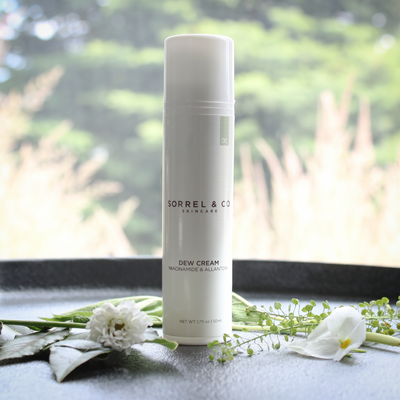
Sixteen of our seventeen formulas contain no parabens, preserved instead with phenoxyethanol at controlled concentrations, ethylhexylglycerin, and pH-managed formulation.
One does. Our Firming Cream uses Phenonip, a preservative blend that includes parabens — it's right there on the label, and since this whole site exists to teach you to read labels, we're saying it here too. We've asked our manufacturing partner for the blend's exact composition and for a paraben-free alternative base, and we'll update this page with what we decide. In the meantime you have what you need to make your own call: the evidence above, the full ingredient list on the product page, and our word that we'd rather show you an imperfect label than write a perfect-sounding sentence.
Last reviewed: May 2026. Sources: Darbre et al. 2004, Routledge et al. 1998, Darbre & Harvey 2008.