

One letter separates the most useful biocompatible lipid in cosmetic chemistry from a molecule that turns rancid on your shelf within months. Squalane and squalene look nearly identical on a label — the difference is a single “a” — but they behave entirely differently in formulations and entirely differently on skin. Every reputable formulation uses the version with the “a.” Many cheaper or less carefully composed products use the version without it, and the difference matters more than the spelling suggests.
The story is small organic chemistry and the kind of formulation detail that does not usually make marketing copy. It is also the difference between an oil that you keep on your shelf for two years and one that oxidizes into a slightly fishy-smelling, lower-performance product over the same window. Here is what is actually going on.
What squalene is
Squalene is a hydrocarbon — a 30-carbon polyunsaturated molecule produced naturally by your skin's sebaceous glands. It is one of the most abundant lipids in human sebum, accounting for roughly 12–20% of the lipid composition by weight depending on the individual.
Squalene has several useful properties for skin. It is highly biocompatible because it is the same molecule your body already makes. It is an effective emollient, providing softness and pliability to the skin surface. It supports the lipid matrix of the stratum corneum without producing the heavy occlusion that some plant oils create. It is non-comedogenic for most skin types.
Squalene has one significant problem: it has six double bonds in its carbon chain. Double bonds are sites of chemical reactivity, particularly with oxygen. When squalene is exposed to air over time, oxygen attacks those double bonds and the molecule oxidizes — producing a family of degradation products including aldehydes, ketones, and peroxides. The result is rancidity, off-smell, color change, and — importantly — the formation of compounds that can be irritating or comedogenic on skin.
This is the squalene shelf-life problem. Even in good packaging, pure squalene begins to oxidize within weeks of exposure and is significantly degraded within 3–6 months. On skin, the oxidation can continue under sun and oxygen exposure, producing the rancid byproducts directly on the user's face.
What squalane is
Squalane is squalene with the double bonds removed. Chemically, it is the fully hydrogenated version — each double bond has had two hydrogen atoms added, converting the reactive sites into stable single bonds. The molecule retains nearly all of squalene's beneficial properties (biocompatibility, emolliency, lipid matrix support, non-comedogenic profile) but eliminates the oxidation problem.
Squalane is shelf-stable for years. It does not turn rancid. It does not produce the irritating oxidation byproducts on skin. It maintains its sensory and functional properties through the entire product lifespan.
The trade-off: squalane requires the additional hydrogenation manufacturing step, which adds cost. The cost difference is meaningful but not enormous — cheap squalene is roughly half the price of cosmetic-grade squalane. This price difference is what drives some formulators, particularly in lower-cost categories or in “natural” positioning, to use squalene rather than squalane.
From a user perspective, the practical implication is straightforward: squalane is what you want. Every reputable cosmetic chemistry text recommends squalane over squalene for topical formulations precisely because of the oxidation issue. Brands using squalene are usually either cutting cost or unaware of the difference — neither is a good signal.
Source variations
Squalane on the market today comes from three main sources, each with slightly different properties and ethical implications:
Shark liver squalane. Historically the dominant source, particularly in pharmaceutical and high-end cosmetic applications. Deep-sea sharks (notably gulper sharks, school sharks, and certain dogfish species) accumulate squalene in their livers. The squalane derived from this source is high-purity and effective, but the sourcing is environmentally devastating — contributing to severe overfishing of deep-water shark populations. Most reputable cosmetic brands have abandoned shark-derived squalane in the past decade, though it persists in some pharmaceutical applications.
Olive-derived squalane. Extracted from olives, refined, and hydrogenated. Comparable purity to shark-derived squalane. Environmentally sound. The dominant source for serious cosmetic formulations through the 2010s. Costs slightly more than shark-derived material but the gap has narrowed substantially as production has scaled.
Sugarcane-derived squalane. A newer source, produced through fermentation of sugarcane-derived glucose to produce farnesene, which is then dimerized and hydrogenated to squalane. Environmentally favorable, produced at industrial scale, comparable purity to olive-derived squalane. Now the dominant source in many modern cosmetic formulations.
For practical purposes, olive-derived and sugarcane-derived squalane are functionally interchangeable in cosmetic formulations. Both are vastly preferable to shark-derived material. Brands using either typically disclose the source as a positioning point. Brands that hide the source may be using a less-favored option.
How squalane fits in a routine
Squalane's most useful applications:
As a face oil base. Pure squalane is one of the most versatile face oils available — lightweight, biocompatible with sebum, fast-absorbing, non-comedogenic, suitable for nearly every skin type. It works alone for people who want minimal-ingredient skincare and as the base for more complex oils that add botanical actives or supporting lipids.
As an emollient in moisturizers. Squalane in the lipid phase of a cream or lotion provides the emollient properties of a heavier oil without the heaviness. It pairs well with ceramides (which provide structural barrier support) and free fatty acids (which provide additional lipid matrix components). We covered the ceramide-cholesterol-fatty acid balance in our piece on ceramides as the building blocks of your barrier.
As a delivery vehicle for lipid-soluble actives. Vitamin E, retinol (in some formulations), CoQ10, and certain peptides are lipid-soluble. Squalane provides a stable, biocompatible vehicle for delivering these actives to skin without the oxidation problems of less-stable plant oils.
For barrier compromise recovery. Squalane on compromised skin behaves much like skin's own sebum — providing the lipid replenishment the barrier needs without the irritation profile of more reactive ingredients. We covered the broader recovery framework in our piece on retinol mistakes that compromise your barrier.
Squalane and jojoba: complementary rather than competing
The two oils most often compared in cosmetic chemistry are squalane and jojoba (technically a liquid wax ester, not a true oil). Both are biocompatible with skin's natural lipids. Both are widely used in modern formulations. The differences:
- Squalane is a hydrocarbon, structurally similar to skin's squalene fraction of sebum. Most useful for emolliency and lipid replenishment.
- Jojoba is a wax ester, structurally similar to skin's wax ester fraction of sebum. Most useful for moisture sealing and a slightly different sensory profile.
Both are non-comedogenic. Both are well-tolerated. They are often used together in formulations rather than as alternatives, because they replicate different fractions of the natural sebum composition. We covered jojoba specifically in our piece on why jojoba is closer to skin's sebum than any other oil.
What to look for on a label
Squalane, not squalene. The most important single check. If a product lists squalene without the “a,” either the brand is making an oxidation-prone choice or there is a typo — either way, ask questions before buying.
Source disclosure. “Olive-derived,” “sugarcane-derived,” “phytosqualane” (plant-derived), or “biosqualane” (fermentation-derived). Brands that disclose are usually using the better sources. Brands that hide the source warrant skepticism.
Position on the ingredient list. Squalane works at any concentration but is most useful at meaningful concentrations — typically in the top 10 ingredients of a face oil or moisturizer where it is doing real work, rather than as a token addition at position 25.
Supporting cast in face oils. A serious face oil pairs squalane with other beneficial lipids — jojoba esters, plant oils with high linoleic acid content, a small amount of botanical extracts for additional activity. Pure squalane is a fine product on its own; a thoughtfully blended formulation can add to it.
The Sorrel approach
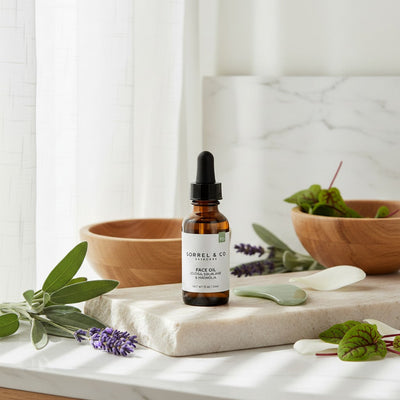
The Face Oil pairs squalane (sugarcane-derived) with jojoba ester for the wax-ester fraction and magnolia bark extract for an additional anti-inflammatory and antioxidant layer. The blend is meant to replicate the lipid composition of healthy sebum more closely than any single oil would — with the shelf stability of squalane carrying the formulation through a normal use cycle without degradation.
The formulation is intentionally not greasy. Squalane absorbs quickly. The supporting lipids add nuance without weight. The result is a face oil that works for combination and oily-tending skin as well as for dry skin, in contrast to the heavier plant-oil-based formulations that often only work for one skin type.
The full ingredient list and the studies behind the formulation are linked from our Research page.
How to use a face oil well
In the routine sequence. Face oils generally go last in a routine — after water-based serums, after moisturizer if you use one, but before SPF in the AM. The lipid layer would otherwise block water-based actives from penetrating.
How much to use. A few drops, warmed between palms, pressed into skin. More is not better — too much oil produces a film without absorbing fully, which can interfere with subsequent product application.
When to use it. Daily for dry skin, particularly in dry seasons or environments. Mixed weeks for combination and oily skin — several nights per week, not necessarily every night. Post-procedure when the barrier needs lipid support. After retinol nights when the barrier is acclimating.
Who should be cautious. People with active acne should approach face oils carefully and look for high-linoleic, low-oleic compositions (squalane is fine; some plant oils high in oleic acid can be comedogenic for acne-prone skin). When in doubt, patch test on a small area for a week before using more broadly.
The Face Oil is part of our founders launch. The first 200 customers join as founding members at 40% off their first order and 20% off every reorder for life with code FOUND40.
If you have read the difference between squalane and squalene now, you have the single most useful tool for evaluating any face oil on the market. The “a” is the difference. Look for it.