

The one oil that isn't really an oil
Most 'face oils' you see on a shelf are triglycerides — three fatty acids attached to a glycerol backbone. Coconut oil is a triglyceride. So is olive oil, argan oil, almond oil, rosehip oil. They differ in their fatty acid profiles (which determines their behavior on skin), but structurally they're all the same molecule type.
Jojoba is the exception.
Jojoba isn't a triglyceride. It's a liquid wax ester — a long-chain fatty alcohol bonded to a long-chain fatty acid. That structural difference is small on paper. On skin, it changes almost everything.
Why wax ester chemistry matters
Your skin's natural sebum is mostly wax esters. About 25% of human sebum by mass is wax esters, alongside triglycerides, squalene, and other lipids. No other plant oil on the market produces wax esters in any meaningful concentration. Jojoba is the only oil whose primary molecular structure mirrors what your skin already makes.
Why does that matter? Three reasons:
It absorbs without sitting on the surface. Triglycerides need to be metabolized or carried into skin via other means. Wax esters integrate directly into the skin's lipid matrix because the skin already recognizes them as compatible with sebum.
It doesn't trigger compensatory sebum suppression. When you apply jojoba, your sebaceous glands don't read 'extra oil!' and shut down to compensate. Other oils can suppress sebum production in the short term (which sounds good but creates rebound effects). Jojoba is sebum-compatible enough that the skin doesn't register it as foreign.
It supports the barrier without occluding it. Some oils form an occlusive layer over skin (sealing in water but also blocking transpiration). Jojoba is light enough that it doesn't fully occlude — it integrates with the existing lipid matrix instead of layering over it.
The comedogenic question
The biggest concern oily-skinned and acne-prone users have with face oil is the comedogenic question: will this oil clog my pores and trigger breakouts?
The comedogenic rating system (0–5) is older than most people realize, and the data behind it is from a 1989 rabbit-ear study by Fulton. Coconut oil rates as a 4 (highly comedogenic). Argan oil rates around 0–2. Jojoba consistently rates 1–2 across multiple later sources.
The system has known limitations — rabbit ears aren't human faces, and the testing was done with pure oil at high concentrations rather than the diluted, formulated state oils appear in. But within those limitations, jojoba is among the most reliably low-comedogenic oils available.
The reason traces back to wax-ester chemistry. Pore-clogging happens when oils oxidize on the skin surface and combine with dead skin cells to form a plug. Jojoba is unusually stable against oxidation — its wax-ester structure resists the kind of rancidity that triggers oxidative pore-clogging in less stable oils.
So in practice: most people with combination or oily skin can use jojoba oil topically without triggering breakouts. The same isn't true of coconut, olive, or many other oils marketed for face use.
Comparing jojoba to other popular oils
A brief survey of the alternatives:
Coconut oil. Almost entirely triglycerides with high lauric and myristic acid content. Highly comedogenic for face use. Great for body. Wrong for sebaceous skin.
Argan oil. Triglyceride with high linoleic and oleic acid content. Light, decent for most skin types, but oxidizes more readily than jojoba.
Rosehip oil. High in retinoic acid precursors, which is interesting for anti-aging but creates instability and a short shelf life. Doesn't mimic sebum.
Marula oil. High oleic acid (similar to olive). Light feel, but the oleic acid content is high enough to be problematic for very oily skin.
Squalane. Not technically an oil; it's a saturated hydrocarbon derived from olive or sugarcane. Compatible with skin (your skin makes squalene), light, non-comedogenic. The closest competitor to jojoba in terms of sebum-compatibility, but with different chemistry.
For someone choosing a single face oil to anchor their routine, jojoba and squalane are the two most universally compatible options. Both behave well across skin types. Jojoba has the longer track record and wider trial base.
How to use jojoba in a routine
Three primary use cases:
1. As a routine moisturizer for combination-to-oily skin. Two to three drops, applied after serum, before sunscreen (or as the last step of a PM routine). The wax-ester structure means it integrates with your sebum rather than feeling greasy on top of it.
2. As a pre-cleanse oil. The oil-dissolves-oil principle. Massage jojoba onto dry skin to dissolve sebum, makeup, and SPF residue, then follow with a gentle pH-5.5 cleanser. We covered the cleansing protocol in The Cleanser Mistake That Breaks Your Skin Barrier. Jojoba is the most barrier-friendly first-cleanse option.
3. As a barrier-rebuild oil during retinol acclimation or post-procedure. When the barrier is compromised (after a chemical peel, microneedling, or in the early weeks of retinol use, see When to Start Retinol), jojoba supports recovery without the heaviness of occlusives like petrolatum or shea butter.
What Sorrel does
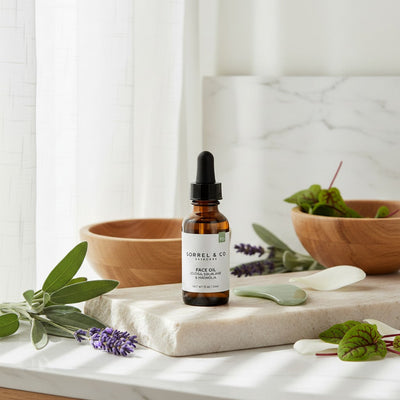
Our Face Oil is a blend of jojoba, squalane, and magnolia bark extract. The jojoba and squalane handle the lipid-compatibility work — both integrate with the skin's existing matrix without occluding. The magnolia bark extract (honokiol and magnolol compounds) adds an anti-inflammatory layer.
The formulation is in an opaque amber bottle to prevent oxidation, which is the failure mode for most face oils on the market. A face oil in clear glass on a sunny bathroom counter is oxidizing measurably within weeks.
For oily and combination skin types, two drops in the PM after serum is enough. For dry skin types, three to four drops, possibly stacked with a richer cream over the top.
When not to use facial oil
Briefly — because the question always comes up:
Active inflammatory acne with pustules. Skip face oil during active flares. Reintroduce when the flare resolves.
Under sunscreen (in some cases). Some oils disrupt sunscreen film integrity. Jojoba is among the better-tolerated, but if you notice your SPF pilling or behaving differently, omit oil in AM and reserve it for PM.
Layered with heavy creams in humid environments. Sometimes the lipid load is too much. Use either oil or rich cream, not both, when the air is already heavy.
The honest summary
Jojoba is the rare ingredient where the marketing matches the chemistry. It really is closer to your skin's sebum than other oils. It really does behave differently from triglycerides. It really is compatible with oily, combination, and sensitive skin in a way that almost no other plant oil is.
If you've been told face oils don't work for your skin type, the test worth running is a cleanser-and-jojoba routine — not a coconut-oil or olive-oil one. The wax-ester chemistry is the difference.
Our Founders 200 launch is open with code FOUND40 — 40% off the first order and lifetime member pricing across the Sorrel range, including our Face Oil. First 200 members only.