

Setting mists are the easiest skincare category to be cynical about. The marketing is florid — “a refreshing burst of hydration,” “a moment of self-care,” “the finishing touch your routine has been missing.” The product itself is, at the basic level, water in a spray bottle. Pricing varies from $4 at the drugstore to $60 in the prestige aisle for what appears to be the same thing.
The cynicism is partially earned. A meaningful portion of the mist market really is $30 of scented water with marketing on top. But there is also a meaningful portion that does real work — not as a moisturizer replacement, not as a foundation setting spray, but as a specific tool for specific moments in a routine. Knowing the difference is the question worth answering.
What a setting mist actually is
A facial mist is a water-based formulation delivered in a fine spray. The water portion is typically purified water plus one or more botanical waters or hydrosols (rose water, chamomile water, witch hazel water, etc.). Beyond water, the useful mists contain some combination of:
- Humectants. Glycerin, hyaluronic acid, sodium PCA. Pull water into the stratum corneum.
- Soothing botanicals. Aloe, chamomile, centella, panthenol. Reduce mild irritation.
- Antioxidants. Green tea, white tea, vitamin C derivatives. Low-concentration protective layer.
- Cooling or astringent agents. Witch hazel, peppermint, cucumber. Mostly sensory but have minor functional effects.
The marketing-only mists usually skip most of this and lean on a fragrance plus water plus a preservative. The functional mists include a meaningful fraction of the ingredient list as actual skin-supporting actives. The label tells you which one you are buying.
The humectant-and-evaporation question
The most common technical objection to facial mists — raised regularly in skincare communities — is the evaporation problem. If you spray water on your skin and it evaporates, it can take additional water with it through the stratum corneum, leaving skin drier than before. This is the same dehydration trap we covered in our piece on why HA serums can dry you out.
The objection is technically correct but typically overstated. Two conditions determine whether a mist dehydrates or hydrates:
Ambient humidity. In a low-humidity environment (winter heating, dry climate, airplane cabin), evaporation pulls more water from skin than the mist deposits. The mist is net-dehydrating. In a high-humidity environment, evaporation is slower, the mist deposits hydration, and net hydration improves.
Whether the mist is sealed in. If you spray a mist and follow within 30–60 seconds with a moisturizer that includes occlusive lipids, the water and humectants stay in the stratum corneum. No evaporation problem. If you spray and leave the mist to dry on its own, the evaporation problem kicks in.
The practical implication: facial mists are useful tools when used inside a layered routine. They are misleading marketing when sold as standalone hydration in a dry environment with no follow-up.
Where mists genuinely add value
Five use cases earn the mist its place:
1. Pre-serum substrate. Most humectant serums (hyaluronic acid, glycerin) work better on damp skin. A mist applied as a controlled water layer before serum increases the active's effectiveness. This is the single highest-leverage mist use.
2. Mid-day comfort. Hot environments, after-workout flush, air-conditioned offices, dry indoor heating — a mist with cooling and soothing ingredients delivers genuine sensory and physiological relief without disrupting the rest of the routine.
3. Post-procedure cooling. After microneedling, retinol acclimation flares, or sun exposure where skin is reactive, a soothing mist with allantoin, panthenol, or aloe provides an immediate calm-down step that supports recovery.
4. Makeup setting. A mist with a mild film-forming agent (some include glycerin or silica) can extend foundation wear and reduce the powdery look that long-wear formulas develop by mid-afternoon. This is the legitimate “setting” function the category name implies.
5. Aerial application of soothing actives. For people with acne or rosacea where touching the face triggers reactions, a mist delivers calming ingredients without the physical contact that other application methods require.
Where mists are mostly marketing
The cases where a mist is doing very little for you:
1. As primary hydration in a dry environment. A mist alone in a low-humidity setting often nets out neutral or slightly dehydrating. You need a moisturizer on top.
2. As a serum replacement. A mist contains active ingredients at very low concentrations because it is mostly water. It is not a substitute for a serum.
3. As a treatment for specific concerns. Aging, hyperpigmentation, acne — a mist is not the right delivery format for the actives that address these concerns. The contact time is too short and the concentration too low.
4. As anything that justifies a $50+ price tag. The ingredient cost of even a thoughtfully formulated mist is low. High prices in the category reflect packaging and brand positioning, not ingredient value.
What to look for on a label
The first ingredient is water or hydrosol. Both are fine. “Rose water,” “chamomile water,” “orange flower water” — these are botanical distillates with mild functional properties and pleasant scent. Plain purified water is also fine and often more elegant in formulation.
At least one humectant in the top 5. Glycerin, sodium PCA, sodium hyaluronate. If the formulation is mostly water with no humectant, the evaporation problem dominates.
At least one soothing ingredient in the top 10. Allantoin, panthenol, aloe, bisabolol, centella, niacinamide. These deliver the calming effect that justifies the use case.
Fragrance considerations. Synthetic fragrance is the #1 skin sensitizer in cosmetic products. We covered this in our piece on what the research says about fragrance in skincare. A mist with added fragrance is more likely to cause contact reactions than the same formulation without. Botanical waters provide natural scent without the fragrance-allergen profile.
Packaging. A fine-mist atomizer is the right delivery. A coarse spray that drips on application is the wrong delivery. A pump that sprays straight rather than misting also fails the format requirement.
The Sorrel approach
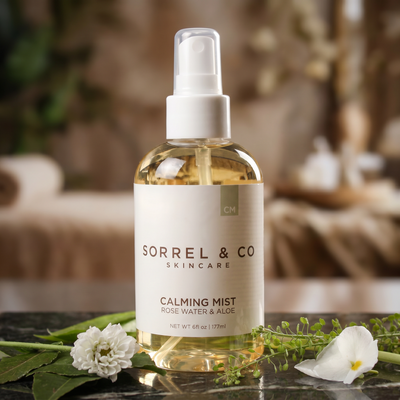
The Calming Mist is built around rose water and aloe as the water-phase base, with panthenol, allantoin, and a small amount of glycerin as the soothing and humectant complement. The formulation is intentionally narrow — not trying to be a serum replacement, not promising visible results from spray-on application, just executing the calming-and-substrate function well.
The mist is fragrance-free except for the natural aroma of the rose and aloe waters. The atomizer delivers an actual fine mist rather than a spray. It is meant to be used as the substrate before serum application, as a mid-day comfort step, and after sun or stress exposure where skin needs a quick reset.
The full ingredient list and the studies behind the formulation are linked from our Research page.
How to use a mist well
As a serum substrate. Cleanse, mist, immediately apply serum to still-damp skin, follow with moisturizer. The serum absorbs better and works harder.
For mid-day reset. Hold the bottle 8–10 inches from your face, close your eyes, and apply a brief spray. Press gently with clean fingertips. Skip the “blot off” step — the residue is the active layer.
For post-exposure soothing. Apply after sun, after workouts, or after retinol nights that produce mild residual irritation. Follow with moisturizer if the skin needs the seal.
What to avoid. Spraying mist as your only hydration step in a dry environment. Using mist instead of an evidence-backed treatment for specific skin concerns. Believing the $60 luxury mist will outperform the $25 thoughtfully formulated one — in this category, ingredient cost is low enough that pricing reflects positioning, not chemistry.
If you have written off mists as a category, the question is not whether mists work — it is whether the mist you tried was doing the job a mist can actually do.
Not sure where a mist fits, or what your routine actually needs? The Skin Plan maps it in about thirty seconds — no email required.