The humectant most people get wrong
Hyaluronic acid is the most-bought hydrating ingredient in skincare, and probably the most misused. Search any skincare forum for 'HA serum dried out my skin' and you'll find years of posts from people who applied a humectant religiously and ended up with tighter, more dehydrated skin than when they started.
This is not a defect in the molecule. It is a defect in how the molecule is being used. Hyaluronic acid is doing exactly what it does — drawing water toward itself. The question is, water from where?
The humectant pathway
A humectant is a molecule that binds water. The technical definition is a substance with a strong affinity for hydrogen bonding, which lets it hold water molecules within its lattice. Glycerin is a humectant. Honey is a humectant. Propylene glycol is a humectant. Hyaluronic acid is a humectant — and an unusually efficient one. A single hyaluronic acid molecule can bind up to 1,000 times its weight in water.
That binding doesn't generate water. It pulls water from the nearest available source. Outdoors on a humid summer evening in a coastal city, that source is the air around you. The atmosphere donates water vapor, the HA on your face binds it, your stratum corneum stays plump.
Indoors in a Montana winter, with the heater running and relative humidity around 15%, that source isn't the air. The air is drier than your skin. Water flows from wet to dry, not the other way. Your hyaluronic acid, doing its job perfectly, pulls moisture out of the deeper layers of your skin and surrenders it to the dry indoor air through transepidermal water loss.
The product worked. The skin got drier.
This is what we mean by the humectant trap. It is not a flaw in HA as an ingredient. It is a flaw in applying a humectant without accounting for the environment it's working in.
The single-MW problem, briefly
We covered the molecular weight question in detail in Hyaluronic Acid: Why Molecular Weight Matters, so we'll skip the long version here. A single molecular-weight HA — especially a high-MW one — sits on the surface of the skin. It does not penetrate. Whatever water it binds, it binds in a thin film at the top of the stratum corneum, which is the layer most exposed to the dry indoor air.
Low humidity + high-MW HA + no occlusive layer = a humectant pulling water from your skin instead of from the room.
Multi-weight HA blends do better. They distribute the water-binding capacity across multiple depths of the stratum corneum, which means the moisture isn't sitting only at the most vulnerable surface layer. But even multi-weight HA cannot fully solve the humidity problem on its own. The fix is procedural.
The damp-skin-plus-occlusive protocol
Two steps fix the great majority of HA disappointments. Neither requires changing the serum.
Apply HA to damp skin. Cleanse, leave the skin slightly wet — towel-press, don't dry — then apply the serum. You're giving the humectant a water source that isn't your dermis. The HA grabs the surface water and locks it in instead of mining your deeper tissue.
Damp skin is not soaking-wet skin. Soaking-wet skin dilutes the active. The target is the skin that feels cool and slightly tacky to the touch, not dripping. Roughly 15–30 seconds after a final rinse.
Layer an occlusive over the HA within 60 seconds. Occlusive means a moisturizer that creates a barrier against transepidermal water loss — ceramide-rich creams, lipid-heavy emulsions, even pure petrolatum at the simplest end. The occlusive layer prevents the humectant from off-gassing the moisture it just bound. You are not just hydrating; you are sealing the hydration in.
Without the occlusive layer, a humectant in dry air is a slow leak. With one, it is a closed system.
The exception: high-humidity environments
If you live in Charleston, Miami, Singapore, or anywhere with consistent 60%+ relative humidity, the protocol is less critical. The air is donating water; the HA has somewhere to pull from. You can get away with looser layering and skip the immediate occlusive in summer months.
But for the majority of people in temperate climates with central heating in winter — which is to say, most of North America for four to six months a year — the damp-skin-plus-occlusive protocol is not optional. It's what the ingredient requires to do its job.
Reading the label
Five things to check on a hydrating serum:
1. Multiple molecular weights of hyaluronic acid. Look for terms like sodium hyaluronate (a more stable salt form), hydrolyzed hyaluronic acid (lower MW), and hyaluronic acid crosspolymer (a form that sits longer at the surface). A formula listing three or four weights is doing more work than a formula listing one.
2. Supporting humectants. Glycerin, panthenol, sodium PCA, and urea each behave differently than HA and stack well with it. We'll cover the supporting cast of hydration in a later piece. A serum that relies on HA alone is incomplete.
3. No high-percentage alcohols in the top of the ingredient list. Some 'hydrating' serums use SD alcohol or denatured alcohol as a carrier. In low concentrations as a preservative or texture modifier, this is fine. In the top five ingredients, it works directly against the hydration goal.
4. Packaging that protects the actives. HA itself is stable. The supporting ingredients — vitamin B5, peptides, antioxidants — often aren't. Opaque or amber dropper bottles preserve potency longer than clear glass or wide-mouth jars.
5. A reasonable, unfragranced formula. Added fragrance in a hydrating serum is usually a tell that the brand is competing on sensory experience rather than function. Fragrance is the most common cause of contact sensitization in modern cosmetics, and a hydrating serum has no functional reason to contain it.
What Sorrel does
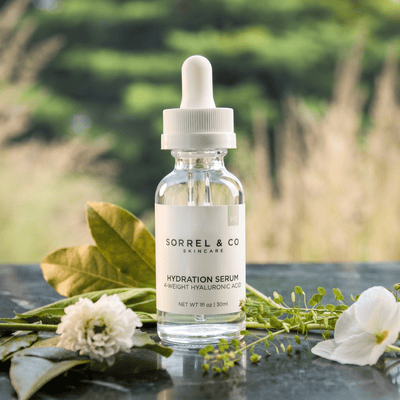
Our Hydration Serum is a four-molecular-weight hyaluronic acid stack — ultra-low, low, medium, and high MW — designed to distribute moisture across multiple depths of the stratum corneum rather than concentrating it at the surface. Supporting humectants include glycerin and panthenol (provitamin B5). No fragrance, no essential oils, no alcohol carrier.
The serum is calibrated to work in the damp-skin-plus-occlusive protocol described above. We don't sell it as a standalone solution to dehydration; we sell it as the central piece of a four-step hydration sequence. A serum that performs as a system component, not a hero product.
Practical use
The full protocol for someone struggling with chronic dehydration:
Morning and night. Cleanse with a pH-5.5 cleanser — see The Cleanser Mistake That Breaks Your Skin Barrier for why pH matters here. Pat the skin until it's damp, not dry. Apply 3–4 drops of Hydration Serum to the damp face and neck. Within 60 seconds, layer a ceramide-rich cream over the top. In AM, finish with broad-spectrum SPF.
Winter additions. In a sub-30% humidity environment, a facial oil — jojoba or squalane work well here — over the cream provides an additional occlusive layer. The order is humectant first, emollient second, occlusive third. Order matters more than people realize.
Travel additions. Airplane cabin humidity runs around 10–20%, drier than most deserts. The same damp-skin-plus-occlusive protocol applies, with an additional reapplication mid-flight if you can.
A 12-week timeline of expected results: visible plumpness within 1–2 weeks, sustained baseline hydration within 4–6 weeks, fine-line softening from improved barrier integrity within 8–12 weeks. The plumpness shows up first; the structural changes take longer.
The honest summary
Hyaluronic acid works. The misconception is that it works alone. A humectant in a dry environment without an occlusive layer is a humectant working against you. The fix isn't a different serum; it's a different protocol. Damp skin, fast layering, occlusive on top.
If you've spent six months convinced HA doesn't work for your skin, run this protocol for two weeks and reassess. The bottle was probably never the problem.
Not sure whether hydration is your skin's real issue, or something else is? The Skin Plan maps your routine in about thirty seconds — no email required.