

The wrong cleanser pH does not give you a rash. It does not sting. It does not leave skin tight in any way you would notice. It works quietly, in the background, by chemically dismantling the acid mantle and giving your barrier slightly less to work with every time you wash your face. Over weeks and months, this is the difference between skin that holds water and skin that does not.
The science here has been settled for decades, but the consumer skincare market has been remarkably slow to catch up. Most of the cleansers sitting in bathroom cabinets right now are formulated at the wrong pH for skin — sometimes by accident, often by cost. Here is what is actually happening, what the research actually shows, and how to spot a cleanser worth using.
What pH actually is, briefly
pH is a measure of how acidic or alkaline a water-based solution is. The scale runs from 0 (most acidic) to 14 (most alkaline), with 7 being neutral. Each step is a tenfold change — pH 5 is ten times more acidic than pH 6, a hundred times more acidic than pH 7.
Healthy skin sits between pH 4.5 and 5.5 — slightly acidic, by design. This acidity is maintained by a layer of secretions from sweat, sebum, and the natural metabolic products of the skin's microbiome, collectively called the acid mantle. The acid mantle is not a metaphor. It is a measurable, functionally critical layer that does specific things: it inhibits pathogenic bacteria, supports the enzymes responsible for ceramide synthesis, and helps regulate the desquamation process that keeps the stratum corneum thin and intact.
What alkaline cleansing actually does
Traditional bar soap sits at pH 9-10. Many gel and foaming cleansers, particularly those built on saponified oils or older surfactant systems, are not far behind. When you wash your face with a cleanser at pH 9, two measurable things happen.
First, the skin's surface pH rises. Studies using non-invasive pH probes have repeatedly shown that a single alkaline cleansing event can raise skin pH by 1.5 to 2 full units, and that the skin takes anywhere from 30 minutes to 14 hours to return to baseline, depending on individual barrier health and how often the alkaline insult is repeated.
Second, while the skin is at the wrong pH, the enzymes responsible for barrier maintenance work poorly or not at all. Beta-glucocerebrosidase and acid sphingomyelinase, the two enzymes that convert lipid precursors into mature ceramides, both have pH optima in the acidic range. At skin pH of 7 or higher, their activity drops by more than 50%. This means: every time you wash your face with an alkaline cleanser, you are not just rinsing oil off the surface. You are temporarily blocking your skin's ability to build the lipid matrix that makes the barrier work.
The snapback myth
You will sometimes see the claim — usually from brands defending an old formulation — that the skin bounces back quickly from alkaline cleansing, and that this transient pH disturbance is therefore meaningless. The data does not support this. The buffering capacity of healthy adult skin can return surface pH to normal within 30-90 minutes after a single mild alkaline wash. That is best-case. With repeated daily exposure, or in skin already compromised by age, irritation, or atopic conditions, recovery takes substantially longer — in some studies, up to 14 hours, which means a person who washes twice a day with an alkaline cleanser may never have skin at its proper pH.
The longer the pH disturbance, the longer the ceramide-synthesizing enzymes are offline. The longer those enzymes are offline, the slower the barrier rebuilds. The slower the barrier rebuilds, the more transepidermal water loss the skin experiences, and the drier and more reactive it becomes. This is a quiet, multi-month process. You do not notice it the way you notice a sting from an acid serum. You just slowly accumulate barrier debt.
What syndet actually means and why it matters
The cleanser industry's response to the alkaline-cleansing problem, starting in the 1950s and finalizing in the 1980s, was the synthetic detergent — abbreviated as syndet. Syndets are cleansing agents (technically: surfactants) that were specifically engineered to work at acidic to neutral pH without forming the harsh soap salts that traditional alkaline soaps rely on.
The most well-formulated modern cleansers use mild amphoteric or non-ionic surfactants — names you will see on labels include cocamidopropyl betaine, decyl glucoside, coco glucoside, sodium cocoyl isethionate, and sodium methyl cocoyl taurate — buffered to a pH between 4.5 and 6. These cleansers can remove oil, makeup, and pollution without disrupting the acid mantle, because they work through completely different surfactant chemistry than soap.
This is the technology that should be in every modern cleanser. It is not, because syndets are more expensive than saponified oils, and because consumer skincare brands often inherit decades-old formulations and never reformulate.
How to read a cleanser label for pH
Cleanser pH is rarely on the label. Brands are not required to disclose it, and most do not. There are three practical ways to know.
Ask the brand. A reputable skincare brand that has formulated its cleanser at skin pH will know the number and tell you. A brand that does not know — or that gives a vague answer about being balanced for skin — is signaling that pH was not a priority during formulation.
Test it yourself. pH test strips for cosmetics are inexpensive and reliable. Mix a small amount of cleanser with distilled water (not tap, which has its own pH), dip the strip, read the color. This is the most honest test.
Read the surfactant list. Saponified oils — Sodium Olivate, Sodium Cocoate, Potassium Olivate — are guaranteed to push the cleanser alkaline. A cleanser whose primary surfactants are coco-glucoside, sodium cocoyl isethionate, or cocamidopropyl betaine is much more likely to be at skin pH. This is an imperfect heuristic but a useful one.
The Sorrel approach
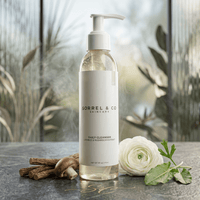
The Daily Cleanser is formulated at the upper end of the skin-pH range — slightly acidic, deliberately. The surfactant system is a blend of mild glucoside-based cleansers, not saponified oils. We pair them with two functional botanicals that reinforce the goal of cleansing without barrier disruption: licorice root extract, which is mildly anti-inflammatory and pigment-modulating, and a tremella mushroom extract that brings polysaccharide-bound water to the surface, leaving skin hydrated post-rinse instead of stripped.
The point is not just that the cleanser does not dry you out. The point is that twice-daily use should not be a barrier insult. Cleansing should be neutral or actively supportive — never a thing your skin spends the rest of the day recovering from.
How to use it without undermining your routine
Three things matter more than people realize.
Water temperature. Lukewarm. Not hot. Hot water — anything above body temperature — dissolves stratum corneum lipids independently of what the cleanser is doing. This is mechanical, not chemical, and a good cleanser cannot save you from it.
Contact time. Roughly 30-60 seconds for a wash-off cleanser is enough for surfactants to lift oil and pollution. Longer contact time does not equal cleaner skin. It equals more time for surfactant residue to interact with the barrier. Rinse generously.
Frequency. Twice daily, max. Many people benefit from a water-only morning rinse and a single full cleanse in the evening — particularly during winter months or in skin that runs reactive. This is not a sign of lazy hygiene. It is a sign of paying attention.
The cleanser is the first product to touch your skin each day and the last to touch it each night. If it is at the wrong pH, no serum or moisturizer downstream is fully going to compensate. Get this right and everything else works harder.
For more on cleansing mistakes that compromise the barrier, see our piece on the most common cleansing error, and our discussion of sulfate surfactants and what 30 years of research show.
Not sure whether your cleanser is the weak link, or which step actually is? The Skin Plan maps your routine in about thirty seconds — no email required.
