

The 'clean' feeling that isn't clean
Most people who use a foaming cleanser describe the result the same way: 'It really gets my skin clean.' What they mean — though they don't usually say it — is that their face feels tight afterward. Maybe a little dry. The pores look smaller. The skin feels smooth.
None of that is what cleaning your skin is supposed to do.
The tightness is barrier damage. The dryness is lipid stripping. The smoothness is the absence of the natural oils your skin produces to protect itself. And your skin's reaction to all of this — overproducing sebum, breaking out, becoming sensitive — is your skin trying to repair an injury you deliver every twelve hours.
What a cleanser is actually doing
The active ingredient in any cleanser is a surfactant. Surfactants are molecules with two ends: one end loves water (hydrophilic), the other end loves oil (hydrophobic). When you wash your face, the oil-loving ends grab dirt, sebum, and makeup; the water-loving ends carry them away when you rinse. That's the entire mechanism.
The problem is that surfactants don't distinguish between the oil and dirt sitting on your skin and the lipid matrix inside your skin barrier. Aggressive surfactants strip everything. Gentle surfactants are more selective. The choice of surfactant is the most important variable in any cleanser, and most consumers never look at it.
The surfactant hierarchy
Here's the hierarchy, roughly from harshest to gentlest:
- Sodium lauryl sulfate (SLS). The cheapest, most aggressive surfactant. Strips everything. Used in cleansers, shampoos, even toothpaste. Excellent foam, terrible for barrier-compromised skin.
- Sodium laureth sulfate (SLES). A milder cousin of SLS — still aggressive, slightly less stripping. Common in mass-market face wash.
- Cocamidopropyl betaine. An amphoteric surfactant derived from coconut. Much gentler. Often used as a co-surfactant alongside milder primaries.
- Coco-glucoside, decyl glucoside. Sugar-based, non-ionic surfactants. Very gentle, mild foaming, barrier-friendly.
- Lauryl glucoside. Another sugar-based surfactant in the same gentle family.
Reading the ingredient list isn't hard. If 'sodium lauryl sulfate' is in the first five ingredients of a cleanser, the formula is built around aggressive surfactant action. If you see cocamidopropyl betaine or a glucoside paired with a milder primary, you're looking at a gentler design.
The pH problem
The other variable nobody reads is pH. Your skin's protective layer — the acid mantle — sits at roughly pH 4.7 to 5.7. It's a thin film of sebum, sweat, and shed cells that holds beneficial microbes, blocks pathogens, and keeps the underlying barrier functional.
Traditional soap-based cleansers (true soap, lye-saponified oils) sit at pH 9–10. Many 'natural' bar cleansers do too. When you wash with a high-pH cleanser, you disrupt the acid mantle. It takes hours to recover. If you cleanse twice daily with a high-pH product, your acid mantle is almost never fully intact.
The signs of acid mantle disruption: a 'tight' feeling for thirty or more minutes after cleansing, increased sensitivity over time, an oilier T-zone (compensatory sebum), unpredictable breakouts. None of these are normal. None of them are your skin 'being difficult.' They're predictable physiological responses to a chronic insult.
The fix is a cleanser formulated at pH 5.5 — close to skin's natural pH. It won't disrupt the acid mantle. It won't require a 'toning' step to restore balance. It will leave your skin feeling clean but not tight.
The frequency mistake
Twice daily is the right cadence for most adult skin. AM rinses off overnight sebum and sweat. PM removes the day's accumulation of sebum, sunscreen, makeup, and environmental particulate. Three or four times daily is over-cleansing. Once daily is fine if you're not wearing sunscreen or makeup, but most adults should hit twice.
The mistake people make isn't usually frequency — it's technique. The cleanser needs about sixty seconds of contact time with your skin to actually work. Most people splash it on and rinse it off in ten seconds. Sixty seconds with a gentle surfactant is more effective than ten seconds with an aggressive one.
Water temperature matters too. Lukewarm is correct. Hot water dilates capillaries (bad for redness-prone skin), accelerates lipid stripping, and signals your sebaceous glands to ramp up. Cold water doesn't dissolve sebum efficiently. Lukewarm splits the difference.
What Sorrel does
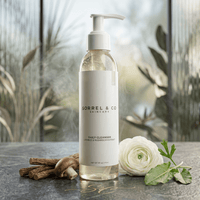
Our Daily Cleanser is built around licorice root extract and beta-glucan from mushroom polysaccharides, paired with a gentle surfactant system. It's formulated at pH 5.5, which means it cleans without disrupting your acid mantle. Glycerin and panthenol round out the formula to support barrier integrity through the cleansing step itself.
It's not designed to feel squeaky afterward. If 'squeaky clean' is your benchmark for whether a cleanser worked, you've been trained to evaluate cleansers by the wrong outcome. The right outcome is: makeup and sebum removed, skin not tight, no compensatory oiliness within the hour.
Reading a cleanser label in 30 seconds
Six items to check:
- Surfactant identity. SLS in the first five ingredients? Look elsewhere. Cocamidopropyl betaine and glucosides? Promising.
- pH listed? Many gentle cleansers volunteer this. 5.5 is the target.
- Fragrance present? Particularly for sensitive skin, 'fragrance' or 'parfum' in a wash-off product is still a contact-irritant risk.
- Alcohol denat in the top half? Denatured alcohol in a cleanser is unnecessary stripping.
- Glycerin, panthenol, or niacinamide in the formula? These barrier-supportive humectants help offset the brief stripping effect of cleansing.
- Plant extracts that do real work? Licorice root, green tea, mushroom polysaccharides, oat. Not 'rose extract' at 0.001% for marketing.
How to recover an over-cleansed barrier
If you've been using a harsh cleanser for years and your skin has been signaling distress — tightness, redness, unpredictable breakouts, sensitivity — here's the recovery protocol:
- Switch to a pH-5.5, gentle-surfactant cleanser. Twice daily.
- Skip exfoliants for two weeks. No AHAs, BHAs, or retinols during the barrier-rebuild window.
- Layer humectants and a barrier moisturizer. Glycerin, hyaluronic acid, panthenol, ceramides. We covered the molecular weight of HA in detail in Hyaluronic Acid: Why Molecular Weight Matters.
- Add SPF in AM. A compromised barrier is more vulnerable to UV.
- Reintroduce actives gradually after week three. Slow ramp-up. Watch for redness or stinging — those are signs to back off. (For retinol specifically, our piece Why Most Retinol Serums Cause Peeling covers the acclimation curve.)
Most barriers recover noticeably within three to four weeks of the right cleansing protocol. Skin that's been chronically stripped for years can take longer. The investment is worth it: a healthy barrier means almost every other active ingredient in your routine works better, with less irritation, at lower concentrations.
The honest summary
The cleanser is the single most-used, least-thought-about product in most routines. People buy it on price or scent and forget about it. But it's the only step where you're actively stripping lipids and disrupting the acid mantle twice a day. The wrong cleanser undermines everything else in your routine.
Get the cleanser right and you fix the foundation. Get it wrong and you'll spend years correcting downstream problems — sensitivity, dryness, overactive sebum production, persistent breakouts — that all trace back to a $12 product you reach for without thinking.
If you're not sure whether your cleanser is the weak link — or which step actually is — the Skin Plan maps it in about thirty seconds, no email required.
