

Panthenol rarely gets top billing. It sits in the middle of ingredient lists, under names like pro-vitamin B5 or dexpanthenol, doing quiet, useful work while flashier actives take the credit. It is one of the most reliable barrier-support ingredients in cosmetic chemistry, and it belongs in the same conversation as allantoin and glycerin — the supporting cast that makes a moisturizer perform above its headline.
What panthenol is
Panthenol is the alcohol form of vitamin B5. Once it is on the skin, it converts to pantothenic acid, the active vitamin. That small conversion is the point: panthenol penetrates well, then becomes the form the skin can actually use.
It plays two roles at once. As a humectant, it draws water into the upper layers and holds it there. As a barrier-support ingredient, it helps the skin keep that water in. In controlled testing, seven days of topical dexpanthenol measurably improved stratum corneum hydration and reduced water loss through the skin compared with vehicle (Gehring & Gloor, Arzneimittelforschung, 2000).
How it works
The current understanding is that dexpanthenol increases the mobility of key molecules in the stratum corneum that matter for barrier function, and supports the skin's own repair processes (Topical use of dexpanthenol: a 70th anniversary review, Journal of Dermatological Treatment, 2017). That is why it shows up in both everyday moisturizers and post-procedure care.
Why it is so well tolerated
Panthenol has one of the gentlest profiles of any functional ingredient. It is non-sensitizing for nearly all skin types, sits comfortably alongside aggressive actives like retinol, and is a common choice in formulas built for reactive, easily irritated skin. It widens a formula's margin for error rather than narrowing it.
How to read a panthenol claim
Effective range: about 1–5%. Most well-built formulas use panthenol somewhere in that band. Below roughly 1%, the effect is mostly cosmetic; in the effective range, it contributes real hydration and comfort.
Position on the list. Panthenol usually appears in the middle of an ingredient list, near other supporting ingredients. If it sits at the very end after the preservatives, it is likely there in name only.
The company it keeps. Panthenol works best stacked with its peers — allantoin, glycerin, hyaluronic acid. Seeing them grouped together is a sign the formulator thought about the supporting cast, not just the headline. We make that case in our piece on allantoin.
Where it fits in a routine
Panthenol earns its place in a daily moisturizer, where it improves comfort and helps everything underneath sit better. It is also a useful ally during retinol acclimation, when the barrier needs extra support between active nights — a theme we cover in our piece on ceramides.
The Sorrel approach
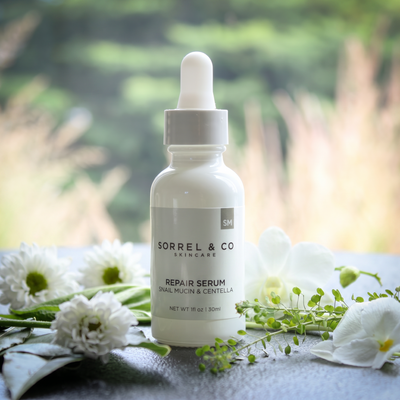
The Repair Serum uses panthenol as part of its supporting cast, alongside snail secretion filtrate, centella, and allantoin, in a barrier-recovery formula built for reactive or compromised skin. The intent is targeted repair — enough barrier support to calm skin that is stinging, flaking, or acclimating to actives. The full ingredient list and the studies behind it are linked from our Research page.
If your routine has plenty of actives but nothing quietly holding it together, pro-vitamin B5 is the unglamorous addition that makes the rest work better.
Not sure what your routine is missing? The Skin Plan maps it in about thirty seconds — no email required.
References
- Gehring W, Gloor M. Effect of topically applied dexpanthenol on epidermal barrier function and stratum corneum hydration. Arzneimittelforschung. 2000. https://pubmed.ncbi.nlm.nih.gov/10965426/
- Topical use of dexpanthenol: a 70th anniversary article. Journal of Dermatological Treatment. 2017. https://www.tandfonline.com/doi/full/10.1080/09546634.2017.1325310