

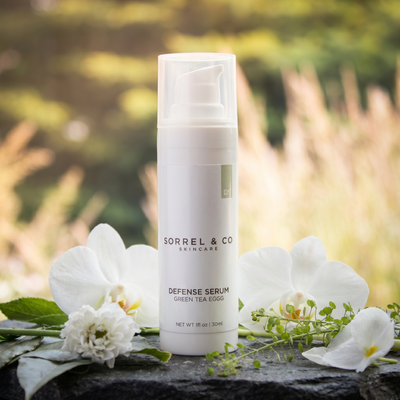
Vitamin C gets most of the attention in the topical antioxidant conversation, and it deserves a lot of it. But it is not the only antioxidant worth putting on your skin in the morning, and for one specific job — defending skin against the oxidative damage caused by air pollution — a green tea polyphenol called EGCG arguably outperforms it. Here is what EGCG is, how it works, and why it belongs in a daytime defense routine alongside, not instead of, your other antioxidants.
What EGCG is
EGCG — epigallocatechin gallate — is the most abundant and most biologically active of the catechins, a family of polyphenol antioxidants found in green tea. The extracted solids of green tea are roughly 30–40% catechins by weight, and EGCG is the largest single fraction. It is the molecule responsible for most of green tea's studied effects, whether ingested or applied.
In topical skincare, EGCG is delivered as a standardized green tea (Camellia sinensis) leaf extract or as purified EGCG. It is one of the most-researched plant polyphenols in dermatology, with a substantial literature on photoprotection, anti-inflammatory activity, and — increasingly — protection against pollution-induced skin damage.
How EGCG works, and why it is different from vitamin C
Vitamin C is primarily a direct free-radical scavenger and a cofactor in collagen synthesis. It donates electrons to neutralize reactive oxygen species, getting used up in the process. It is excellent at this, but it works mostly at the level of quenching radicals one at a time.
EGCG works at multiple levels, and this is what makes it complementary rather than redundant.
It scavenges free radicals directly, like vitamin C, neutralizing reactive oxygen species before they damage cell membranes and DNA.
It chelates transition metals. This matters enormously for pollution defense. Airborne particulate matter carries heavy metals — iron, copper — on its surface, and these metals catalyze the formation of new free radicals through Fenton-type reactions once they land on skin. EGCG binds these metals, shutting down the catalytic cycle at its source rather than just mopping up the radicals it produces.
It modulates inflammatory signaling. EGCG downregulates the NF-kB inflammatory pathway, reducing the cascade of inflammatory mediators that pollution and UV exposure trigger. This is something vitamin C does not do meaningfully, and it is a large part of why EGCG is so effective against the chronic low-grade inflammation that drives pollution-related skin aging.
It inhibits matrix metalloproteinases. MMPs are the enzymes that break down collagen and elastin in response to UV and oxidative stress. EGCG suppresses MMP activity, helping preserve the structural proteins that keep skin firm. This is a downstream protective effect that pure radical scavengers do not provide.
Why pollution defense specifically
Air pollution is one of the more under-discussed drivers of skin aging. Epidemiological studies have linked living in high-particulate environments to increased pigment spots, deeper wrinkles, and compromised barrier function. The mechanism is largely oxidative: fine particulate matter (PM2.5) lands on the skin, the metals and polycyclic aromatic hydrocarbons it carries generate reactive oxygen species, and the resulting oxidative cascade damages lipids, proteins, and DNA.
EGCG's combination of mechanisms maps almost perfectly onto this threat. It quenches the radicals, chelates the catalytic metals that generate more of them, calms the inflammatory response, and protects the collagen from the enzymes that pollution-driven oxidation activates. For the specific job of defending skin in an urban, high-pollution environment, this multi-level action is more comprehensive than direct radical scavenging alone.
The stability caveat
EGCG shares one weakness with vitamin C: it is prone to oxidation. EGCG in solution degrades with exposure to oxygen, light, heat, and alkaline pH — turning brown and losing activity as it does. A green tea serum that has gone brown has lost much of its EGCG, the same way an oxidized vitamin C serum has lost its ascorbic acid.
This means formulation and packaging matter as much as the ingredient itself. EGCG needs an acidic, low-oxygen formulation, opaque or airless packaging, and ideally stabilizing co-antioxidants. A poorly formulated EGCG product is just expensive brown water by the time you finish the bottle.
How to read a green tea serum label
Two things to check.
Standardized extract or purified EGCG. Camellia Sinensis Leaf Extract on a label tells you green tea is present but not how much active polyphenol. A product that specifies a standardized polyphenol or EGCG percentage, or lists purified EGCG, is being transparent about dose. Vague green tea extract near the bottom of the list is likely a token inclusion.
Protective packaging. Given the stability problem, EGCG in a clear jar or a clear bottle is a red flag. Opaque, airless, or tinted glass packaging signals that the brand understands the molecule it is working with.
The Sorrel approach
The Defense Serum is built around stabilized EGCG as the primary active, formulated at an acidic pH and packaged to limit oxygen and light exposure — because an antioxidant that has oxidized before it reaches your skin is worse than useless. The serum is designed as a daytime product: antioxidant defense is most valuable during the hours you are actually exposed to UV and pollution.
We position it as a complement to, not a replacement for, other antioxidants. EGCG and vitamin C work through different and overlapping mechanisms; using both gives broader coverage than either alone. The Defense Serum is the pollution-and-inflammation specialist in that pairing.
How to use it
Apply in the morning, on clean skin, before moisturizer and — critically — before sunscreen. Antioxidants and sunscreen are partners, not alternatives. Sunscreen blocks and absorbs most UV; the antioxidant mops up the reactive oxygen species generated by the fraction that gets through, plus the radicals generated by pollution that sunscreen does nothing about. Together they cover far more than either does alone.
EGCG is well tolerated and can be used daily, including on sensitive skin, where its anti-inflammatory action is often an asset rather than a liability. The benefits are protective and cumulative — you are preventing damage rather than reversing it — so consistency matters more than any single application.
For the broader picture on how topical antioxidants work, see our piece on what topical antioxidants actually do for skin, and our discussion of antioxidant synergy in the vitamin C, E, and ferulic acid stack.
Not sure whether daily antioxidant defense is the gap in your routine, or you have that covered and need something else? The Skin Plan sorts it in about thirty seconds — no email required.