

Every cell in your body that needs energy depends on a molecule called coenzyme Q10. Your skin cells are no exception, and as skin ages, its CoQ10 levels fall — part of the broader decline in cellular energy production that characterizes aging tissue. Topical CoQ10 is one of the better-studied attempts to address this directly, and it works through a mechanism that is genuinely different from the radical-scavenging antioxidants that dominate the skincare aisle. Here is what CoQ10 is, what it does for aging skin, and what the evidence actually supports.
What CoQ10 actually is
Coenzyme Q10 — also called ubiquinone, because it is ubiquitous in living tissue — is a fat-soluble molecule found in the membranes of mitochondria, the energy-producing structures inside every cell. It has two jobs, and both matter for skin.
First, it is an essential component of the electron transport chain, the series of reactions inside mitochondria that produces ATP, the energy currency of the cell. Without adequate CoQ10, mitochondria produce less energy, and energy-intensive cellular processes — including the synthesis of collagen and the repair of damaged tissue — slow down.
Second, CoQ10 is itself a potent fat-soluble antioxidant. Because it lives in cell membranes, it protects the fatty components of cells from oxidative damage in a way that water-soluble antioxidants like vitamin C cannot reach. It also has the unusual property of being regenerable — the body can recycle oxidized CoQ10 back to its active form, so it is not simply used up the way some antioxidants are.
Why aging skin runs low on it
CoQ10 levels in skin decline measurably with age. Studies analyzing skin biopsies have found that epidermal CoQ10 content drops substantially from young adulthood into middle age and beyond. UV exposure accelerates this depletion — ultraviolet radiation generates oxidative stress that consumes CoQ10 faster than aging skin can replace it.
The consequence is a kind of cellular energy crisis. Aging fibroblasts — the cells responsible for producing collagen and the rest of the dermal matrix — have measurably impaired mitochondrial function. They produce less energy, and with less energy available, their capacity to synthesize and maintain collagen declines. This mitochondrial-decline model is one of the leading frameworks for understanding intrinsic skin aging, distinct from the more familiar photoaging-and-collagen-breakdown story.
What topical CoQ10 does
Topically applied CoQ10 has been shown to penetrate the viable layers of the epidermis and reach the cells that need it. Once there, the research supports a few effects.
It reduces oxidative damage. As a membrane-resident antioxidant, topical CoQ10 measurably reduces markers of UV-induced oxidative stress in skin, protecting cellular structures from the free radicals generated by sun exposure and pollution.
It supports collagen-relevant cellular function. Several controlled studies, including well-known work by Hoppe and colleagues, found that topical CoQ10 applied over several months reduced the depth of wrinkles, particularly around the eyes, and improved measures of skin smoothness. The proposed mechanism is a combination of antioxidant protection and support for the cellular energy that fibroblasts need to maintain the dermal matrix.
It suppresses collagen-degrading enzymes. CoQ10 has been shown to reduce the expression of matrix metalloproteinases — the UV-activated enzymes that break down collagen — adding a protective effect on top of its antioxidant and energy roles.
Ubiquinone versus ubiquinol
One label-literacy point worth understanding. CoQ10 exists in two forms: ubiquinone, the oxidized form, and ubiquinol, the reduced form. Ubiquinol is the more directly active antioxidant form, but it is also less stable and harder to formulate, since it readily oxidizes back to ubiquinone on exposure to air.
Most topical products use ubiquinone, which is more stable and which skin cells can convert to ubiquinol as needed. This is a reasonable formulation choice — the more stable form that survives the bottle is more useful than the more active form that has oxidized before you apply it. Either form on a label is legitimate; the more important questions are concentration and packaging.
How to read a CoQ10 product label
Two things to check.
Position on the ingredient list. CoQ10 (listed as Ubiquinone or sometimes Coenzyme Q10) used at a meaningful concentration sits in the middle of an ingredient list. The studied topical concentrations are on the order of 0.5 to 1%. Listed dead last, it is likely a fairy-dusting for the marketing claim.
Protective packaging. CoQ10 is fat-soluble and reasonably stable, but it still degrades with prolonged light and air exposure. Opaque or airless packaging is a good sign that the rest of the formula was taken seriously.
Why pair CoQ10 with DMAE
CoQ10 and DMAE address aging skin from complementary directions. CoQ10 works at the cellular-energy and antioxidant level — protecting and supporting the machinery that maintains the dermal matrix over the long term. DMAE provides a more immediate firming and tightening effect at the skin surface. One is a long-game cellular-support ingredient; the other contributes nearer-term visible firmness. Together they give a firming cream both an immediate and a cumulative dimension.
The Sorrel approach
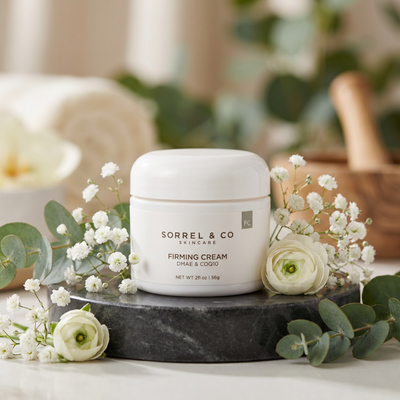
The Firming Cream pairs CoQ10 with DMAE on exactly this logic: address the visible firmness now, support the cellular function that maintains skin structure over time. The CoQ10 is included at a concentration consistent with the studied range and in a formulation designed to keep it stable through the life of the jar.
We are clear-eyed about what this does. Topical CoQ10 is a supportive, protective, slow-acting ingredient — not a retinoid-grade remodeler. Its value is in the long game of protecting cellular energy and reducing oxidative wear, which is real, measurable, and worth doing, but not overnight.
How to use it
CoQ10 can be used morning or night. In the morning, its antioxidant action complements sunscreen by mopping up the oxidative stress that UV and pollution generate. At night, it supports the cellular repair processes that peak during sleep. Many people use it in the evening as part of a firming-and-repair step, after lighter serums and before any heavier occlusive.
As with every protective antioxidant, the benefit is cumulative and prevention-oriented. The wrinkle-depth improvements in the clinical studies emerged over months of consistent use, not days. Consistency is the mechanism.
For more on the other active in this cream, see our piece on DMAE and what the research actually shows, and for the broader antioxidant picture, what topical antioxidants actually do for skin.
Not sure whether firming belongs in your routine yet, or whether a foundation step should come first? The Skin Plan maps your routine in about thirty seconds — no email required.