

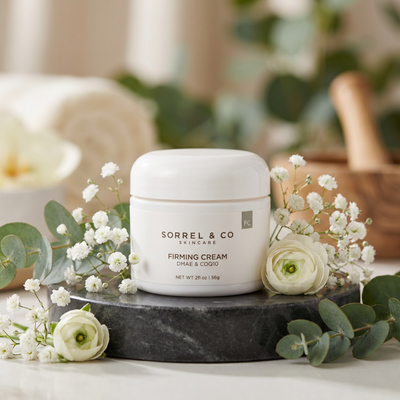
DMAE is one of the most divisive ingredients in skincare. Its defenders treat it as a near-instant firming agent. Its skeptics dismiss it as a marketing molecule with one citable study behind it. Both camps are partially right, which is what makes it interesting.
The honest version of the DMAE story is more nuanced than either side typically admits. There is real evidence behind a real effect. The effect is smaller and slower than enthusiastic marketing suggests. The mechanism is incompletely understood. And DMAE works best not as a standalone hero but as one piece of a firming-targeted stack alongside peptides and CoQ10. Here is what the research actually shows and how to think about DMAE in a serious anti-aging routine.
What DMAE actually is
Dimethylaminoethanol — DMAE — is a small organic molecule. Chemically it is closely related to choline, the precursor to acetylcholine, which is the neurotransmitter that signals muscles to contract. The proposed mechanism for DMAE's firming effect is that topical application increases local acetylcholine availability, which in turn produces a subtle tonic contraction of the small muscles beneath facial skin.
That mechanism is plausible. It is not proven. Multiple researchers have tried to demonstrate the acetylcholine pathway in skin and the results are mixed. Some studies show measurable changes in muscle tone after topical DMAE. Others show structural changes in the dermis itself that have nothing to do with muscle signaling. The most candid summary is that DMAE produces a visible effect through a mechanism we have not fully characterized.
The Grossman 2005 study
If you look up DMAE research you will find one paper cited over and over: Grossman R, “The role of dimethylaminoethanol in cosmetic dermatology,” American Journal of Clinical Dermatology, 2005. This is a review article rather than an original trial, but it summarizes the controlled clinical evidence available at the time and remains the most-referenced citation for DMAE in cosmetic chemistry.
What it actually shows: in a controlled trial referenced within the review, a 3% DMAE gel applied daily over 16 weeks produced measurable improvement in forehead lines, peri-orbital wrinkles, and the appearance of skin firmness compared to vehicle control. The effect was statistically significant. The effect was also modest — visible at 16 weeks, partially regressive when the product was discontinued.
What it does not show: a clear mechanism. The Grossman review acknowledges that the underlying biology behind the visible effect is incompletely understood. It does not show that DMAE is more effective than retinol, peptides, or other better-characterized actives. It does not show that DMAE works for everyone — some participants in the underlying studies showed no measurable effect.
The honest interpretation: DMAE has more evidence behind it than most botanical extracts and less than tier-one actives like retinol or vitamin C. It is a real ingredient with a real but modest effect, and the mechanism question is genuinely open.
Why DMAE works better in a stack
If you treat DMAE as a standalone firming hero, you will likely be disappointed. The 16-week timeline is long. The effect is subtle. The mechanism question creates legitimate doubt about who responds and who does not. A 3% DMAE serum used by itself often underperforms expectations.
What DMAE does well is fill a specific gap in a broader anti-aging stack — the firming gap. Most anti-aging actives target different problems:
- Retinol drives cellular turnover and collagen synthesis. We covered the mechanism in our piece on why most retinol serums cause peeling.
- Vitamin C protects collagen from oxidative degradation and supports synthesis as a cofactor.
- Peptides signal fibroblasts to upregulate extracellular matrix production.
- Hyaluronic acid hydrates and visually plumps.
None of those address the subtle loss of dermal and muscular tone that contributes to the appearance of jawline softening, eyelid laxity, and the slow downward shift of facial structure with age. DMAE specifically addresses that tone question — modestly, slowly, but in a way the other actives do not. In a stack alongside retinol or peptides, DMAE adds a layer the other actives are not contributing.
The CoQ10 pairing
CoQ10 — coenzyme Q10, ubiquinone — is the second ingredient worth understanding alongside DMAE. CoQ10 is essential for mitochondrial ATP production, which is the cellular energy currency. As skin ages, mitochondrial CoQ10 levels decline, ATP production falls, and energy-intensive cellular maintenance processes (including collagen synthesis) slow down.
Topical CoQ10 has been shown in controlled studies to partially restore mitochondrial function in skin cells. The effect is not dramatic in any single study, but the metabolic argument is strong: cells with adequate ATP perform better than cells without it.
The pairing logic with DMAE is straightforward. DMAE addresses the visible tone question. CoQ10 addresses the cellular energy question that determines how well skin can maintain its own structure over time. Neither replaces retinol or peptides. Both add layers that retinol and peptides do not provide.
What to look for on a label
If you decide DMAE is worth trying, here is what separates a meaningful formulation from a marketing exercise.
Concentration disclosed. DMAE works in the 1–3% range in published studies. Below 1%, the effects are inconsistent. A product that lists DMAE near the bottom of its ingredient list almost certainly contains it well below this range. Brands that have invested in clinical-dose DMAE typically disclose the percentage.
Supporting actives present. A serious DMAE product pairs the active with at least one of: peptides (for signaling), CoQ10 (for mitochondrial function), or antioxidants (to support the tissues DMAE is acting on). DMAE alone is incomplete.
pH appropriate. DMAE is a base. Formulations should be neutralized to a skin-compatible pH (typically 5.5–6.5). High-pH formulations can be irritating; low-pH formulations destabilize the active.
Realistic claims. Brands claiming “instant lift” or “eight-hour firming” from DMAE are misrepresenting what the science actually shows. The visible effect is gradual — measurable at 8 weeks, more pronounced at 16. Skepticism toward overpromised effects is appropriate.
The Sorrel approach
The Firming Cream uses DMAE at 2% — in the middle of the published effective range — paired with CoQ10 and a complement of signal peptides. The formulation reflects the honest interpretation of the literature: DMAE is real but modest, peptides add a signaling layer the DMAE molecule itself cannot provide, and CoQ10 addresses the metabolic foundation both are operating on.
We do not market the product as an instant-lift cream. The effect builds over 12–16 weeks of consistent use. The before/after photos that matter are taken at week 16, not week 1. The full ingredient list and the studies behind each active are linked from our Research page.
An honest take on whether DMAE is for you
DMAE makes sense for people who:
- Already have a barrier-stable routine with retinol, vitamin C, or both
- Are specifically interested in firmness/tone in addition to texture and tone-evenness
- Are willing to commit to 12–16 weeks of consistent use before evaluating results
- Are comfortable with the mechanism uncertainty in exchange for the modest documented effect
DMAE probably does not make sense for people who:
- Have not yet established a foundation routine (retinol, antioxidant, SPF)
- Want fast visible changes
- Are uncomfortable with the open mechanism questions
The position is not that DMAE is essential. The position is that within the firming category specifically, DMAE has more evidence behind it than most ingredients sold for the same purpose — and that paired with CoQ10 and peptides in a thoughtful formulation, it earns a place in a serious anti-aging stack.
If you have wondered whether DMAE is real or hype, the honest answer is: a little of both, and the formulation determines which.
Not sure whether firming belongs in your routine yet, or whether a foundation step should come first? The Skin Plan sorts it in about thirty seconds — no email required.