If you have spent any time in the skincare aisle in the last three years, you have heard about ceramides. Ceramides have become the celebrity lipid of barrier care — featured on labels, foregrounded on marketing pages, treated as the single answer to dry or compromised skin. There is good science behind the attention. There is also a problem with stopping there.
Ceramides make up roughly 40-50% of the lipids in your stratum corneum. They are the most abundant component of the barrier and the most-talked-about. What gets less attention, in formulation and in marketing alike, is cholesterol — which sits at about 25% of barrier lipids and is just as functionally essential. A cream that delivers ceramides without thinking about cholesterol is like building a brick wall and forgetting half the mortar.
What the stratum corneum is actually made of
Your outermost layer of skin is built like a brick wall — corneocytes are the bricks, and a precisely organized lipid mixture is the mortar. The mortar holds water in, keeps irritants out, and is the difference between skin that feels comfortable and skin that does not.
The lipid mortar is not interchangeable. It is composed of three classes of molecules in a roughly fixed ratio, established by decades of dermatological research:
Ceramides: 40-50% of the lipid mass. These are sphingolipid molecules — a sphingoid base linked to a fatty acid — and there are at least 12 distinct ceramide subtypes in human skin, each with slightly different physical properties.
Cholesterol: roughly 25% of lipid mass. A familiar molecule from cardiology, less so from skincare. Cholesterol is the only sterol in the stratum corneum and serves as a fluidity regulator and lamellar organizer for the entire lipid bilayer system.
Free fatty acids: roughly 25% of lipid mass. Mostly long-chain saturated fatty acids — palmitic, stearic, lignoceric — derived from sebum and from the processing of phospholipid precursors as keratinocytes mature.
The 3:1:1 ratio matters. Multiple studies, going back to the seminal Mao-Qiang and Elias work in the 1990s, have shown that topical application of ceramides alone — or any of the three lipid classes alone — produces a slower and less complete barrier recovery than application of the three together at the physiological ratio. Single-lipid replacement can actually delay barrier recovery compared to no treatment at all, because the abnormal ratio disrupts the lamellar phase structure of the lipid bilayer.
Why cholesterol gets ignored
Three reasons, none of them about science.
First, cholesterol does not have a great consumer story. The word still carries baggage from decades of cardiovascular warnings, and skincare brands tend to avoid ingredients that require explaining-against-prior-belief. Ceramides have no such problem.
Second, cholesterol is invisible on a marketing claim. You cannot meaningfully advertise with cholesterol the way you can advertise with ceramides, because consumers do not know to look for it. The lipid that gets the marketing dollars is the lipid that ends up on the label.
Third, cholesterol is more expensive and harder to formulate than people realize. Pharmaceutical-grade cholesterol, in a stable cream emulsion, is not a cheap raw material. Many brands choose to spend the formulation budget elsewhere.
What happens with cholesterol-deficient skin
Cholesterol synthesis in the epidermis declines measurably with age. Studies of skin from people in their 50s and 60s show approximately 30% lower cholesterol synthesis compared to younger adults — and this decline is one of the leading proposed mechanisms for the dryness, fragility, and slow barrier recovery characteristic of mature skin.
This is not just an age effect. Cholesterol synthesis is also depressed by chronic UV exposure, by certain prescription medications including some statins, and by acute barrier disruption from soap, surfactants, or aggressive acid use. The skin that needs cholesterol most is often the skin making the least of it.
When cholesterol is depleted, the lamellar structure of the lipid bilayer collapses. Ceramides can be present in normal amounts, but without cholesterol to organize the bilayer geometry, they do not form the orderly stacked sheets that make the barrier water-resistant. Transepidermal water loss rises. Topical irritants penetrate more easily. The barrier feels permanently dry and reactive even when the products being applied are theoretically supportive.
What retinol does to the lipid picture
Here is where the conversation gets interesting. Topical retinoids have a complicated relationship with the barrier. In the short term — the first two to four weeks of use — they reliably disrupt it, by increasing keratinocyte turnover faster than lipid synthesis can keep up. This is the well-known retinization phase.
In the longer term — beyond approximately eight weeks of consistent use — retinoids increase epidermal lipid synthesis, including ceramide, free fatty acid, and cholesterol production. Multiple controlled studies have measured this directly: in skin treated for 12 weeks with low-concentration retinol, lipid content increased by 20-40% across all three lipid classes. The retinized barrier is, by then, thicker and more resilient than the untreated control.
The problem is the gap between weeks two and eight. During that window, the skin is producing keratinocytes faster than it can produce lipids, and the lamellar matrix is disordered. This is where most people quit retinol. Either they cannot tolerate the irritation, or they assume the irritation means the product is wrong for them.
A retinol cream that pairs the active with lipid material the barrier can use during that gap is doing something different from a retinol serum alone. The lipids cushion the transition. The barrier gets a head start on its own lipid synthesis. The retinization window narrows.
How to read a ceramide cream label
Ceramides on a label can mean almost anything from a token amount to a clinically relevant concentration. Three things to look for.
Multiple ceramide subtypes. Ceramide NP, AP, EOP, EOS, NS — the names refer to different sphingoid bases. A formula with several is usually closer to the physiological ratio than a formula with only one. Ceramide 3 alone, by itself, on an INCI list near the bottom — that is a marketing claim, not a clinical dose.
Cholesterol on the ingredient list. If you do not see cholesterol — sometimes listed as Cholesterol, sometimes as Lanosterol — the cream is not delivering the lipid trio. This is the simplest, most under-used label-literacy move in barrier care.
Position on the ingredient list. Ceramides and cholesterol used at clinically meaningful concentrations sit in the middle third of an ingredient list. Bottom third — last few ingredients before fragrance, preservatives, and pH-adjusters — almost always means below the threshold of measurable effect.
Where our own label lands
The uncomfortable part of publishing a label test is that you have to run it on yourself. So here is our own cream against the three checks above, and it does not come back clean.
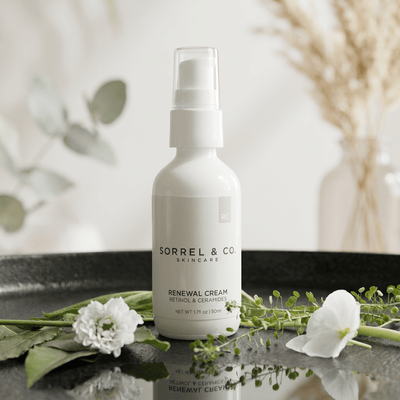
The Renewal Cream pairs retinol with phospholipids — the encapsulation approach that releases it gradually rather than delivering it all at once — and carries Ceramide NP in the middle of the list, alongside shea butter, meadowfoam seed oil, milk lipids, and d-alpha-tocopherol. It is a genuinely lipid-rich cream, and the occlusive and emollient half of the barrier story is well covered.
What it does not contain is cholesterol. And it carries one ceramide subtype, not several. By the test in the section above, it is a ceramide cream, not a lipid-trio cream — it passes the position check and fails the other two.
We chose this formula for the logic that opens this article: retinol paired with lipid material to cushion the retinization window. That is a real premise and the ingredient list supports it. It is not the same premise as physiological ratio replacement, and we would rather say so plainly than let our own article imply a claim the label does not carry. Two other things worth knowing before you reach for it: the formula contains fragrance, and it contains milk-derived lipids.
If cholesterol-and-free-fatty-acid ratio replacement is specifically what your barrier needs, ours is not the one — and the checks above are how to find one that is. The full ingredient list sits on the product page, which is where this kind of question should always start.
How to use it
Apply at night, on cleansed skin, after any water-based serums and before any heavier face oil. The lipid components of the cream are most useful when they have direct contact with the stratum corneum, not when they are layered under or over occlusive products that prevent absorption.
For most people, three to four nights a week is the right starting cadence — enough to support the transition without crowding out the rest of the evening routine. Increase frequency as tolerance builds. The first eight weeks are when the barrier is rebuilding; the second eight weeks are when the work shows.
For more on the science of ceramides themselves, see our piece on ceramides as the building blocks of the skin barrier. The cholesterol story, like the ceramide story, is one of those skincare topics where the science has been settled for thirty years and the marketing has not yet caught up.
Not sure whether barrier support is your priority, or whether another concern comes first? The Skin Plan maps your routine in about thirty seconds — no email required.