

Centella asiatica is one of the rare ingredients in cosmetic chemistry with both centuries of traditional medicinal use and a substantial body of modern controlled-trial research supporting that traditional use. Most botanical ingredients have one or the other. Centella has both, which is part of why it has moved from obscure traditional remedy to a near-standard component in barrier-repair and post-procedure formulations.
The K-beauty world helped reintroduce centella to Western skincare in the form of cica creams — the “cica” being shorthand for centella's tendency to cicatrize (form scar tissue and heal wounds). But the actual mechanism is more interesting than the marketing, and the right way to use it depends on understanding what the plant's active compounds do at the cellular level. Here is the long story.
The traditional history
Centella asiatica grows wild across India, Southeast Asia, parts of Africa, and the wetlands of the southeastern United States. It has been used medicinally in Ayurvedic, traditional Chinese, and Indonesian traditional medicine for at least 2,000 years — sometimes called brahmi in Sanskrit (where it is associated with cognition and memory), gotu kola in Sri Lanka and southern India (where it has been used for skin conditions and wound healing), and pegaga in Malay traditions.
The traditional uses included topical application to wounds, burns, and skin lesions; oral consumption for what we would now call inflammatory and cognitive complaints; and dermatological applications for what we would now categorize as eczema, psoriasis-adjacent conditions, and slow-healing wounds. The traditional indications consistently overlap with what modern research has subsequently confirmed at the mechanistic level.
This is not always how it works with traditional medicine. Many traditional ingredients turn out, on rigorous investigation, to have minimal active compound concentrations or to work through placebo or general anti-inflammatory effects rather than specific mechanisms. Centella is one of the cases where the traditional reputation tracks the actual chemistry remarkably well.
The active compounds
Centella's wound-healing and barrier-supportive effects come from a family of triterpenoid saponins, primarily four compounds:
Asiaticoside. The most-studied. Stimulates collagen synthesis, particularly Type I collagen. Accelerates wound contraction and re-epithelialization in controlled studies.
Asiatic acid. The aglycone (non-sugar component) of asiaticoside. Anti-inflammatory through cyclooxygenase pathway modulation. Antimicrobial against several skin-relevant species.
Madecassoside. Anti-inflammatory and antioxidant. Reduces several inflammatory cytokines and has direct free-radical scavenging activity.
Madecassic acid. The aglycone of madecassoside. Anti-inflammatory and supports vascular integrity in dermal tissues.
A high-quality centella extract used in cosmetics is standardized to a defined ratio of these four compounds — often called TECA (titrated extract of centella asiatica) or sometimes Madecassol when at pharmaceutical grade. The ratio and total triterpene content determine the formulation's actual potency. A “centella asiatica extract” with unspecified composition can vary substantially in activity.
The modern research
Centella's modern research program began in the mid-20th century with pharmaceutical work on TECA as a wound-healing agent, particularly for slow-healing chronic wounds. By the 1960s and 1970s, centella-derived preparations were prescription items in some European pharmacopoeias for venous insufficiency, slow-healing surgical wounds, and certain dermatological conditions.
The cosmetic chemistry research has accelerated in the past two decades. Key findings:
- Collagen synthesis. Multiple in vitro and in vivo studies have shown that asiaticoside and asiatic acid upregulate collagen synthesis in dermal fibroblasts at concentrations achievable through topical application. The effect size is moderate but consistent.
- Wound healing. Controlled trials in both surgical wound healing and minor skin lesions have shown faster re-epithelialization and reduced scarring with centella-containing topicals compared to vehicle controls.
- Anti-inflammatory activity. Madecassoside reduces TNF-alpha, IL-1, and IL-6 expression in skin under inflammatory stress. The effects overlap with niacinamide's anti-inflammatory mechanism through a different pathway, making the two ingredients useful in combination.
- Antioxidant activity. Both madecassoside and asiaticoside have direct free-radical scavenging activity, adding an antioxidant layer beyond the wound-healing mechanism.
The summary: centella is not a miracle ingredient. The effects on wound healing, inflammation, and collagen synthesis are real but moderate. What makes centella useful in cosmetic chemistry is the breadth of activity — anti-inflammatory plus pro-collagen plus antioxidant plus barrier-supportive — in a single, well-tolerated ingredient.
Where centella fits in a routine
Centella's most useful applications:
Barrier compromise recovery. Anyone whose barrier has been damaged — from over-exfoliation, retinol acclimation gone wrong, post-procedure recovery, environmental damage — benefits from centella as part of the recovery protocol. The anti-inflammatory activity reduces the irritation cycle, while the pro-collagen activity supports structural repair. We covered the recovery framework in our piece on retinol mistakes that compromise your barrier.
Post-procedure care. After microneedling, chemical peels, or laser, centella accelerates the comfort phase of recovery without interfering with the procedure outcome. Often paired with snail mucin (which we covered in our piece on the science behind the K-beauty trend) in K-beauty-influenced post-procedure protocols.
Reactive and sensitive skin baseline. For people with persistent low-grade reactivity who do not have a specific dermatologic diagnosis, centella in a daily product provides anti-inflammatory support without the irritation profile of stronger interventions.
Adjunctive for early aging. The pro-collagen effect is modest but real. Centella does not replace retinol or peptides, but adds a parallel signal for collagen synthesis through a different mechanism.
What to look for on a label
The ingredient form. “Centella asiatica extract” alone tells you little about the composition. “Centella asiatica leaf extract,” “asiaticoside,” “madecassoside,” “asiatic acid,” or “TECA” are more informative. The most rigorous formulations specify the percentage of total triterpene content (often called “total madecassoside complex” in K-beauty products).
Position on the ingredient list. Centella works at moderate concentrations — typically 0.5–2% of total extract by weight in the finished formula. Position 5–10 in the ingredient list is generally meaningful. Position 20+ is usually too low to produce the studied effects.
Supporting cast. Centella appears in serious formulations alongside other repair-supportive ingredients: panthenol, allantoin, niacinamide, snail mucin, ceramides. The stack tells you the formulator is thinking about barrier repair as a whole rather than treating centella as a marketing word.
Source documentation. Some brands publish the source and specifications of their centella extract. This is more common in K-beauty than Western beauty. When available, it is a useful signal of formulation quality.
The Sorrel approach
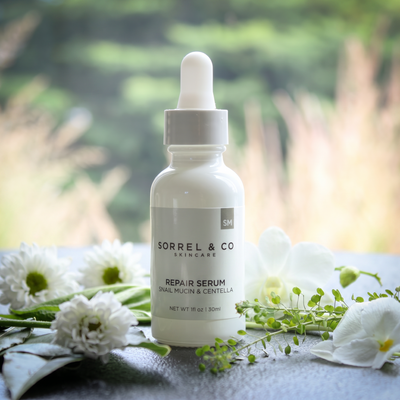
The Repair Serum pairs centella asiatica extract (standardized for total triterpene content) with snail mucin filtrate, which we covered in detail in our K-beauty piece. The two ingredients address different aspects of barrier repair through complementary mechanisms: centella drives the anti-inflammatory and pro-collagen pathways, while snail mucin contributes its glycoprotein complex to surface barrier support and hydration.
The formulation also includes panthenol (vitamin B5) for additional barrier-supportive activity and hyaluronic acid for hydration. The intent is a serum specifically built for the barrier-recovery use case — not a general-purpose moisturizer, not an anti-aging treatment, but the tool for the times when the barrier itself is the problem.
The full ingredient list and the studies behind the formulation are linked from our Research page.
How to use centella products
During barrier compromise. Twice daily, AM and PM, applied to clean skin before moisturizer. Skip other actives entirely until the barrier has recovered — no retinol, no acid exfoliants, no high-concentration vitamin C. The job is repair, not stacking.
For daily use in reactive skin. Once daily, typically PM, paired with the rest of a gentle routine. Centella works well alongside niacinamide and snail mucin, which is the standard K-beauty pairing.
Post-procedure. Begin centella as soon as the immediate post-procedure window allows (usually 24–48 hours after, depending on the procedure). Continue twice daily for at least two weeks, then taper to daily.
What to evaluate. Barrier-repair improvements show up first as reduced reactivity — products that used to sting do not sting, environments that used to trigger flushing trigger less. Visible erythema reduction follows over 4–8 weeks. Pro-collagen effects are slower and modest — not the reason to choose centella, but a quiet bonus.
If you are recovering from a barrier compromise or simply have skin that reacts more often than seems reasonable, centella is one of the most evidence-supported tools available for the problem. The traditional reputation is in this case backed by the modern research.
Not sure whether barrier repair is your priority right now, or whether another concern comes first? The Skin Plan maps your routine in about thirty seconds — no email required.