

The ingredient that sounds like marketing — and isn't
Snail secretion filtrate, more familiarly snail mucin, is the ingredient that has done the most to break Western skincare orthodoxy in the last decade. It sounds like it should be a gimmick. The bottle says 'snails.' The label says it's a secretion. The instinct is to dismiss it.
That instinct is wrong.
Snail mucin is one of the better-studied non-pharmaceutical wound-healing ingredients in modern dermatology. The mechanism is specific. The trial data is real, though most of it comes out of South Korea, Argentina, and Spain. And the molecule does, in fact, do what the K-beauty marketing claims it does.
What's actually in snail mucin
Cryptomphalus aspersa (the common garden snail) and Helix aspersa Müller (a closely related variant) produce a glycoprotein-rich mucin under stress — when threatened, when desiccating, when injured. The secretion is part of the snail's own wound-repair and barrier-maintenance system. Filtered and processed, the resulting 'snail secretion filtrate' (SSF) contains a layered mix of compounds:
Glycoproteins. The structural backbone of the mucin. They bind water and form a gel-like matrix on skin that holds moisture and creates a protective film.
Hyaluronic acid. Naturally occurring in the secretion. The snail-derived HA is fragmented enough to penetrate, similar to a low-MW HA. We covered the molecular weight question separately in Hyaluronic Acid: Why Molecular Weight Matters.
Glycolic acid. Low concentrations of glycolic acid contribute mild keratolytic activity — gentle surface exfoliation that doesn't require a separate AHA step.
Allantoin. A soothing, keratinocyte-proliferation-promoting compound that shows up in nearly every serious barrier-repair formulation worth considering.
Antimicrobial peptides. Several short-chain peptides with documented antibacterial activity against common skin flora.
Copper peptides and zinc compounds. Trace minerals that participate in collagen synthesis and tissue repair pathways.
The combination is doing several things at once. That is the unusual feature of snail mucin. It is not a single-active ingredient that targets one pathway. It is a multi-component system that the snail itself uses to repair its own tissue and seal its own moisture.
The wound-healing evidence
The strongest data on snail mucin comes from wound-healing studies rather than cosmetic ones.
A 2008 study by Tribó-Boixareu et al., published in the Journal of Drugs in Dermatology, tested a Cryptomphalus aspersa secretion on post-laser facial skin. The treated side showed faster re-epithelialization and reduced erythema duration compared to the control side. The sample size was small but the design was a split-face control, which limits confounding.
A 2013 trial by Brieva et al. studied SSF for radiation dermatitis in cancer patients. Patients applying SSF twice daily showed significantly less Grade 2 dermatitis than the control arm. This is not a cosmetic claim — it is a clinical outcome in a vulnerable patient population, and it's a reasonably hard endpoint.
A 2017 Argentinian trial (Fabi et al.) studied SSF for photoaging. After 12 weeks of twice-daily application, treated patients showed measurable improvement in fine lines, skin tone, and elasticity versus baseline, with statistical significance on multiple endpoints.
None of these are blockbuster Phase 3 pharmaceutical studies. They are small, sometimes industry-adjacent, often single-center. But the consistency across independent groups, in different patient populations, with different endpoints, is the kind of converging evidence that distinguishes a real effect from a marketing artifact.
What it's good for, what it's not
Snail mucin reliably does three things in skin:
Barrier repair. The glycoprotein matrix, allantoin, and supporting compounds work together to support stratum corneum integrity. For a compromised barrier — over-exfoliation, retinol overuse, post-procedure, environmental insult — it is one of the better daily-use repair ingredients available.
Hydration that doesn't pull from the dermis. Unlike pure HA at the surface, the snail mucin glycoprotein matrix holds water within a structural gel that behaves more forgivingly in low-humidity environments. We covered the dry-air problem with pure humectants in The Hydration Mistake: Why Your HA Serum Might Be Drying You Out. Snail mucin doesn't fully solve that problem, but it's less vulnerable to it.
Mild keratolytic resurfacing. The trace glycolic acid is gentle enough for daily use but consistent enough, over weeks, to contribute to smoother texture.
What it is not:
A retinol replacement. Snail mucin doesn't upregulate collagen synthesis the way retinoids do. It supports existing structure; it doesn't drive cellular turnover.
An active acne treatment. The antimicrobial peptides are real but mild. For active inflammatory acne, salicylic acid or benzoyl peroxide is the mechanism-appropriate tool. Snail mucin is supportive, not primary.
A brightening agent. Mild glycolic activity over time can contribute to evenness, but it's not a tyrosinase inhibitor. The brightening pathways have their own piece coming later in this series.
The cruelty-free question
The harvest method matters. Two approaches dominate the supply chain:
Stress-based harvesting. Snails are agitated — with heat, salt, or mechanical stress — to produce mucin under duress. This is the older method, and it is the one that produces the welfare concerns critics cite. Mucin volume is high but the snails are stressed.
Ambient harvesting. Snails are placed on mesh in a controlled, low-stress environment and produce mucin passively as they move. Volumes are lower; welfare outcomes are better. Suppliers using this method typically certify the practice and disclose the farm.
Reputable formulators source from ambient-harvest farms and disclose the harvesting method. If a brand can't tell you how the mucin is harvested, that gap is worth weighing.
Centella asiatica: the natural pairing
Snail mucin almost always shows up alongside centella asiatica — commonly called 'cica' — in modern formulations. The reason is mechanistic: centella's madecassoside and asiaticoside compounds upregulate collagen synthesis and modulate inflammation through pathways distinct from the snail glycoprotein matrix. The two ingredients address different parts of the barrier-repair problem.
The trial data on centella for wound healing actually predates the snail mucin literature by decades. It has been studied in clinical contexts since the 1960s, with applications ranging from burn treatment to scar reduction. The two ingredients together are more than the sum of their parts, in a way that mirrors the vitamin C + E + ferulic stack: complementary mechanisms layered into a single formulation.
Reading the label
What to check on a snail mucin product:
Concentration of snail secretion filtrate. Some products name the percentage in the product title. Look for products in the 40–96% range. Below 20%, the inclusion is more marketing than function.
Ingredient list position. Snail secretion filtrate should appear in the top three ingredients. If it's at the bottom of the list near the preservatives, it's a token inclusion.
Pairing with centella or allantoin. Snail mucin alone works. Paired with centella, it works better. Solo formulations are fine; pair formulations are typically more complete and more clinically grounded.
Source and harvest disclosure. The better brands disclose where the snails are farmed and how the mucin is harvested. The absence of disclosure isn't an automatic red flag, but disclosure is a positive signal.
A clean carrier. Look for unfragranced formulations without irritant essential oils. Snail mucin is being chosen for barrier-compromised skin; the carrier should respect that.
What Sorrel does
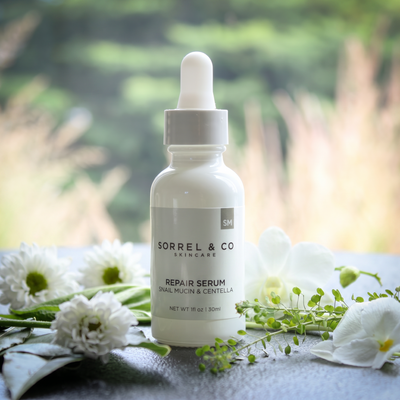
Our Repair Serum pairs snail secretion filtrate at a meaningful concentration with centella asiatica extract standardized for madecassoside and asiaticoside content. Allantoin and panthenol round out the formula. No fragrance, no essential oils, no irritant carriers.
The serum is positioned as a daily baseline for reactive skin and as a targeted recovery treatment after exfoliation, sun exposure, or active disruptions like retinol acclimation. We covered the retinol acclimation timeline in When to Start Retinol: A 12-Week Beginner's Guide. Repair Serum is built to be the layer that sits on top of an irritated barrier without making it angrier.
Practical use
Two main protocols:
As a daily PM baseline. After cleansing and any leave-on hydration step, apply 3–4 drops of Repair Serum to face and neck. Let it absorb 30 seconds, then layer the rest of the routine over it.
As a recovery treatment. After a stronger active session — a chemical exfoliation, a retinol night, a long sun day, a microneedling appointment — skip the actives entirely, layer Repair Serum twice (once on damp skin, once 60 seconds later), and follow with a barrier-rich cream. Three nights of this protocol after most disruptions is enough to restore baseline.
Expected timeline:
Weeks 1–2. Visible reduction in redness and reactivity. Less stinging when other products go on.
Weeks 4–6. Sustained barrier improvement. The skin tolerates actives better; flare-ups recover faster.
Weeks 8–12. Subtle textural changes from the glycolic activity. Pore appearance refines slightly. Tone evens.
The honest summary
Snail mucin is not magic, but it is one of the better-documented barrier-repair ingredients in non-pharmaceutical skincare. The trial base is small but consistent. The mechanism is clear. The cosmetic effects align with what the wound-healing studies predict.
If your skin is reactive, post-procedure, or in the early weeks of retinol acclimation, snail mucin is a reasonable thing to layer in. If your skin is performing well and you are looking for a single dramatic active, look elsewhere — snail mucin is a supporting player, not a lead.
Not sure whether barrier repair is your priority right now, or whether another concern comes first? The Skin Plan maps your routine in about thirty seconds — no email required.