Activated charcoal is one of those skincare ingredients that arrived with enormous marketing momentum and a story that does not quite survive contact with the chemistry. It is in cleansers, masks, scrubs, even toothpaste, almost always accompanied by language about drawing out toxins and impurities and detoxifying the skin. Most of that language is wrong, or at least badly overstated. But charcoal is not useless in a cleanser — it just does something narrower and less dramatic than the marketing claims. Here is what activated charcoal actually does, what it cannot do, and why a wash-off cleanser is the only format where it makes any sense at all.
What activated charcoal actually is
Activated charcoal is carbon — usually from coconut shells, wood, or peat — that has been processed at high temperature with a gas or chemical that riddles it with microscopic pores. This activation step massively increases its surface area. A single gram of activated charcoal can have a surface area of 500 to 1,500 square meters, the result of an enormous internal network of tiny pores.
That surface area is the entire point. Activated charcoal works by adsorption — with a d, not absorption with a b. Adsorption is the process by which molecules stick to a surface through weak intermolecular forces. The more surface area, the more molecules can stick. This is genuinely useful chemistry: it is why activated charcoal is used in water filtration, in gas masks, and in emergency medicine to bind certain ingested poisons in the gut.
The gut-versus-skin problem
Here is where the skincare story breaks down. The evidence for activated charcoal binding things is overwhelmingly from contexts — water filters, the digestive tract — where charcoal sits in prolonged, intimate contact with a fluid full of dissolved molecules, for hours, in large quantities.
A cleanser is the opposite of that. It sits on your skin for 30 to 60 seconds, then gets rinsed off. The charcoal has very little time, very little of it is present, and the skin surface is not a fluid full of freely dissolved molecules waiting to be adsorbed. The conditions that make charcoal effective in a poison-control setting simply are not present on your face during a wash.
And the bigger conceptual problem: there are no toxins in your skin for charcoal to draw out. The detox framing imagines impurities buried in the skin that a topical ingredient pulls to the surface and removes. That is not how skin works. The body's detoxification happens in the liver and kidneys. Your skin's job is barrier, not waste disposal. There is no reservoir of toxins for charcoal to extract.
What charcoal can actually do in a cleanser
Strip away the detox mythology and a couple of real, modest effects remain.
It can bind surface oil and sebum. During the brief contact of a wash, charcoal's surface does adsorb some of the oil sitting on the skin and in the upper part of pores. For oily and acne-prone skin, this contributes to the clean, matte feeling after washing. It is an incremental effect on top of what the surfactants in the cleanser are already doing, not separate magic, but it is real.
It can bind some surface pollutant particles. Airborne particulate matter that has settled on the skin can be adsorbed and rinsed away. Again, modest, and largely overlapping with what any good cleanser does mechanically.
It provides very mild physical texture. Fine charcoal particles add a slight exfoliating texture to a cleanser, which some people find satisfying. This is a sensory feature more than a functional one.
None of these justify the detox language. All of them are legitimate small contributions to a cleanser aimed at oily or congested skin.
Why charcoal only makes sense in a wash-off product
Activated charcoal is a black powder. It is not selective — it adsorbs indiscriminately, which means in a leave-on product it would happily bind the other active ingredients in the formula, neutralizing them. It also has no leave-on benefit: its only mechanism is surface adsorption during contact, after which it needs to be removed along with whatever it has bound.
This is why charcoal belongs in cleansers and rinse-off masks and essentially nowhere else. A leave-on charcoal serum would be both cosmetically absurd and functionally counterproductive. The wash-off cleanser is the one format where charcoal's adsorption can do its small job and then leave.
Why pair charcoal with tea tree
For oily, congestion-prone skin, charcoal and tea tree are a sensible pairing in a wash because they add different things to a gentle cleanse. Charcoal contributes oil-binding and a deep-clean feel. Tea tree is a purifying botanical — the ingredient has real clinical research behind it, but that research is on a 5% leave-on gel, so in a brief rinse-off it is a supporting botanical, not a clinical-dose active.
Together, in a wash-off cleanser, they round out a cleanse aimed at oily skin: physical oil adsorption plus a light purifying botanical, both delivered in a brief contact and rinsed away before either can irritate. The rinse-off format also keeps the tea tree contact and concentration low, well below the level where high-strength leave-on tea tree can irritate.
How to read a charcoal cleanser label
Two things worth checking.
Charcoal position and form. Activated Charcoal or Charcoal Powder should appear meaningfully in the ingredient list, not as a trace amount added purely to make the product gray for visual effect. A faint gray tint with charcoal listed dead last is theater.
The supporting cast. Because charcoal's own contribution is modest, the rest of the formula matters more. A well-built charcoal cleanser pairs it with a mild, skin-pH surfactant system and a supporting botanical like tea tree, or a gentle exfoliating acid. A poorly built one relies on the charcoal as a marketing hook and skimps on everything else.
Where our own label lands
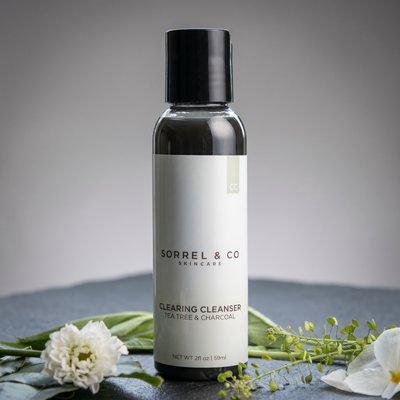
The Clearing Cleanser uses activated charcoal for what it can actually do — oil and particle adsorption during the wash — with tea tree as a supporting purifying botanical, in a gentle, aloe-based wash-off cleanser. We do not make detox claims, because there is nothing to detox, and we do not present the tea tree as a clinical-strength active, because at a fraction of a percent in a rinse-off it is not one. The honest claim is narrower: for oily and congestion-prone skin, this is a daily cleanser that cleans thoroughly without the harsh stripping that triggers rebound oiliness.
The deep-clean feel is real. The mythology is not. We would rather sell you the first than the second.
How to use it
Once daily is plenty for most people, in the evening, when the day's sebum, sunscreen, and pollution have accumulated. Even oily skin rarely benefits from charcoal cleansing twice a day — over-cleansing oily skin triggers a rebound increase in sebum production, the opposite of the intended effect.
Work into a light lather, massage for 30 to 60 seconds, rinse with lukewarm water. Follow with a lightweight hydrating step — oily skin still needs hydration, and skipping it is one of the most common reasons oily skin stays oily. If you use a separate leave-on tea tree or salicylic treatment, the cleanser is the foundation, not the whole protocol.
For more on the tea tree botanical in this cleanser, see our piece on tea tree oil for acne and what the studies actually show, and on cleanser fundamentals, why cleanser pH matters more than you think.
Not sure whether breakouts or oil are your main concern, or which step your routine is missing? The Skin Plan maps your routine in about thirty seconds — no email required.