

Tea tree oil has the dubious honor of being both one of the most-studied botanical actives in acne research and one of the most poorly formulated ingredients in the OTC skincare market. The research behind tea tree's purifying activity against acne-associated bacteria is solid. The clinical evidence for its effect on acne is also solid. What is usually unsolid is the formulation: products that contain tea tree at concentrations far below the studied effective dose, or at concentrations high enough to cause significant irritation, with very little middle ground.
Understanding what tea tree actually does, what the studies actually show, and how it compares to the conventional acne workhorse benzoyl peroxide is the difference between a tea tree product that works for you and one that either does nothing or makes things worse. Here is the honest read on the most-studied botanical in the acne category.
What tea tree oil actually is
Tea tree oil is the essential oil distilled from the leaves of Melaleuca alternifolia, a tree native to coastal Queensland and New South Wales in Australia. The oil contains roughly 100 different volatile compounds, but the dominant active is terpinen-4-ol, which accounts for 30–48% of high-quality tea tree oil by weight depending on the source.
Terpinen-4-ol is the compound behind that activity. It disrupts bacterial cell membranes through a mechanism that affects gram-positive bacteria — including Cutibacterium acnes (formerly called Propionibacterium acnes), the bacterium implicated in inflammatory acne. The mechanism is non-specific enough that resistant strains have not been documented, which sets tea tree apart from antibiotic-based acne treatments where resistance is an ongoing clinical problem.
Research also associates the oil with a calming effect on the look of irritated skin. This matters because breakouts are not purely a bacterial story: the visible papules and pustules are driven as much by the skin's response and the shedding pattern of the follicle as by the bacterial population itself.
The 2007 study
The reference trial for tea tree in acne is Enshaieh et al., published in the Indian Journal of Dermatology, Venereology and Leprology in 2007. The study compared 5% tea tree oil gel to vehicle placebo in 60 patients with mild-to-moderate acne over a 45-day treatment period.
The results: tea tree produced a 3.55-fold improvement in total acne lesion count compared to placebo, and a 5.75-fold improvement in acne severity index. Both differences were statistically significant. Onset of visible improvement was approximately 30 days. Tolerability was good — some patients reported mild dryness or itching, but no significant adverse events.
The study has limitations. It was not a head-to-head against benzoyl peroxide. It was a relatively small trial. It looked specifically at mild-to-moderate acne and did not address severe cystic or nodular acne. But within its scope, it provided the cleanest evidence available that tea tree at clinical concentration produces meaningful acne improvement.
Tea tree vs benzoyl peroxide
The earlier head-to-head trial worth knowing about is Bassett et al., published in the Medical Journal of Australia in 1990. This was a single-blind randomized study of 124 patients comparing 5% tea tree oil gel to 5% benzoyl peroxide lotion over 3 months.
What the trial showed: both treatments significantly reduced inflammatory lesion counts. Benzoyl peroxide produced faster onset of visible improvement — measurable difference at weeks 4 and 8. Tea tree caught up by week 12. By the end of the study, the magnitude of improvement was roughly comparable, with benzoyl peroxide slightly favored on raw lesion count but tea tree significantly favored on tolerability — fewer side effects, less dryness, less peeling, less burning.
The trade-off is roughly the same trade-off you find across many acne actives: faster onset usually comes with more irritation. Tea tree is the slower, gentler option. Benzoyl peroxide is the faster, harsher one. Which is better for any individual patient depends on the severity of the acne, the sensitivity of the skin, and the patient's willingness to tolerate side effects in exchange for speed.
For mild-to-moderate inflammatory acne in a patient with sensitive or reactive skin, tea tree often wins on net outcome. For more aggressive acne or for patients who have tolerated benzoyl peroxide before, benzoyl peroxide remains a useful first-line treatment.
The formulation problem
Most tea tree products on the market do not work the way the studies above predict. The reasons fall into three categories:
Concentration too low. A product labeled "with tea tree" that lists Melaleuca alternifolia oil seventeenth in the ingredient list almost certainly contains it well below 1% — nowhere near the 5% concentration studied in the clinical trials. The marketing claim is technically true. The therapeutic effect is essentially absent.
Concentration too high (undiluted). Pure tea tree oil at full strength is a significant irritant and can cause contact dermatitis. Online recommendations to dab undiluted tea tree on individual pimples produce mixed results — sometimes the lesion resolves, sometimes the surrounding skin becomes inflamed in a way that lasts longer than the acne would have. The studied form is always a diluted gel, lotion, or cleanser at 5% concentration.
Combined with too many other irritants. Tea tree paired with high-concentration salicylic acid, retinol, and benzoyl peroxide in the same routine often produces aggregate irritation that exceeds the irritation threshold for any one ingredient. The result is a barrier-compromised face that breaks out worse than before treatment.
What to look for on a label
Concentration disclosed. Effective range is 2–5%. Below 2%, results are inconsistent. Above 5%, tolerability drops. Products that disclose the concentration are formulating to the evidence base; products that hide it usually have something to hide.
Terpinen-4-ol content listed. A serious tea tree product will specify the terpinen-4-ol content of the oil used — ideally above 30%. This is the active compound; oils with low terpinen-4-ol content are less effective.
Formulation matrix. Tea tree works best when paired with mild surfactants in a cleanser format, or when carried in a gel base that does not occlude the follicle further. Heavy-cream tea tree products work less well — the matrix interferes with delivery to where the bacteria actually live.
Supporting cast. A thoughtful tea tree formulation usually pairs the active with at least one soothing ingredient (allantoin, niacinamide, centella asiatica) to keep the surrounding skin comfortable, and with a barrier-supportive ingredient (glycerin, panthenol) to keep the surrounding skin in balance. We covered the soothing case in our piece on why bisabolol earns its place in nearly every gentle formulation.
Where our own label lands
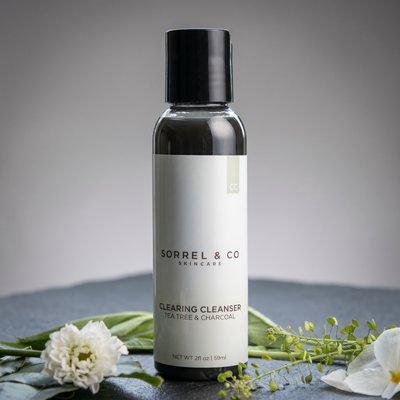
Here is the honest part, and it is the whole reason to read this before you shop. Everything above describes tea tree at the studied 5% concentration in a leave-on gel. The Clearing Cleanser is not that, and does not pretend to be. It is a rinse-off cleanser, tea tree sits near the end of its ingredient list at a fraction of a percent, and its contact time is the thirty to sixty seconds of a wash. So the tea tree in it is a minor purifying botanical — not the clinical-dose active the trials tested, and not what makes the cleanser worth using.
What makes it worth using is that it is a gentle, barrier-safe daily cleanser. It is aloe-based, with glycerin high on the list and mild coconut-derived surfactants that clean without the stripping that drives the rebound-oil cycle. Activated charcoal does modest oil-and-particle adsorption during the wash — we grade it Mixed, because that is what its skin-specific evidence supports — and the tea tree is a supporting botanical on top. It is a cleanser doing a cleanser's job well, not an active treatment in disguise. The full ingredient list, and the grade behind each ingredient, are on the product page, with the method explained on our research page.
How to use tea tree without overshooting
A cleanser is the gentlest way to include tea tree — brief contact, rinsed after thirty to sixty seconds, so it never sits on skin long enough to irritate. It is also, for the same reason, the lowest-dose way: a rinse-off delivers far less tea tree than a 5% leave-on gel, and should be judged as a gentle cleanser rather than a treatment. If you specifically want the studied clinical effect, that comes from a leave-on product at the right concentration, used carefully — not from a wash.
If you layer additional acne actives on top: choose one. Salicylic acid OR benzoyl peroxide OR retinol — not all three at full strength. A gentle tea tree cleanser plus one well-chosen leave-on active is usually a sensible routine for mild-to-moderate inflammatory acne, with the leave-on step doing the clinical-strength work rather than the cleanser. Stacking more than that usually triggers the irritation cycle that makes breakouts worse.
What to expect on timeline: visible improvement at weeks 3–4, meaningful improvement at weeks 6–8, full effect at weeks 10–12. Quitting at week 2 because results are not yet visible is the most common reason tea tree products get a reputation for not working. They work — on the tea tree timeline, which is slower than benzoyl peroxide but with significantly better tolerability.
What to monitor: dryness around the chin and jawline (where acne cleansers are typically used most), tightness after cleansing (a barrier-disruption signal — dial back frequency), and any new redness in areas where you do not normally break out (a possible irritation response — lower concentration or reduce frequency).
If you have tried tea tree products that did not work, the variable most worth changing is concentration. A clinical-dose formulation is a different product than the marketing version.
Not sure whether breakouts are where to start, or which step your routine is missing? The Skin Plan maps your routine in about thirty seconds — no email required.