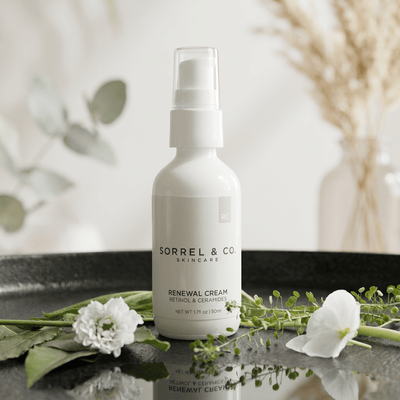
Skin does not read a calendar, but it does read the air around it, and the air changes sharply in the fall. Humidity drops, indoor heating comes on, and the barrier that coped easily through a humid August starts to feel tight, flaky, or reactive through October. A routine that was well-judged for summer can become slightly wrong for autumn without a single product going bad. This is a piece about the small, cheap adjustments that fix that, and about where a richer nighttime step honestly fits, our own Renewal Cream included.
None of this requires buying a new routine. Most of it is reordering and re-weighting what you already own.
What actually changes in autumn
The single biggest shift is humidity. Humectants — the ingredients that pull water into skin — draw that water from wherever it is available, and in humid air some of it comes from the surroundings. When the air dries out, there is less to pull, and a humectant applied to bare skin in a heated room can end up drawing moisture up from deeper in the skin, where it evaporates. The product that hydrated you in July can leave you tighter in November if nothing has changed but the weather.
The second shift is the barrier itself. Cold outdoor air, dry indoor heat, and the temperature swings between them stress the lipid layer that holds water in. A barrier that was comfortably intact starts losing water faster than it did, which reads as tightness, rough patches, and sometimes a reactivity that was not there a month ago.
Neither of these is a signal to strip more or exfoliate harder. Both are signals to seal better and cushion more.
The adjustments, in order of leverage
The highest-leverage change is also the smallest: apply your humectants to damp skin and seal them. A hydrating serum on bone-dry skin in dry air is the single most common self-inflicted autumn problem. Straight after cleansing, before the water has evaporated, then a moisturizer on top within a minute. That one habit does more than any product swap.
The second change is to reconsider your cleanser if it runs even slightly stripping. What skin tolerated in summer, when oil production ran higher, it tolerates less in the cold. The test is how skin feels sixty seconds after towel-drying: comfortable is right, tight is a signal to go gentler.
The third change is to add weight at night, not in the morning. Daytime skin still has to sit under sunscreen and, for many people, makeup, so a heavy morning cream is often more than it needs. The evening is where a richer, more occlusive step earns its place — sealing the day's hydration in overnight, when the barrier does most of its repair work anyway.
And the fourth, easy to forget: sunscreen does not become optional in autumn. Shorter days and weaker-feeling sun change how it feels, not how much protection skin needs. The step stays.
Where a richer night cream fits, and where our own lands
Autumn is the season a heavier nighttime cream stops being too much and starts being right, which is why this is the moment to talk honestly about ours.
The Renewal Cream is a rich evening step built around retinol — one of the most-studied ingredients in skincare, which we grade Strongest — paired deliberately with barrier-supporting material so the retinol has something to work against rather than a dry, unsupported barrier. That pairing is the whole design idea, and the ingredient list shows it: shea butter and meadowfoam seed oil for sealing weight, Ceramide NP to reinforce the barrier, and a peptide pair for the look of firmness. The grades and citations for each are published on the product page, and you can read how the grading works in our research library.
Two honest disclosures, both on the panel, because an autumn-comfort article is exactly where they matter. The cream contains Fragrance — the undisclosed kind, a single label line that can stand for many compounds — and it contains milk lipids, which is worth knowing if you avoid animal-derived ingredients. If your skin is reactive, fragrance is a real consideration and this may not be your cream; we would rather say that plainly than have you find out in October. It is on the label because it is in the bottle.
The reason to place retinol in the autumn conversation at all is timing. Retinol can be drying during the weeks skin adjusts to it, and starting it as the humidity drops means beginning a potentially drying active exactly when the air is already pulling moisture out. The workable version is to go slow — twice a week to begin, on a well-sealed barrier — rather than to start aggressively and blame the weather for the irritation.
A sample autumn night, in order
Cleanse gently, without stripping. If you use a hydrating serum, apply it while skin is still damp. Then the richer cream over the top, as the sealing layer, worked in while there is still a little moisture underneath for it to hold. On retinol nights, dry completely first, apply the retinol step to dry skin, then the cream over it — the one time in the routine that dry application is correct.
That is the whole switch. Not new products for a new season, but the same logic re-weighted: seal more, cushion more, add weight at night, and treat the drop in humidity as the thing you are actually adjusting for.
If you would rather have the seasonal version of your routine mapped than assembled, the Skin Plan maps yours in about thirty seconds — no email required.
References
- Kong R, et al. A comparative study of the effects of retinol on the look of aging skin. J Cosmet Dermatol. 2016. pubmed.ncbi.nlm.nih.gov/26578346
- Spada F, et al. Skin hydration is significantly increased by a cream formulated to mimic the skin's own natural moisturizing systems. Clin Cosmet Investig Dermatol. 2018. pubmed.ncbi.nlm.nih.gov/30410378
- Rawlings AV, Harding CR. Moisturization and skin barrier function. Dermatol Ther. 2004. pubmed.ncbi.nlm.nih.gov/14728698