

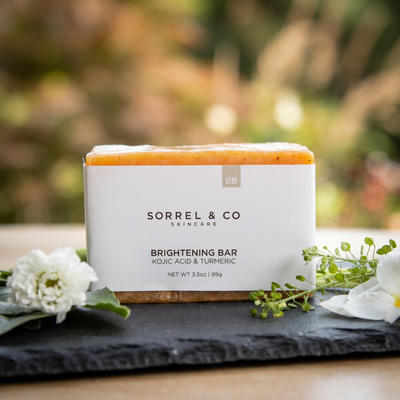
Kojic acid is one of the most-studied brightening ingredients in dermatology. It has been used in Japanese topical therapy since the 1970s, has more clinical efficacy data behind it than most newer brightening molecules, and at the right concentration can deliver brightening results comparable to prescription-strength hydroquinone — without hydroquinone's controversy. It also has a stability problem that most consumer skincare brands quietly ignore.
Kojic acid in a leave-on serum, sitting in a clear bottle on a bathroom shelf, loses a substantial fraction of its activity within months. The fix, oddly enough, is not better packaging or better preservatives. The fix is to put kojic acid in the product format where the stability problem largely disappears: a wash-off cleanser, used and replaced quickly, where degradation never has time to accumulate.
Here is what kojic acid actually does, why it works, and why a cleansing bar might be the most effective format for it.
What kojic acid is
Kojic acid is a small organic molecule produced by certain species of Aspergillus and Penicillium fungi — the same fungal genera responsible for sake fermentation. It was first isolated in 1907 from the malt of rice koji, which is how it got its name, and was developed into a topical therapy in Japan in the 1970s for treating melasma and post-inflammatory hyperpigmentation.
Structurally, kojic acid is a pyrone — a six-member ring with two oxygens and a hydroxyl group. The structure matters because of how the molecule does its work.
How kojic acid actually brightens
Kojic acid is a tyrosinase inhibitor, like most brightening ingredients, but its mechanism is unusually precise. Tyrosinase — the enzyme that produces melanin — requires two copper ions at its active site to function. Kojic acid is a copper chelator: it binds copper with high affinity, pulling the cofactor away from the enzyme and shutting down melanin production at the source.
This makes kojic acid a competitive inhibitor of tyrosinase, with binding affinity that compares favorably to most other naturally derived brightening molecules. Its inhibition constant — the concentration at which half of tyrosinase activity is blocked — is in the low micromolar range, meaning it does not take much, in absolute terms, to produce a measurable brightening effect.
Clinical studies have repeatedly shown that 2% topical kojic acid produces brightening results in melasma and PIH comparable to 4% hydroquinone, with substantially fewer side effects and none of the ochronosis risk associated with long-term hydroquinone use. A 2007 controlled study from the journal Dermatologic Surgery, comparing kojic acid plus glycolic acid against hydroquinone plus glycolic acid for melasma, found the two treatments statistically equivalent over twelve weeks.
The stability problem
Kojic acid has a known and well-documented weakness: it oxidizes. Exposure to oxygen, light, and even mildly alkaline pH gradually converts kojic acid into a colored, less-active oxidation product. You can watch this happen in real time in laboratory samples — a fresh kojic acid solution is colorless, and a kojic solution stored at room temperature for several months turns yellow to brown as the molecule degrades.
In a leave-on serum or cream, this is a serious formulation problem. The product sits on a shelf for months between manufacturing and use. It sits in a bathroom — humid, sometimes warm, often exposed to ambient light when the bottle is on the counter — for months more during use. By the time the consumer is on the second half of the bottle, the kojic acid concentration may be a fraction of what was on the label at manufacture.
Formulators address this with several workarounds. Tinted bottles. Heavy preservative systems. Conversion of kojic acid to its more-stable ester form, kojic dipalmitate, which trades stability for reduced bioavailability. Sealed airless pumps. Each helps, none fully solves the problem, and many introduce their own trade-offs.
Why a cleansing bar avoids the problem
Cleansing bars have a structural property that solves the kojic acid stability problem almost incidentally: they are used and replaced quickly. A typical cleansing bar lasts six to eight weeks in regular use. Manufacturing-to-disposal time is short relative to the degradation timeline. The active is fresh.
The wash-off format also avoids the leave-on storage problem. The bar sits in a dry, dark drawer or container between uses. It is not exposed to bathroom humidity the way an open serum bottle is. The hydration-driven hydrolysis that degrades kojic acid in aqueous serums is much slower in a solid-format product.
The mechanism of delivery is different too. A leave-on serum needs to keep the active on the skin for hours to drive penetration. A cleansing bar applies a high concentration of active for 30-60 seconds during the wash, then rinses most of it off. Counter-intuitively, this can work well for brighteners: short, repeated exposures avoid the irritation that can come from chronic leave-on use, while still depositing enough active in the stratum corneum to inhibit tyrosinase over time.
This is not a hypothetical advantage. Dermatologists in Japan and Korea have used kojic acid cleansing soaps as part of melasma protocols for decades, often as adjuncts to leave-on prescription therapy, sometimes as standalone treatments for milder hyperpigmentation. The format has clinical credibility that the consumer market has been slow to recognize.
What pairing kojic acid with turmeric actually does
Single-ingredient brighteners produce slower results than well-designed combinations, because the melanin-production pathway has multiple steps and inhibiting more than one of them in parallel works better than blocking one step harder.
Turmeric — specifically, the curcuminoid fraction extracted from Curcuma longa rhizomes — is a complementary brightening agent that works through different pathways than kojic acid does. Curcuminoids inhibit tyrosinase at a different site than kojic acid, and they also suppress the inflammatory signaling (particularly MAP kinase pathway activation) that drives post-inflammatory hyperpigmentation in the first place. The combined effect of the two molecules is consistently greater than either alone, with several in vivo studies showing additive or even synergistic brightening over 8-12 week treatment windows.
The cleansing-bar format also turns out to be a good vehicle for turmeric, which has its own bioavailability problems in leave-on aqueous products. The polyphenols in turmeric extract are highly oil-soluble and tend to phase-separate in serum formats. In a bar, where the formulation is built around saponified oils and emollient esters, curcuminoids stay solubilized and deposit efficiently during the wash.
How to read a brightening cleansing bar label
Two key things to look for.
Where the actives sit — and why a bar reads differently. The studies cited above used 1-2% kojic acid as the threshold for clinical efficacy. In a leave-on serum, an active high on the ingredient list is reassuring and a spot near the very bottom can signal a token amount. A cleansing bar reads differently: most of its mass is the soap-and-oil base and humectants, so brightening actives legitimately sit lower on the list than they would in a serum. In a rinse-off, what matters is deposition during the wash, not saturation — so judge a brightening bar on whether it names its actives and pairs them sensibly, not on how high kojic acid climbs a list dominated by base ingredients.
Saponified oil base. The carrier system matters. Saponified oils — Sodium Olivate, Sodium Palmate, Sodium Cocoate — are the structural backbone of a true cleansing bar. They control the rinse-off behavior, the lather profile, and the deposition of active. A bar built on a syndet pellet base (often labeled with surfactants like sodium cocoyl isethionate as the dominant ingredient) is functionally closer to a solid syndet cleanser, with different deposition properties. Both can work; the saponified-oil bar tends to deposit brightening actives more efficiently.
The Sorrel approach
The Brightening Bar is built around the combined kojic acid plus curcuminoid premise. On the ingredient list, kojic acid and turmeric sit low — near the end, below the soap-and-oil base and humectants that make up most of the bar. That is exactly what the section above describes: in a rinse-off used and replaced quickly, the actives deposit during the wash rather than needing to saturate a leave-on. Turmeric extract — standardized for curcuminoid content rather than total turmeric mass — provides the secondary tyrosinase inhibition. The soap base solubilizes both and rinses cleanly.
One honest note the format demands: the bar also contains a small amount of lemon oil, which is phototoxic on skin left in the sun. Because this is a rinse-off used at night and washed away, that exposure is minimal — but use the bar in the evening, rinse thoroughly, and pair it with daily SPF, which the brightening routine needs anyway.
The format choice was deliberate. We could have made a kojic acid serum. The market would have understood it. Instead, the bar form gets around the stability problem that quietly limits how well most kojic acid products perform, and the wash-off format avoids the irritation that 2%+ kojic acid can cause in chronic leave-on use.
How to use it
Once daily, in the evening, after any oil-based makeup-removal step and before any leave-on actives. Wet the bar, work into a lather between the hands, apply to the face in slow circular motions for 30-60 seconds, then rinse with lukewarm water.
Pair with a daily mineral SPF in the morning. This is not optional. Tyrosinase inhibitors disinhibit the production of melanin, and melanin is the skin's primary defense against UV-induced DNA damage. Brightening without sun protection is the most common reason brightening protocols fail — not because the brightener was wrong, but because new UV-driven melanin production outpaces the brightening.
Initial visible results typically appear at four to six weeks for fresh hyperpigmentation, eight to twelve weeks for established melasma or post-inflammatory marks. Consistency outperforms intensity. Use the bar nightly, use the SPF daily, and let the chemistry do its work.
For more on what tyrosinase inhibitors actually do at the cellular level, see our broader piece on brightening versus whitening. The brightening category is a marketing minefield, and understanding what the actives are actually doing — and why format choice matters — is the difference between a routine that delivers and one that just sounds like it should.
Not sure whether uneven tone is where to start, or which step your routine is missing? The Skin Plan maps your routine in about thirty seconds — no email required.