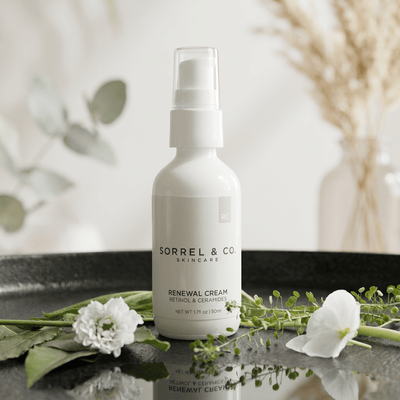
Most of the conversation about a night cream is about its active — the retinol, the peptide, the headline ingredient. Much less is said about the part of the formula that actually determines whether the cream feels good and does its sealing job: the lipids. The oils, butters, and barrier ingredients that make up the base are treated as filler, when they are often the reason a cream works or does not. This piece is about that base, using the three barrier lipids in our own Renewal Cream as the example — and disclosing, plainly, the two things on its panel a careful reader should know.
Why the base is not filler
Skin's barrier is, in large part, a lipid structure — a layer of fats that holds water in and keeps irritants out. When that structure is depleted, skin loses water faster and reacts more easily. A good moisturizer does two related things: it slows water loss by sealing the surface, and it supplies materials that resemble the barrier's own lipids, so the structure has something to work with. The base of a cream is what does both of those jobs, which is why "just the oils" is exactly the wrong way to read it.
Not all lipids are interchangeable, either. They differ in how occlusive they are, how they feel, how well they mimic skin's own lipids, and how likely they are to sit poorly on some skin. A well-built base chooses lipids that complement each other, and reading which ones a cream uses tells you a lot about how it will behave.
The three in the Renewal step
Our Renewal Cream is built around a deliberate trio, and each does a distinguishable job.
Shea butter is the rich, occlusive anchor — a butter, not a light oil, that seals the surface and slows water loss, with a cushioning feel that reads as "rich cream." It is the ingredient doing most of the sealing weight, which is exactly what you want in an evening step where a heavier finish is welcome and there is no makeup or sunscreen to sit under.
Meadowfoam seed oil is the complement — a remarkably stable oil with a lighter, less greasy feel than its sealing ability suggests, which keeps the shea-heavy base from feeling suffocating. It is one of the more oxidatively stable plant oils, which matters in a cream you keep and use over months, and it rounds the texture so the richness is comfortable rather than heavy.
Ceramide NP is the barrier-identical piece, and the one that separates a thoughtful base from a merely rich one. Ceramides are a class of lipid the skin's barrier is literally built from; supplying one that matches means the cream is not just sealing the surface but contributing the same kind of material the barrier uses to repair itself. We grade Ceramide NP Strongest, with its citation on the product page. Shea seals, meadowfoam balances the feel, and the ceramide speaks the barrier's own language — three lipids, three jobs, one base.
The two disclosures on this panel
A barrier-lipid article is precisely where a reader is reading the panel closely, so here are the two things on it worth knowing, both stated plainly because they are on the label.
The Renewal Cream contains Fragrance — the undisclosed kind, a single label line that can stand for many compounds. Fragrance is among the more common triggers for reactive skin, so if yours runs sensitive, this is a real consideration and this may not be your cream; our fragrance-free options are the better route. And it contains milk lipids, an animal-derived ingredient, which matters if you avoid those. Neither is hidden and neither is an accident — they are on the panel because they are in the bottle, and a brand that asks you to read labels has to be the first to point at the lines on its own.
Reading any moisturizer's base
The transferable habit is to stop skipping past the oils and butters to find the "active," and instead read the base as information. A cream built on a single cheap oil behaves differently from one built on a considered combination. Look for whether there is a barrier-identical lipid like a ceramide, not just occlusive oils. Look at whether the richest ingredients are near the top, which tells you how heavy the finish will be. And notice that "rich" and "good for the barrier" are related but not identical — the best bases are the ones that seal and resupply, not just coat.
For most people, a considered base like this belongs in the evening step, where richness is an asset, layered as the last thing on so it seals everything beneath it. A lighter daytime moisturizer can carry the morning; the heavy, barrier-focused cream earns its place overnight, when the barrier does most of its repair anyway.
If you would rather have the sealing step matched to the rest of your routine than guessed at, the Skin Plan maps yours in about thirty seconds — no email required.
References
- Spada F, et al. Skin hydration is significantly increased by a cream formulated to mimic the skin's own natural moisturizing systems. Clin Cosmet Investig Dermatol. 2018. pubmed.ncbi.nlm.nih.gov/30410378
- Rawlings AV, Harding CR. Moisturization and skin barrier function. Dermatol Ther. 2004. pubmed.ncbi.nlm.nih.gov/14728698
- Lin TK, et al. Skin barrier repair and soothing effects of topical plant oils. Int J Mol Sci. 2018. pmc.ncbi.nlm.nih.gov/PMC5796020