

The global collagen supplement market is worth billions of dollars and growing, built on a promise that is intuitively appealing and biochemically suspect: eat collagen, get more collagen in your skin. The intuition is wrong in its simple form — you do not absorb collagen and deposit it in your face — but the conclusion turns out to be partly right anyway, for reasons that have everything to do with peptide size. Here is what actually happens when you take a collagen supplement, why the hydrolyzed form is the only one worth taking, and what the research genuinely supports.
Why you cannot absorb intact collagen
Collagen is an enormous protein. In its native form it is a triple helix — three protein chains wound around each other — with a molecular weight in the hundreds of thousands of daltons. Your digestive system cannot absorb a molecule that large. It has to be broken down first.
When you eat any protein, including collagen, digestive enzymes cleave it into progressively smaller pieces: first into polypeptides, then into short peptides, then into individual amino acids. Most dietary protein is absorbed as single amino acids and the occasional dipeptide. Those amino acids enter a common pool and are used by the body for whatever it needs at the time — which is rarely, specifically, building skin collagen.
This is why eating a bowl of bone broth or a collagen-rich cut of meat does relatively little for your skin in any direct way. The collagen is digested to its constituent amino acids, which are indistinguishable from amino acids derived from any other protein source. There is no targeting mechanism that sends them back to collagen.
What hydrolysis changes
Hydrolyzed collagen — also called collagen peptides — is collagen that has been enzymatically pre-broken-down during manufacturing into short peptide fragments, typically with molecular weights between 2,000 and 5,000 daltons. This pre-digestion is the entire point, and it changes the picture in two ways.
First, the peptides are small enough to be absorbed efficiently and in high quantity, where intact collagen has to be fully degraded before any absorption can occur.
Second, and more importantly, certain specific small peptides survive digestion intact and appear in the bloodstream as peptides, not just as free amino acids. The most-studied of these is prolyl-hydroxyproline — a dipeptide of proline and hydroxyproline. Human studies using labeled collagen peptides have detected these specific dipeptides in blood plasma within an hour of ingestion, confirming they are absorbed without being fully broken apart.
The signaling mechanism
This is where the collagen-supplement story stops being about raw materials and becomes about signaling. The prolyl-hydroxyproline dipeptides that reach the bloodstream do not get used as bricks. They act as messengers.
Hydroxyproline is a relatively unusual amino acid — it appears in significant quantities almost nowhere in the body except collagen. When fibroblasts, the cells that produce skin collagen, detect a sudden rise in circulating hydroxyproline-containing peptides, they appear to interpret this as a signal of collagen breakdown somewhere in the body. The fibroblasts respond by upregulating their own collagen synthesis — producing new collagen, hyaluronic acid, and other extracellular matrix components.
In other words, the supplement does not deliver collagen to your skin. It prompts your skin to make more of its own. This is a subtle but crucial distinction, and it is why peptide size and form matter so much: only the small, specific, pre-hydrolyzed peptides can pull off this signaling trick. Intact collagen, fully digested to amino acids, sends no such signal.
What the clinical evidence shows
The research here is better than skeptics often assume. Multiple randomized, placebo-controlled trials over the last decade have measured skin outcomes from oral collagen peptide supplementation, and the pattern is fairly consistent: measurable improvements in skin elasticity and hydration, and some evidence of increased dermal collagen density, over treatment periods of 8 to 12 weeks.
The effect sizes are moderate, not miraculous — this is a supplement that produces a real but incremental improvement, not a replacement for topical retinoids or in-office procedures. But the direction and consistency of the evidence is genuine, and the mechanism of peptide signaling rather than brick-delivery explains why the studied doses work.
How to read a collagen supplement label
The category is full of products engineered to look impressive and underdeliver. Three things to check.
Hydrolyzed, not just collagen. The label should say hydrolyzed collagen or collagen peptides, not simply collagen or gelatin. Unhydrolyzed collagen and gelatin are not pre-broken into the small signaling peptides and do not share the same absorption profile.
Dose per serving. The clinical studies generally used 2.5 to 10 grams of collagen peptides per day. A product that provides a fraction of a gram per serving — common in collagen-infused beverages and beauty gummies — is below the studied threshold regardless of how it is marketed. Check the grams, not the marketing.
Source transparency. Bovine, marine, and porcine collagen all work; the differences between them are smaller than the marketing suggests, and come down mostly to the specific peptide profile and amino acid composition. What matters more than the source animal is whether the product is genuinely hydrolyzed and genuinely dosed.
The Sorrel approach
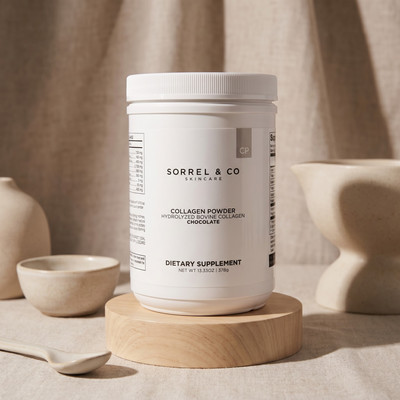
The Collagen Powder is hydrolyzed bovine collagen peptides, dosed within the clinically studied range per serving rather than the trace amounts common in beauty-beverage products. The peptides are processed to the low-molecular-weight range associated with efficient absorption and the signaling effect, not merely labeled hydrolyzed for marketing.
The chocolate flavor is not incidental. The single biggest predictor of whether a supplement works is whether the person actually takes it consistently for the 8 to 12 weeks it takes to show results. A powder that is pleasant to drink daily outperforms a theoretically superior product that sits unused in a cabinet because it is unpalatable. Compliance is a feature, not an afterthought.
How to use it
One serving daily, mixed into coffee, a smoothie, or simply water. Timing relative to meals does not appear to matter much for absorption, so the right time is whenever you will reliably remember to take it. Consistency is the entire game.
Set expectations on the timeline: skin changes from oral collagen are slow and cumulative. The clinical trials measured outcomes at 8 and 12 weeks, and that is a fair expectation — do not judge results at two weeks. Pair it with the rest of a sound routine; oral collagen is a useful adjunct to topical care and sun protection, not a substitute for either.
For more on the mechanism and the clinical evidence, see our piece on what oral collagen supplementation actually does for skin.
Not sure where to start, or which step would move the needle for your skin? The Skin Plan maps your routine in about thirty seconds — no email required.