

The supplement category that has more evidence than it gets credit for
For about a decade, oral collagen supplementation has occupied an awkward space in the skincare conversation. Pharmacologists tended to dismiss it on first principles: protein is digested in the gut, broken down into amino acids, and reassembled into whatever proteins the body needs. The argument was that consuming collagen was no different from consuming any other protein source. You might as well eat a chicken breast.
That argument turned out to be partially wrong. The mechanism is more specific than first-principles digestion suggests, and the trial base — modest but growing — supports a real, measurable effect on skin parameters.
That doesn't mean every collagen product on the shelf works. It means the category has real signal in it, and the differences between products matter more than most marketing acknowledges.
The peptide pathway
Whole, unhydrolyzed collagen is a roughly 300,000-Dalton protein. The molecule is far too large to absorb through the intestinal wall intact. If you ate raw collagen, your gut would break it apart into individual amino acids — primarily glycine, proline, and hydroxyproline — which the bloodstream would carry without any retained signaling information from the original protein.
Hydrolyzed collagen is different. The hydrolysis process — enzymatic cleavage with specific proteases — cuts the original protein into short peptide chains, typically 2,000–5,000 Daltons. These chains are small enough to absorb through the small intestine wall partially intact.
The critical finding is that some of these absorbed peptides are not just amino acids in transit. Specific di- and tripeptides — particularly hydroxyproline-glycine (Hyp-Gly) and proline-hydroxyproline (Pro-Hyp) — circulate in plasma at detectable concentrations after oral collagen ingestion and reach dermal fibroblasts.
What do they do once there? Two mechanisms appear to matter:
1. Substrate provision. The amino acids freed from the peptides are used by fibroblasts to synthesize new collagen, with hydroxyproline being the rate-limiting cofactor in much of the synthesis pathway.
2. Signaling. Pro-Hyp specifically has been shown in cell culture to upregulate fibroblast proliferation and hyaluronic acid synthesis. This is a signaling effect, not a substrate effect — the peptide is acting like a messenger, telling the fibroblast to do more work, not just feeding it raw material.
This is the mechanism that broke the 'you'll just digest it' argument. The peptide isn't surviving as a structural ingredient. It is surviving as a chemical signal.
The trial evidence
The clinical literature on oral collagen for skin has grown substantially since 2014. A few representative trials:
Proksch et al., 2014. Published in Skin Pharmacology and Physiology. 114 women aged 45–65, randomized to 2.5g hydrolyzed collagen or placebo daily for 8 weeks. The collagen arm showed statistically significant improvement in eye-wrinkle volume versus placebo. Effects were still measurable 4 weeks after stopping supplementation.
Asserin et al., 2015. Three sub-studies in the same paper, testing different collagen sources. The takeaway: fish-derived (marine) and porcine-derived hydrolyzed collagen both improved skin hydration and dermal collagen density over 8 weeks of supplementation.
Bolke et al., 2019. 72 women, 12 weeks, 2.5g daily of bioactive collagen peptides. Significant improvements in skin elasticity, hydration, density, and roughness versus placebo. The improvements persisted 4 weeks post-trial, again suggesting the effects aren't a transient phenomenon.
Choi et al., 2019. A meta-analysis pulling together 11 randomized controlled trials on oral collagen. The conclusion: short-term and long-term collagen supplementation has favorable effects on skin hydration and elasticity. The effect sizes were modest but consistent across studies.
None of these trials are large by pharmaceutical standards. They are large by nutraceutical standards. And the convergence of independent groups, on different patient populations, with different collagen sources, on consistent endpoints, is what evidence-based supplement evaluation looks like.
Type I vs Type III
Collagen comes in many types. The two that matter for skin are Type I (roughly 80–85% of dermal collagen by mass) and Type III (the supporting matrix collagen, especially prominent in younger skin).
Bovine-derived collagen is typically Type I + Type III, mirroring the dermal collagen distribution. Most of the strongest skin-specific trials use bovine peptides.
Marine collagen is almost entirely Type I, derived from fish skin and scales. It is well-absorbed and lower-allergen, but its biotype profile is narrower than bovine.
Chicken-derived collagen is primarily Type II. Type II is dominant in joint cartilage, not skin. Chicken-source collagen is appropriate for joint health, less so for skin endpoints.
'Plant collagen' is a misnomer. Plants do not produce collagen — collagen is a uniquely animal protein. Products labeled as plant collagen are typically mixtures of amino acids or plant peptides intended to support the body's own collagen synthesis. They may have value, but they are not collagen, and the trial base for them is much thinner.
Dose and timing
The clinical trial doses cluster around 2.5–10g per day. The 2.5g end is the threshold below which effects become inconsistent. The 10g end is where studies stop finding additional benefit — diminishing returns set in past that point.
For most adults, 5–10g per day is the practical target. Higher doses don't appear to add benefit and start to crowd out other protein intake.
Timing is less critical than people make it out to be. Some practitioners argue for taking collagen on an empty stomach to improve absorption; the trial data doesn't strongly support that requirement. Taking it with vitamin C is more meaningful: hydroxylation of proline and lysine residues during collagen synthesis is vitamin C-dependent. Pairing collagen intake with a vitamin C source — citrus, supplement, food — supports the synthesis pathway downstream.
What it won't do
The honest disqualifications matter more than the claims.
It won't replace topical retinoids for photoaging. The mechanisms are different. Topical retinoids drive epidermal turnover and dermal remodeling locally. Oral collagen supports substrate availability and fibroblast signaling. They stack; they don't substitute.
It won't reverse deep static wrinkles. Established structural damage to the dermal matrix isn't undone by feeding the system more raw material. Collagen supports maintenance and incremental improvement, not reversal of long-accumulated change.
It won't show results in two weeks. The trials that demonstrate effect run 8–12 weeks minimum. Collagen turnover in the dermis is slow. If you stop in week three because you don't see anything yet, you've stopped before the mechanism has had time to show up.
It isn't a substitute for protein intake. If overall protein intake is low (below roughly 0.8g/kg body weight per day), the systemic protein deficit will dominate any specific collagen contribution. Collagen is a layer on top of adequate baseline nutrition, not a replacement for it.
Reading the label
What to check on an oral collagen product:
Hydrolyzed, not whole. 'Collagen' without 'hydrolyzed' or 'peptides' on the label may be undenatured collagen, which is intended for joint health (Type II) rather than skin. The molecular weight matters.
Type I and III, ideally bovine. For skin endpoints, this is the studied biotype mix. Marine is a reasonable alternative if you avoid bovine for dietary or religious reasons.
Dose per serving. 2.5g is the minimum threshold; 5–10g is the target. A 'blend' that lists collagen 4th or 5th in a multi-ingredient powder is underdosing. Read the supplement facts panel, not the front label.
Source disclosure. Grass-fed bovine, wild-caught marine, etc. Provenance matters for sourcing ethics and for amino acid profile consistency.
Minimal additives. A clean hydrolyzed collagen powder doesn't need flavorings, sweeteners, or fillers. The cleanest products are nearly tasteless and dissolve cleanly in water.
What Sorrel does
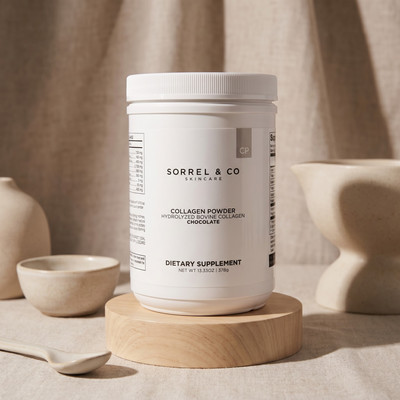
Our Collagen Powder is a hydrolyzed bovine peptide blend of Type I and Type III at the studied biotype ratio, dosed at a clinical serving size. The peptide molecular weight is targeted to the 2,000–5,000 Dalton range, where the bioactive di- and tripeptide research applies. Source: grass-fed bovine, with full provenance documentation.
The powder is unflavored, neutral, and dissolves cleanly in hot or cold liquid. We don't add vitamin C to the powder itself — we recommend taking it with a vitamin C source you already use (a glass of citrus, a vitamin C supplement, a fortified food), because the cofactor pathway works better with separately dosed vitamin C than with a small amount blended into a powder.
Practical use
One serving per day. Mix into coffee, tea, water, smoothies, soup, or oatmeal. Hot or cold both work — collagen peptides are stable across a wide temperature range and don't denature at the temperatures used in normal cooking or beverage preparation.
Timing: consistent is more important than specific. Pick a moment of the day you already drink something and add it to that. Morning coffee is the most common; it works as well as any other timing.
Expected timeline:
Weeks 1–4. No visible change. Plasma peptide concentrations elevating; fibroblast signaling beginning. The biological work is happening; the visual signal hasn't surfaced yet.
Weeks 4–8. Subjective changes — skin feels more pliant; nails grow stronger; some users report sleep quality improvement from the glycine content (glycine is a known inhibitory neurotransmitter in some contexts).
Weeks 8–12. Measurable changes in hydration and elasticity in studied populations. Skin density changes detectable by ultrasonography in trial settings, though that's not something you'll measure at home.
Beyond 12 weeks. Sustained supplementation maintains the elevated synthesis baseline. Effects partially persist 4 weeks after discontinuation, but a stable baseline requires continued intake.
The honest summary
Oral collagen used to be dismissed as marketing. The pharmacology has caught up with the trial data, and there is now a defensible mechanism — peptide signaling at the fibroblast level — supporting modest but real effects on skin hydration, elasticity, and density.
It is not a replacement for topical actives. It is not a quick fix. It is a long-game supplement with a reasonable evidence base for the skin claims it makes, provided you pick a hydrolyzed, biotype-appropriate product at a clinical dose.
Not sure where collagen fits, or what your skin would benefit from most? The Skin Plan maps your routine in about thirty seconds — no email required.