

Skin keeps a schedule. The barrier that holds moisture in and irritants out doesn’t maintain itself at a constant rate around the clock — it runs on a daily rhythm, and the busiest repair window is while you sleep. Understanding that rhythm is the difference between a night cream that’s doing real work and one that’s just sitting on your face until morning.
The ingredient at the center of that repair is the ceramide. But ceramides are widely misunderstood — sold as a hero when they’re really one member of a trio, and marketed for any time of day when the biology points clearly at one. Here’s what’s actually happening overnight, and how to use it.
The overnight water-loss problem
Transepidermal water loss — the quiet evaporation of moisture up through the skin and into the air — is a normal, constant process. But it isn’t flat. It rises in the evening and peaks in the night, while skin temperature and blood flow shift and while you’re lying in a drier bedroom for eight hours with no barrier maintenance from you at all.
At the same time, the cellular machinery of repair runs faster overnight. Cell turnover, the synthesis of new barrier lipids, the housekeeping that undoes the day’s damage — skin front-loads this work into the sleeping hours. So the night presents both the greatest need (peak water loss) and the greatest opportunity (peak repair). A well-built PM cream meets both.
Why ceramides — and why not ceramides alone
Your barrier’s waterproofing is often described as a brick wall: the skin cells are the bricks, and a lipid mortar seals the gaps. That mortar is not one ingredient. It’s a specific blend of three lipid families — ceramides, cholesterol, and free fatty acids — and the research is consistent that they work in proportion, not in isolation.
This is the detail most ceramide marketing skips. A cream can be full of ceramides and still underperform if it ignores the cholesterol and fatty acids that complete the mortar; some studies even find that an unbalanced single-lipid application can be less effective than the balanced trio. When you read a barrier cream, you’re not just looking for the word ceramide — you’re looking for a formulator who understood it was building mortar, not stacking one ingredient.
Reading a night cream properly
A few things separate a real barrier-repair cream from a moisturizer wearing the label. Does it include the supporting lipids — cholesterol, fatty acids — alongside the ceramides, or ceramides alone? Does it pair the lipids with humectants to hold water and an occlusive layer to slow the overnight evaporation we started with? And is it honest about being a night product, rather than promising to do everything at every hour? On our research page, ceramides sit in the strong tier for barrier support — the evidence is genuinely good — with the caveat that the formulation, not the ingredient name, decides the outcome.
What to layer under it
Because the renewal step is the sealing step, it goes last in a PM routine — after the water-based treatments have gone on and had their moment. Cleanse, apply your active or hydrating serums, then finish with the ceramide cream to lock the whole routine in for the night’s repair window. A hydrating serum underneath gives the cream water to seal; the cream gives that water somewhere to stay.
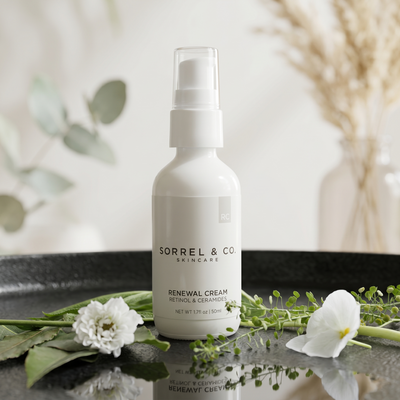
Our Renewal Cream is built around this overnight logic — the full lipid trio rather than ceramides alone — and it’s designed to sit over a treatment step like the Face Serum on the nights you’re using retinol, where barrier support during acclimation genuinely matters.
The takeaway
Skincare timing usually gets waved off as a marketing invention, and often it is. Barrier repair is the real exception. The biology points at night, the ingredient that supports it works as a trio rather than a solo, and a cream that respects both facts earns its place in your routine. One that ignores them is just occupying the last step.
Want to know whether barrier repair is actually your priority — or whether your barrier is fine and something else is the real issue? The Skin Plan takes thirty seconds and asks for no email.