

Short answer: After menopause, lower estrogen means skin loses collagen quickly — studies estimate roughly 30% in the first five years — along with moisture, firmness, and barrier strength. The most evidence-backed routine is short and focused: a retinoid for collagen and fine lines, ceramides to rebuild the barrier and hold water, a firming and peptide step, steady hydration, and daily sunscreen — all in a gentle, fragrance-free base.
What changes after 50
Skin behaves differently after menopause, and it is mostly about estrogen.
Estrogen supports collagen, moisture, and barrier strength, and as it declines, all three drop. Research estimates that women lose around 30% of their skin collagen in the first five years after menopause, with a steadier decline after that — a loss tied more to the duration of estrogen deficiency than to age itself (Managing Menopausal Skin, European Medical Journal, 2025; Phytoestrogens review, 2025). The visible result is thinner skin, less firmness, more lines, and more dryness. Menopause also shifts the skin's ceramide profile, which weakens the barrier and adds to the dryness.
The point is not to fight aging. It is to give skin back some of what it is no longer making on its own.
What actually helps
A few steps have real evidence behind them, and they matter more than a long shelf of products.
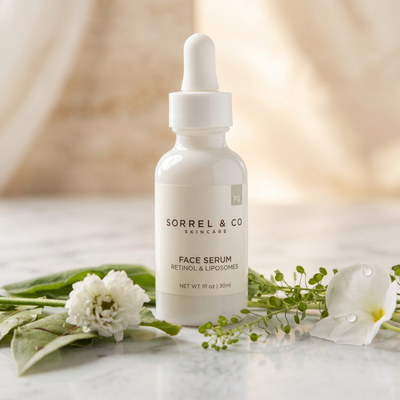
A retinoid. Topical retinoids are the most established active for the look of aging skin. A meta-analysis of randomized trials found that topical retinoids significantly improve the signs of facial photodamage, including wrinkles (Dermatology Practical & Conceptual, 2025). Start low and slow, since they can irritate at first.
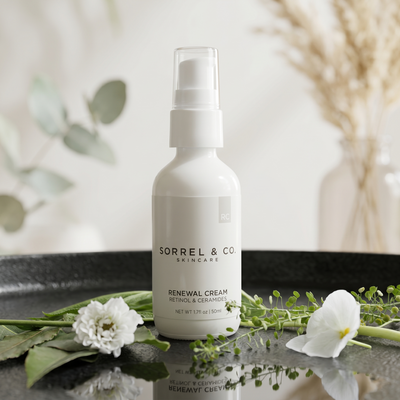
Ceramides. Because the menopausal barrier loses lipids, replacing ceramides, cholesterol, and fatty acids helps rebuild it and ease dryness (ceramide cream raises skin lipid levels, JDD, 2020).
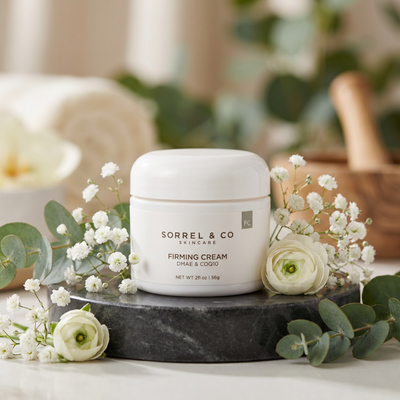
A firming step. DMAE has a placebo-controlled trial behind it showing improved firmness and reduced fine lines over 16 weeks (Grossman, American Journal of Clinical Dermatology, 2005) — one of the few firming actives with that kind of evidence.
Hydration and a peptide eye step. Humectants like hyaluronic acid restore water the skin no longer holds (Bravo, Dermatologic Therapy, 2022), and a gentle peptide eye cream addresses the thinner skin around the eyes.
Daily sunscreen. Sun protection does more for the long-term look of skin than any cream, and it protects the collagen you are working to keep.
This is part of why our routine looks the way it does
This stage of life is exactly who we grouped the Renewal Cream (retinol with ceramides), the Firming Cream (DMAE), and the Eye Cream (a peptide) together as one routine — retinoid, ceramides, firming, and peptide in a few steps rather than a dozen. The Anti-Aging Bundle is simply those pieces in sequence. None of it carries fragrance, because thinner, drier skin reacts more easily. Pair it with daily sunscreen and the routine does the things the evidence actually supports.
Frequently asked questions
What skincare ingredients are best after menopause?
A retinoid for collagen and fine lines, ceramides to rebuild the barrier, a firming active such as DMAE, humectants like hyaluronic acid for hydration, and daily sunscreen.
Why does skin get drier after menopause?
Lower estrogen reduces collagen, natural moisturizing factors, and barrier lipids like ceramides, so skin holds less water and feels drier.
Is retinol good for women over 50?
Yes. Topical retinoids have strong evidence for improving the look of wrinkles and photodamage. Start with a low strength a few nights a week to let skin adjust.
Can you rebuild collagen after 50?
You cannot fully replace what is lost, but retinoids, sun protection, and a supported barrier help preserve and improve the look of firmness over time.
Do I still need sunscreen after 50?
Yes. Daily sunscreen protects existing collagen and does more for the long-term appearance of skin than any anti-aging cream.
The takeaway
After 50, skin is making less collagen and holding less water, so the best routine gives those back: a retinoid, ceramides, a firming step, hydration, and sunscreen. A few evidence-backed steps, used consistently, beat a crowded shelf.
This article is educational and not medical advice.
— SORREL & CO · sorrel.skin
References
- Managing Menopausal Skin: A Clinician's Review. European Medical Journal. 2025. https://www.emjreviews.com/dermatology/article/managing-menopausal-skin-a-clinicians-review/
- Phytoestrogens as Natural Anti-Aging Solutions for Collagen Synthesis. 2025. https://www.ncbi.nlm.nih.gov/pmc/articles/PMC11845927/
- Tretinoin/retinoids for photodamaged skin: systematic review and meta-analysis of RCTs. Dermatology Practical & Conceptual. 2025. https://dpcj.org/index.php/dpc/article/view/5172
- Spada F, et al. Ceramide-containing product and stratum corneum lipid levels. Journal of Drugs in Dermatology. 2020. https://pubmed.ncbi.nlm.nih.gov/32272513/
- Grossman R. The role of dimethylaminoethanol in cosmetic dermatology. American Journal of Clinical Dermatology. 2005. https://pubmed.ncbi.nlm.nih.gov/15675889/
- Bravo B, et al. Benefits of topical hyaluronic acid for skin quality. Dermatologic Therapy. 2022. https://onlinelibrary.wiley.com/doi/10.1111/dth.15903