

Short answer: Hyaluronic acid is a humectant — it pulls water toward your skin and holds it there. In dry air, when there is little moisture to draw from, it can pull water up from the deeper layers of your skin to the surface, where it evaporates. That can leave skin feeling tighter than before. Two things prevent it: apply hyaluronic acid to damp skin, and seal it with a moisturizer on top. The kind of hyaluronic acid matters too.
What hyaluronic acid actually does
Hyaluronic acid does not add water to your skin. It holds it.
It is a humectant — a molecule that binds water and keeps it close. It is unusually good at the job, able to hold many times its own weight in water, and it draws moisture toward the upper layers of skin to make the surface look plumper and feel smoother (Bravo et al., Dermatologic Therapy, 2022). That is why it works so well. It is also why it can turn on you in the wrong conditions.
A humectant needs a source of water to do its job. It takes that water from wherever it can find it — the product around it, the air, or, when neither offers enough, from deeper in your own skin.
Why it can leave skin feeling drier
Most people who feel tight or flaky after hyaluronic acid are running into one of four things.
The air is dry. In low humidity — winter, a heated room, a dry climate — there is little moisture in the air to draw from, so a humectant reaches for the next available source: the deeper layers of your skin. Because hyaluronic acid draws water from the dermis toward the epidermis (Bravo et al., 2022), that water can rise to the surface and simply evaporate, since the moisture a topical humectant gathers will leave the warm skin surface depending on the humidity and temperature around it (Majewski et al., Skin Research and Technology, 2019).
You applied it to dry skin. Hyaluronic acid works best with water already present. Smoothed onto a fully dry face, it has less to bind to and is more likely to reach inward for it.
Nothing sealed it in. A humectant holds water in place, but it does not stop that water from evaporating. Without a moisturizer on top, the moisture it gathered simply leaves.
It only worked on the surface. Not all hyaluronic acid is the same. The form matters more than most labels admit.
Why molecular weight matters
Hyaluronic acid comes in different molecular weights, and the weight decides where it can go.
High-molecular-weight hyaluronic acid is large. It sits on the surface, forms a light film, and hydrates the top layer. Low-molecular-weight hyaluronic acid is small enough to settle into the epidermis, where it holds water further down (Journal of Clinical and Aesthetic Dermatology, 2024).
A serum built on a single weight works at a single depth. One made with several weights holds water at more than one level at once — surface and below — which is closer to how comfortable skin holds water on its own.
How to use it so it works
The fix is mostly about sequence.
Apply hyaluronic acid to damp skin — straight after cleansing, before your skin has fully dried, or over a light mist. Give it a few seconds. Then follow with a moisturizer to seal everything in and slow the water loss. This step is not optional in dry air. In one study, a hyaluronic acid serum followed by a moisturizing cream held skin hydration and lowered water loss more than either product used alone (Maldonado López et al., International Journal of Cosmetic Science, 2026).
Used this way, hyaluronic acid does what it is supposed to. Skin looks fuller, feels softer, and holds its hydration through the day.
This is part of why our Hydration Serum is built the way it is
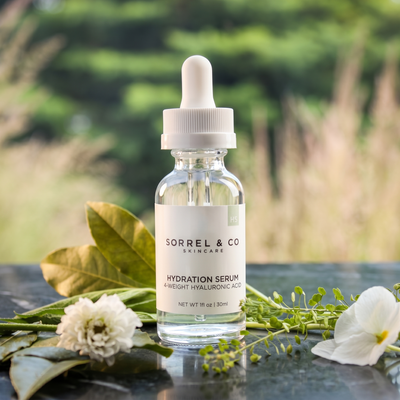
We made the Hydration Serum with four molecular weights of hyaluronic acid, so it holds water at more than one depth instead of sitting on the surface and leaving. It is also why we tell people to apply it to damp skin and follow it with a moisturizer — the Dew Cream seals it in. The serum is the part most people already know to buy. The damp skin and the seal are the part that decides whether it works.
Frequently asked questions
Can hyaluronic acid actually dry out your skin?
Indirectly, yes. As a humectant in dry air with little to draw from, it can pull moisture from deeper in the skin to the surface, where it evaporates. Applying it to damp skin and sealing it with a moisturizer prevents this.
Should you apply hyaluronic acid to wet or dry skin?
Damp skin. It needs water present to bind to. On fully dry skin it has less to work with and is more likely to draw moisture inward.
Do you have to moisturize after hyaluronic acid?
Yes. Hyaluronic acid holds water but does not stop it from evaporating. A moisturizer on top seals it in, and the two together hold hydration better than either alone.
What molecular weight of hyaluronic acid is best?
More than one. Different weights reach different depths, so a serum with several holds water at multiple layers rather than only on the surface.
Why does my face feel tight after a hyaluronic acid serum?
Usually dry air, application to dry skin, or no moisturizer to seal it. Adjust those three and the tightness generally resolves.
The takeaway
Hyaluronic acid is not the problem. The conditions around it are. Use it on damp skin, seal it, and choose one made with more than a single molecular weight. Then it holds water instead of borrowing it.
— SORREL & CO · sorrel.skin
References
- Bravo B, et al. Benefits of topical hyaluronic acid for skin quality and signs of skin aging. Dermatologic Therapy. 2022. https://onlinelibrary.wiley.com/doi/10.1111/dth.15903
- Majewski G, et al. Characterization of bound water in skin hydrators. Skin Research and Technology. 2019. https://onlinelibrary.wiley.com/doi/full/10.1111/srt.12624
- Clinical Evaluation of Multi-weight Hyaluronic Acid–based Topical Formulations. Journal of Clinical and Aesthetic Dermatology. 2024. https://jcadonline.com/clinical-evaluation-hyaluronic-acid-skin-rejuvenation/
- Maldonado López A, et al. A serum and cream moisturization regimen outperforms separate use in sustaining hydration and reducing TEWL. International Journal of Cosmetic Science. 2026. https://onlinelibrary.wiley.com/doi/10.1111/ics.70100