

Short answer: Niacinamide itself rarely irritates — it is one of the better-tolerated active ingredients in skincare. A burning or stinging feeling usually points to something around it: a skin barrier that is already compromised, the niacinamide layered over or formulated with low-pH acids or retinoids, added fragrance, or simply too high a concentration too soon. True niacinamide does not cause the flush that its cousin niacin does. Correct the surrounding conditions and the burning almost always settles.
What niacinamide is, and why burning is a surprise
Niacinamide is a form of vitamin B3, also called nicotinamide. It is water-soluble, and in skin it supports the barrier, calms visible redness, and evens tone over time.
It is also well tolerated. It is not a classic irritant in the way strong acids or high-strength retinoids can be, and at low concentrations it has been shown to reduce water loss through the skin and improve hydration (cosmetic.science evidence review). Reviews of the ingredient describe a consistently favorable tolerability profile, including in sensitive and rosacea-prone skin (Nowicka, Applied Sciences, 2025). So when it stings, the ingredient is usually not the real story.
Niacinamide is not niacin — the flushing confusion
The warmth and redness people fear is mostly a case of mistaken identity.
Niacin, also called nicotinic acid, is a close chemical relative of niacinamide. Niacin causes flushing — it widens the small blood vessels near the skin surface, which shows up as redness and heat (Medical News Today). Niacinamide does not work on those vessels the same way and does not typically cause that flush. In poorly made or unstable products, a trace of niacinamide can convert toward nicotinic acid, which is one reason a low-quality formula can feel warmer than a well-made one — but that is a formulation problem, not the ingredient itself.
The real reasons it burns
When a niacinamide product stings, look at the conditions, not the label.
Your barrier is already compromised. Over-exfoliated, sunburned, or simply over-worked skin will sting from almost anything, including gentle actives. A barrier that needs repair is the most common reason a previously fine product suddenly bites.
You layered it with acids or retinoids. Niacinamide does not need an acidic base to work. Applied right after a low-pH exfoliating acid or alongside a retinoid, the combination — not the niacinamide — is usually what you feel.
There is fragrance in the formula. Fragrance is the single most common cause of allergic contact dermatitis from cosmetics (Scheinman, American Journal of Contact Dermatitis, 1996; de Groot, review, 2020). A serum can be perfectly dosed and still sting because of what was added to make it smell pleasant.
Too much, too soon. Very high concentrations, applying to damp skin, or using several niacinamide products at once can overwhelm skin that has not adjusted.
How to use it without burning
Most of the fix is simple.
Apply it to dry skin, not damp. Space it apart from your strongest actives — acids in one part of the routine, niacinamide in another. If your skin is reacting, pause and repair the barrier first, then reintroduce slowly. Patch test a new product. And read the label: a fragrance-free formula removes one of the most common reasons skincare stings at all.
This is part of why our Clarity Serum is made the way it is
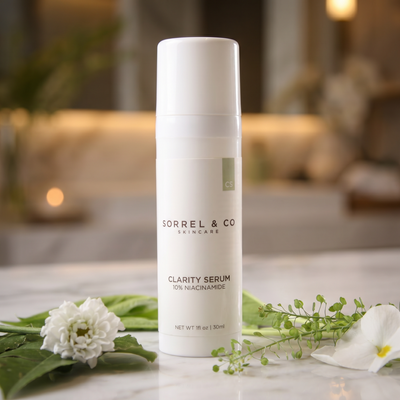
We dosed the Clarity Serum at 10% niacinamide, in a fragrance-free base, with nothing added to make it sting. The number on the label matters less than what surrounds it — the right base, no fragrance, and a formula meant to be layered thoughtfully rather than piled on. That is the part that decides whether niacinamide feels like nothing at all, which is how it should feel.
Frequently asked questions
Is it normal for niacinamide to burn?
No. Niacinamide is well tolerated, so a burning feeling usually signals a compromised barrier, layering with acids or retinoids, added fragrance, or too high a concentration — not the ingredient itself.
Does niacinamide cause flushing?
Not usually. Flushing is associated with niacin (nicotinic acid), a related but different molecule that widens surface blood vessels. Niacinamide does not typically do this.
Can you use niacinamide with vitamin C, acids, or retinol?
Yes, though layering it directly over low-pH acids or a retinoid is a common cause of stinging. Spacing them apart in your routine usually solves it.
What percentage of niacinamide should I use?
Most benefits are seen across a range of concentrations, and the formulation matters as much as the number. If a product stings, a lower concentration or a simpler, fragrance-free base often helps more than chasing a higher percentage.
How do I stop niacinamide from stinging?
Apply to dry skin, separate it from your strongest actives, repair the barrier first if skin is reacting, and choose a fragrance-free formula.
The takeaway
Niacinamide is one of the gentlest actives there is. When it burns, the cause is almost always around it — a stressed barrier, a harsh neighbor in the routine, or fragrance in the bottle. Remove those, and it goes back to doing quiet, steady work.
This article is educational and not medical advice. If your skin is persistently irritated, see a dermatologist.
— SORREL & CO · sorrel.skin
References
- Niacinamide — evidence-based ingredient review (tolerability, TEWL, hydration). cosmetic.science. https://cosmetic.science/ingredients/niacinamide/
- Nowicka D. Topical Niacinamide in Daily Skincare: A Real-World Cosmetic Study. Applied Sciences. 2025;15:9729. https://www.researchgate.net/publication/395313242_Topical_Niacinamide_in_Daily_Skincare_A_3-Week_Real-World_Cosmetic_Study
- Niacin flush: why it occurs (vasodilation mechanism). Medical News Today. https://www.medicalnewstoday.com/articles/niacin-flush
- Scheinman PL. Allergic contact dermatitis to fragrance: a review. American Journal of Contact Dermatitis. 1996. https://pubmed.ncbi.nlm.nih.gov/8796745/
- de Groot AC. Allergic Contact Dermatitis to Fragrances. 2020. https://pubmed.ncbi.nlm.nih.gov/32475515/