

Pick up almost any face oil and you will find vitamin E somewhere on the ingredient list — usually as tocopherol or tocopheryl acetate, usually near the end. It is one of the most reliable inclusions in the category, and there is a good reason for it that most brands never explain: vitamin E is doing two jobs at once, and only one of them is for your skin.
Understanding both is a useful piece of label literacy, because it changes how you read every oil you will ever buy.
Job one: keeping the oil itself alive
Plant oils go rancid. The same unsaturated fatty acids that make an oil feel nourishing are chemically vulnerable — exposed to oxygen, light, and warmth, they oxidize, and an oxidized oil smells faintly of crayon or old nuts and is more likely to irritate skin than help it.
Vitamin E is fat-soluble, which means it dissolves into the oil phase and sits there, intercepting the chain reaction of oxidation before it propagates. In a bottle of face oil, tocopherol is functioning as an antioxidant for the formula — a preservative of freshness rather than of microbes. That is why it appears in oils at low percentages so consistently. It is protecting your purchase.
This is also why the smell test is a real diagnostic. If a face oil you have owned for a year smells sharper or duller than it did, that is oxidation, and no amount of vitamin E holds it off forever. Oils have a working life, usually six to twelve months after opening.
Job two: the antioxidant on your skin
The second job is the one the marketing talks about. Skin is under constant low-level oxidative stress — UV exposure, pollution, ordinary metabolism — all of which generate free radicals that damage lipids and proteins in the skin. Topical antioxidants are the counter-move, and vitamin E is one of the most-studied of them.
What makes vitamin E specifically well-suited to skin is that it is lipid-soluble. The skin barrier is built of lipids, and cell membranes are lipids, and a great deal of oxidative damage happens in that lipid phase. A water-soluble antioxidant cannot easily get there. Vitamin E can, which is why it is often described as the barrier's resident antioxidant rather than a visiting one.
On our scale, vitamin E grades Strong. It is well characterized, widely studied, and genuinely useful — but the human evidence for topical tocopherol alone producing visible change is thinner than the enthusiasm around it, and we would rather say that than imply otherwise. You can read how we grade in our research library.
The C and E pairing
The most interesting vitamin E research is not about vitamin E alone. It is about what happens when you put it next to vitamin C.
When vitamin E neutralizes a free radical, it is itself oxidized in the process — it spends itself doing the job. Vitamin C can regenerate oxidized vitamin E back to its active form. The two work in different phases, water and lipid, covering ground neither reaches alone, and the C recycles the E so the E keeps working. This is the reason so many antioxidant serums pair them, and the reason the pairing has more research behind it than either ingredient by itself.
Practically, that pairing does not have to happen in one bottle. A routine that includes a vitamin C product in the morning and an oil carrying vitamin E is a network, spread across steps.
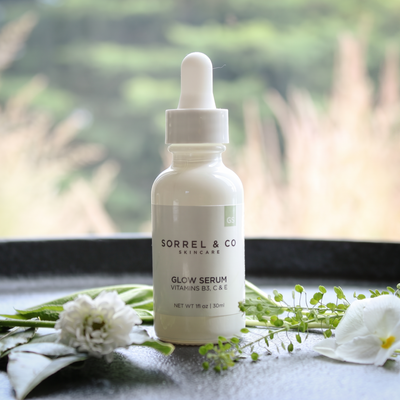
Our Glow Serum is where that pairing lives in our range — ethyl ascorbic acid, a stable vitamin C derivative, alongside tocopheryl acetate and niacinamide, built for the look of even tone across the face, neck, and décolletage.
And now our own label
Here is where we have to be straight with you, because this article would be easier to write if we simply said “and our Face Oil has vitamin E too.”
It does not.
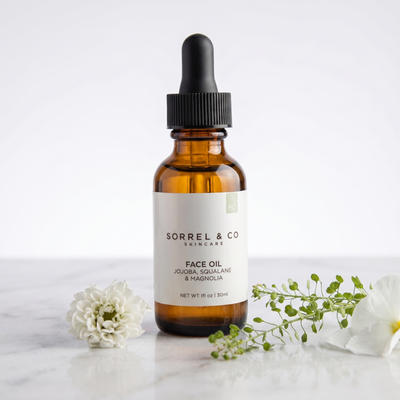
The Face Oil is jojoba, squalane, magnolia bark extract, bisabolol, prickly pear, and frankincense. There is no tocopherol on that list. Its companion antioxidant is magnolia bark — honokiol and magnolol, two well-characterized polyphenols with documented free-radical scavenging activity. We grade magnolia Mixed, because the research is largely mechanistic rather than long human trials, and Mixed is what that evidence honestly supports.
Why that formula instead of the conventional one? The oil is built around lipids that are structurally close to skin's own — jojoba is a wax ester that behaves much like sebum, squalane is the stabilized form of a lipid your sebaceous glands already make — and the antioxidant chosen with them is a polyphenol rather than a tocopherol. It is a different answer to the same problem, and we would rather tell you which answer we picked than let you assume.
If vitamin E in a face oil is specifically what you want, ours is not the one. That sentence is not a comfortable one for a brand to write, and writing it is more or less the entire point of this blog.
How to read an oil, and how to use one
When you pick up any face oil, look for three things. What are the base oils, and are they lipids that suit your skin? What antioxidant is in there, and is it doing formula-protection duty, skin duty, or both? And is the bottle opaque or dark glass — because a clear bottle on a sunlit shelf is working against its own antioxidant.
Using one is simpler. Oil goes last in a routine, over your moisturizer, because it is the most occlusive layer and its job is to seal what is underneath. A few drops warmed between the fingers and pressed — not rubbed — into slightly damp skin. At night for most people; in the morning only if your skin is dry enough to want it under sunscreen.
And if you would rather have the whole thing mapped rather than assembled, the Skin Plan maps your routine in about thirty seconds — no email required.
References
- Lin FH, et al. Ferulic acid stabilizes a solution of vitamins C and E and doubles its photoprotection of skin. J Invest Dermatol. 2005. pubmed.ncbi.nlm.nih.gov/16185284
- Shen JL, et al. Honokiol and magnolol: multifunctional antioxidative molecules. Molecules. 2010. pmc.ncbi.nlm.nih.gov/PMC6257695
- Pazyar N, et al. Jojoba in dermatology: a succinct review. G Ital Dermatol Venereol. 2013. pubmed.ncbi.nlm.nih.gov/24442052
- Iliopoulos F, et al. 3-O-ethyl-L-ascorbic acid: characterisation and investigation of single solvent systems for delivery to the skin. Int J Pharm X. 2019. pmc.ncbi.nlm.nih.gov/PMC6733298