Vitamin C is one of the most bought and most misunderstood ingredients in skincare, and most of the confusion comes from a single fact the marketing tends to skip: vitamin C is not one ingredient. It is a family of forms, and the form on the label changes almost everything about how the product behaves — how stable it is, how it is absorbed, how likely it is to irritate, and whether the bottle in your cabinet is still doing anything at all. This is a guide to reading that family, and to where our own Glow Serum sits within it.
The one that gets all the attention
The most-studied form is L-ascorbic acid, the pure, active vitamin C. It has the deepest research behind it, and when it is fresh and correctly formulated it is the reference standard the others are measured against. It also has three real problems that the research is equally clear about.
It is unstable. L-ascorbic acid oxidizes on contact with air and light, degrading into a form that does nothing and can even contribute to irritation — which is why a serum that has turned brown has already spent itself, and why the serious formulas ship in opaque, air-restricting packaging. It requires a low, acidic pH to be absorbed, which can sting or irritate sensitive skin. And it is fussy to keep stable in a formula, which is a large part of why good L-ascorbic acid serums are expensive and short-lived. It is the highest ceiling and the most demanding to live with.
The derivatives, and why they exist
The derivatives are modified forms of vitamin C engineered to solve L-ascorbic acid's problems — chiefly stability and tolerability — usually at the cost of some of its raw, best-case potency. This is the central trade of the whole category: a derivative is generally more stable, gentler, and more reliable in the bottle over time, in exchange for a lower theoretical peak than perfect, fresh L-ascorbic acid. For most people using a product daily over months, reliable-and-gentle beats a high ceiling that has degraded by week three.
A few worth knowing by name. Sodium ascorbyl phosphate and magnesium ascorbyl phosphate are stable, gentle, water-soluble derivatives with reasonable research, often chosen for sensitive skin. Ascorbyl glucoside is stable and mild, converting to vitamin C in the skin. Tetrahexyldecyl ascorbate is oil-soluble, stable, and well-absorbed, common in richer formulas. And 3-O-ethyl ascorbic acid — ethyl ascorbic acid — is a stable, water-soluble derivative that is close in structure to L-ascorbic acid and converts efficiently, which has made it one of the more useful modern options for combining stability with genuine activity.
Ranking them absolutely is a mistake, because the right one depends on the skin and the formula. But the useful reflex is: identify which form you have, and judge the product against what that form realistically does, rather than against the halo the word "vitamin C" carries.
The company you keep it in
Whatever the form, vitamin C rarely works alone in a well-built formula, and the panel tells you whether the supporting cast is there. Vitamin E is the classic partner — the two work in different phases and vitamin E extends what the C can do, with the C regenerating the E in return. Niacinamide pairs well for the look of even tone and is generally well tolerated. A vitamin C sitting alone on a short panel is doing less than one built into a network, and the ingredient list is where you see which one you bought.
Where our own label lands
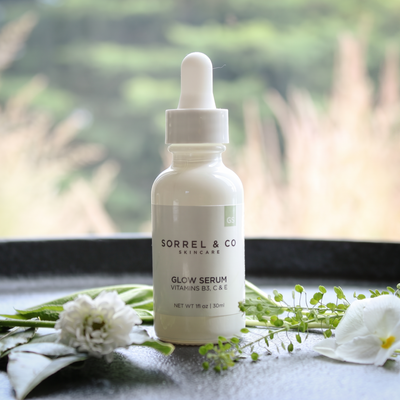
Our Glow Serum uses 3-O-ethyl ascorbic acid as its vitamin C, and that choice is a deliberate answer to the trade described above. We chose the stable, water-soluble derivative rather than pure L-ascorbic acid because a product people use daily over months should still be active in month three, not oxidized by week three — a high ceiling you cannot keep is worth less than a dependable one you can.
It does not sit alone. The serum is built as a network: niacinamide, which we grade Strongest for the look of even, calm skin; the ethyl ascorbic acid, also graded Strongest; and tocopheryl acetate, a form of vitamin E graded Strong, for antioxidant support. That is three named actives, in order by weight on the panel, with no proprietary blend hiding the amounts. The grades and citations are on the product page, and the grading is explained in our research library.
One point of label-reading precision, because this is an article about forms and we hold ourselves to it: our vitamin E is tocopheryl acetate, the ester, not free tocopherol, and our vitamin C is the ethyl ascorbic acid derivative, not L-ascorbic acid. Both are named exactly on the panel. Naming the specific form is the entire point of the piece, and it would be strange to make an exception for our own.
How to use vitamin C, whatever the form
Apply it in the morning, on clean, dry skin, before anything thicker, and give it a minute before the next step. Follow with moisturizer and, always, sunscreen — vitamin C supports the look of even tone, but it does not replace sun protection, and the two together do more than either alone. Store it away from heat and light, and if it darkens noticeably, treat that as the signal it has oxidized. And keep the expectation honest: vitamin C supports the look of brighter, more even tone gradually, over weeks, not overnight.
If you would rather have the whole routine mapped than assembled piece by piece, the Skin Plan maps yours in about thirty seconds — no email required.
References
- Iliopoulos F, et al. 3-O-ethyl-L-ascorbic acid: characterisation and investigation of single solvent systems for delivery to the skin. Int J Pharm X. 2019. pmc.ncbi.nlm.nih.gov/PMC6733298
- Pinnell SR, et al. Topical L-ascorbic acid: percutaneous absorption studies. Dermatol Surg. 2001. pubmed.ncbi.nlm.nih.gov/11207686
- Bissett DL, et al. Niacinamide: a B vitamin that improves aging facial skin appearance. Int J Cosmet Sci. 2004. pubmed.ncbi.nlm.nih.gov/18492135