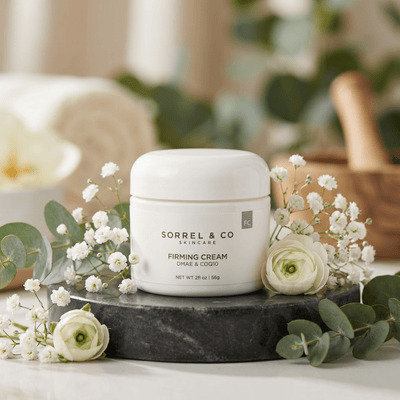
Skin laxity — the loss of firmness that shows up along the jaw, the neck, and under the chin — is one of the most requested things in skincare and one of the least honestly discussed. The gap between what a topical cream can do about it and what the marketing around firming products implies is wide, and the useful thing is to stand in that gap and describe it plainly, our own Firming Cream included.
So this is a piece about what topicals can and cannot do for laxity, and where the honest line sits. It has to start with the mechanism, because the mechanism is the whole reason the honest line is where it is.
What laxity actually is
Firmness in skin comes largely from the dermis — the layer beneath the surface — and from two proteins in it: collagen, which provides structure, and elastin, which provides the recoil that lets skin snap back after it moves. With time, sun exposure, and ordinary biology, both decline in quantity and quality. Collagen production slows, existing collagen fragments, and elastin, which the body barely replaces in adulthood, degrades and does not come back. Fat pads beneath the skin also shift and lose volume, and the bone underneath remodels. The visible result is skin that sits less tightly than it once did.
Read that list again and notice where it happens: the dermis, the fat, the bone. These are structural layers, and most of what determines firmness is happening well below the surface a cream sits on. That single fact sets the ceiling for what any topical can honestly claim.
Why the marketing outruns the mechanism
The firming category is built on language that implies structural change — lifting, tightening, rebuilding — because that is what people want and what sells. But a cream is applied to the outermost layer of the skin, and the proteins that govern firmness live several layers down, behind a barrier specifically evolved to keep things out. Getting a meaningful quantity of an active down to where collagen and elastin live, in a form that does something useful when it arrives, is genuinely hard, and no cream reverses the structural changes of laxity the way the verbs on the box suggest.
What good topicals can do is real but more modest: support the look of firmer, smoother skin, hydrate the surface so it reads plumper and more resilient, and deliver antioxidants that address some of the daily oxidative stress that contributes to protein breakdown over time. That is a worthwhile job. It is just not the same job as the marketing verbs, and the distance between the two is where most disappointment in this category comes from.
Reading a firming label without the wishful thinking
When you turn a firming product over, a few ingredients recur, and it helps to know what each is actually doing.
DMAE appears in a lot of firming formulas. It has real published research behind it, including a controlled clinical trial on the appearance of skin firmness — but the evidence is mixed rather than settled, the mechanism is not fully understood, and the effect it produces is on the look of firmness, not a structural rebuild. That is worth saying clearly, because DMAE is often presented with a confidence the research does not support.
Coenzyme Q10 is an antioxidant with research on the look of fine lines. Its job in a firming formula is to address oxidative stress, which is one contributor to protein breakdown over time — a supporting role, not a lifting one.
Hyaluronic acid does not firm anything in the structural sense. It draws in moisture, and well-hydrated skin looks plumper and smoother and therefore firmer to the eye. This is a real, immediate, and entirely surface effect, and it is worth having as long as you know that is what it is.
What you will also see, and should read carefully, are the things a firming label would rather you skimmed: the oils and the preservative system. Those are not filler. On a product used around the eyes and neck, they are exactly the part a careful reader checks.
Where our own label lands
Our Firming Cream is built on the honest version of the above, and its ingredient list says so out loud.
The active stack is DMAE, Coenzyme Q10, and hyaluronic acid — the three ingredients described above, and only those three. We grade DMAE Mixed on our evidence scale, exactly because the research is mixed; we grade CoQ10 Strong and hyaluronic acid Strongest, and all three grades, with their citations, are published on the product page. You can read how the grading works in our research library.
What is not in it matters just as much, and here we have to be direct, because this is a firming article and the temptation is to overstate. There are no peptides in this formula. Peptides are a legitimate and well-studied tool for the look of firmness, and they appear elsewhere in our range — in the Eye Cream, the Renewal Cream, and the Face Serum — but they are not in this cream, and we are not going to imply that they are because the word tests well on a firming label.
Two more disclosures, both of which sit plainly on the panel. The emollient layer includes almond oil, which is a tree-nut-derived ingredient — if you have a tree-nut allergy, this is the sentence to stop on, and this is not the product for you. And the formula is preserved with Phenonip, a preservative blend that includes parabens. We disclose that on the product page in the same plain language, because a preservative is why a water-containing cream is safe to keep and use, and hiding the specific one behind a "paraben-free" style badge would be exactly the kind of move this whole blog exists to distrust. It is on the label because it is in the bottle, and we would rather tell you than hope you do not look.
How to use a firming step, and what to expect
Applied to the neck, jawline, and décolletage, this is a targeted step, not a whole-face treatment, and it belongs in the part of your routine where creams go — after your serums, as one of the last things on. A small amount, worked in gently upward, once or twice a day.
Calibrate the expectation to the mechanism. The hydration-driven smoothness shows up fastest, within days to a couple of weeks, and it is partly a plumping-with-water effect, which is real but reversible if you stop. The antioxidant and DMAE contributions are slower and subtler and are about the look of firmness maintained over months, not a visible lift on a timeline. And structural laxity — the kind driven by collagen loss, fat-pad shift, and bone change — is not something a cream reverses. If that is specifically what concerns you, the honest pointer is toward a dermatologist or an aesthetic physician, whose tools reach layers a topical cannot.
None of that makes a good firming cream pointless. It makes it a cream that does a real, modest, surface job honestly, which is the only kind worth putting your name on.
If you would rather have the whole routine mapped than assembled piece by piece, the Skin Plan maps yours in about thirty seconds — no email required.
References
- Uhoda I, Faska N, Robert C, Cauwenbergh G, Piérard GE. Split face study on the cutaneous tensile effect of 2-dimethylaminoethanol (deanol) gel. Skin Res Technol. 2002;8(3):164–167. pubmed.ncbi.nlm.nih.gov/12236885
- Hoppe U, et al. Coenzyme Q10, a cutaneous antioxidant and energizer. BioFactors. 1999. pubmed.ncbi.nlm.nih.gov/10416055
- Pavicic T, et al. Efficacy of cream-based novel formulations of hyaluronic acid of different molecular weights in anti-wrinkle treatment. J Drugs Dermatol. 2011. pubmed.ncbi.nlm.nih.gov/22052267