

The most underrated acne ingredient
When someone with acne-prone skin walks into a drugstore, the products waiting for them are loud about it: 'Acne.' 'Spot treatment.' 'Blemish fighting.' The active ingredients are usually benzoyl peroxide or salicylic acid, and both work — but both are aggressive.
What's missing from the acne aisle is the ingredient that quietly handles most of the things acne-prone skin needs from a product: niacinamide.
Niacinamide isn't marketed as an acne treatment. It's marketed as a 'brightening' or 'pore-minimizing' ingredient, which is true but undersells it. The same molecule that reduces hyperpigmentation also regulates sebum production, calms inflammation, supports barrier integrity, and reduces the post-inflammatory marks that linger after breakouts heal. That's a fuller-stack acne ingredient than benzoyl peroxide, with dramatically better tolerability.
How niacinamide regulates sebum
Sebum is the oil your skin produces from sebaceous glands. Acne happens when sebum mixes with dead skin cells and clogs pores, creating an environment where Cutibacterium acnes (the acne-associated bacterium) thrives, triggering inflammation. Most acne treatments attack the bacteria (benzoyl peroxide) or unclog the pores (salicylic acid). Niacinamide does something different: it regulates the sebum production itself.
The mechanism involves NADPH-dependent pathways inside sebocytes (the cells that produce sebum). Niacinamide is a precursor to nicotinamide adenine dinucleotide (NAD+) and its phosphorylated form NADP+, both of which are cofactors in sebum-synthesis enzymes. By altering the availability of these cofactors, niacinamide downregulates the rate of sebum production.
In a 2006 study by Draelos et al., a 2% niacinamide formulation reduced sebum excretion rate measurably in subjects after two to four weeks of twice-daily use. Higher concentrations have been tested in subsequent literature with similar or improved outcomes. The effect is mechanism-specific: niacinamide isn't drying skin out (the way benzoyl peroxide or salicylic acid can). It's signaling sebaceous glands to produce less in the first place.
For someone with oily-and-acne-prone skin, this is the difference between 'my skin is stripped, so it overproduces oil to compensate, so I break out again' and 'my skin produces less oil at the source.'
The inflammation pathway
The second mechanism: niacinamide inhibits the inflammatory cascade that turns a clogged pore into a painful, red, swollen pimple.
Acne lesions are inflammatory by definition. The redness, swelling, and tenderness come from cytokine release in response to C. acnes and to follicular wall rupture. Niacinamide reduces multiple inflammatory mediators — IL-6, IL-8, TNF-alpha — through pathways involving nuclear factor kappa B (NF-κB) modulation.
What this looks like at the visible level: a pimple under niacinamide treatment tends to resolve faster, with less redness and less tissue trauma than one that was just attacked with a drying spot treatment. The lesion is less likely to leave a mark behind.
Post-inflammatory hyperpigmentation: the marks that linger
For darker skin tones especially, the visible problem with acne is often not the active breakout — it's the dark spot left behind after it heals. Post-inflammatory hyperpigmentation (PIH) can persist for months or years.
Niacinamide reduces PIH through a third mechanism: it inhibits melanosome transfer from melanocytes (pigment-producing cells) to surrounding keratinocytes. Melanin gets produced but doesn't distribute as widely through surrounding skin. The end result, over 8–12 weeks of consistent use, is measurable fading of post-acne marks.
This is one of the most well-documented effects of niacinamide in clinical literature. Hakozaki et al.'s 2002 work first established the melanosome-transfer mechanism; subsequent trials have replicated and extended it across multiple skin tones.
So niacinamide isn't just handling active breakouts. It's handling the consequence of breakouts — the marks — in the same product.
Why niacinamide is unusually well-tolerated
The fourth thing niacinamide does, and the reason it belongs in nearly every acne-prone routine: it doesn't compromise the barrier.
Most acne treatments make skin worse before they make it better. Benzoyl peroxide is harsh on the barrier. Salicylic acid is mild but still an exfoliant. Retinoids accelerate cellular turnover at the cost of weeks of acclimation. All of these are valuable tools, but all of them require the user to spend energy on barrier defense to avoid the secondary problems they create.
Niacinamide is unusual: it supports the barrier rather than challenging it. The same active that's regulating sebum and reducing inflammation also upregulates ceramide synthesis in keratinocytes. The barrier gets stronger while the breakouts get treated.
This is why niacinamide is the rare acne ingredient that's appropriate even for sensitive, rosacea-adjacent, or already-compromised skin types. Most people can apply 5–10% niacinamide twice daily without any tolerance issues from day one.
The 4–12 week timeline
What to expect, realistically:
Week 1–2: Subtle reduction in skin oiliness, particularly in the T-zone. Possibly some early calming of mild inflammation. Most users notice their skin feels less greasy by mid-afternoon than before.
Week 3–4: Measurable reduction in active breakout frequency for most users. Existing breakouts heal faster and with less drama.
Week 6–8: Significant fading of post-inflammatory hyperpigmentation begins. Pore size visibly reduced (this is a sebum effect — less production means less stretched-out pore).
Week 12+: Compound benefits. Skin texture smoother, tone more even, breakout frequency and severity both lower than baseline.
The timeline is longer than spot treatments (which suppress symptoms within 24 hours) but more durable. Niacinamide is a maintenance ingredient, not a rescue ingredient.
Pair niacinamide with
- Hyaluronic acid. No interaction. Apply HA on damp skin, then niacinamide.
- Vitamin C (despite the persistent myth). Modern formulations don't have the compatibility issue.
- Retinol. Niacinamide and retinol are highly complementary — retinol drives turnover and collagen, niacinamide handles sebum and inflammation. The pairing is excellent. (See When to Start Retinol: A 12-Week Beginner's Guide for the acclimation protocol.)
- Zinc. Synergistic for acne specifically.
- Sunscreen. Always.
Avoid pairing (in the same step)
- Very low pH formulations. Niacinamide is most stable at neutral pH (6–7). Applying it directly on top of a pH 2.5–3.5 L-ascorbic acid serum can briefly convert some niacinamide to nicotinic acid, which is the flushing ingredient. Wait a few minutes between layers or use them at different times of day.
That's it. Almost everything else is fine.
What Sorrel does
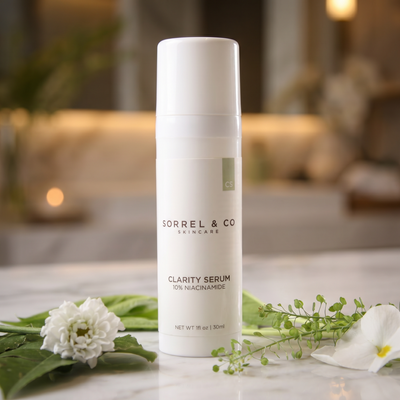
Our Clarity Serum is a 10% niacinamide formulation in a short, fragrance-free supporting base with hyaluronic acid and allantoin — no zinc in it, because we do not sell a zinc product. The 10% concentration sits in the upper end of the clinical-trial range, well above the 2–3% that most 'brightening' products contain. We covered the underdosing problem in The 2% Niacinamide Trick: Why Most Brands Underdose — most brands underdose because of cost engineering, not clinical reasoning.
For acne-prone skin specifically, the use case is twice daily under moisturizer. Some users find better results layering Clarity Serum AM and stacking it with retinol PM (with appropriate retinization).
The honest summary
Niacinamide is the most underrated ingredient in acne care. It addresses the cause (sebum overproduction) rather than just the symptom (active pimples). It calms inflammation, fades post-acne marks, and supports rather than compromises the barrier. The benefits compound over weeks, and the tolerability is unusually high across skin types.
For someone who's tired of the boom-bust cycle of harsher acne actives — a week of breakthroughs followed by weeks of dry, sensitive, reactive skin — niacinamide is the maintenance ingredient that breaks the loop.
Not sure whether breakouts are where to start, or which step your routine is missing? The Skin Plan maps your routine in about thirty seconds — no email required.