

Your skin spends every day in an environment it didn’t evolve for. Traffic exhaust, industrial particulates, the fine soot collectively labeled PM2.5 — particles small enough to settle into the skin’s surface and set off a chain of damage you can’t see happening. Sunscreen doesn’t stop it. Cleansing removes what’s sitting on top but not what the particles already triggered.
This is the problem a defense-oriented antioxidant is built for, and the most interesting molecule in that category isn’t vitamin C. It’s a green tea polyphenol with an unwieldy name — epigallocatechin gallate, EGCG — and the case for it is specific, mechanistic, and worth understanding before you decide whether it belongs in your morning routine.
What pollution actually does to skin
When airborne particulates reach the skin surface, two things happen. First, the particles themselves carry reactive compounds that generate free radicals — unstable molecules that pull electrons from whatever they touch, including the lipids that hold your barrier together and the collagen that keeps skin looking firm. Second, the skin mounts an inflammatory response to the intrusion, and chronic low-grade inflammation is its own slow tax on how skin looks over time.
The research linking particulate exposure to visible skin aging has grown steadily — population studies comparing higher- and lower-pollution environments consistently find differences in the look of pigmentation and lines. The mechanism is oxidative, which is why the countermeasure is antioxidant.
Where EGCG fits — and why not just vitamin C
Vitamin C is the famous antioxidant, and it’s genuinely excellent (we’ll always point you to it). But antioxidants aren’t interchangeable — they work in different phases of skin and quench different radicals at different rates. EGCG brings two things to the pairing that vitamin C brings less of.
The first is a dual action: EGCG is both a direct free-radical scavenger and an anti-inflammatory, dampening the signaling cascade that pollution kicks off rather than only mopping up the radicals afterward. The second is regeneration — polyphenols like EGCG help extend the working life of other antioxidants in the system, part of why antioxidant networks outperform any single ingredient (a theme we’ll return to in a later piece). In an AM routine, that makes EGCG a defense specialist rather than a vitamin C substitute.
The bioavailability catch worth knowing
Here’s the honest complication. EGCG is not the most stable molecule — it oxidizes in water and light, which is why a green tea serum needs thoughtful formulation and opaque packaging to mean anything by the time you use it. A product that lists green tea near the bottom of the ingredients, in a clear jar, is selling you the word, not the dose.
And no, drinking green tea is not the same. Oral EGCG is subject to a bioavailability gap — a large fraction is metabolized before it ever reaches skin, and what arrives is distributed across your whole body, not concentrated where particulates landed. The cup of tea is good for you for other reasons. It is not a topical pollution defense.
How to read a defense antioxidant on a label
Three checks. Is the antioxidant high enough in the ingredient list to be present at a working concentration? Is the packaging opaque and air-limiting, since these molecules degrade in light and air? And is it paired — the strongest antioxidant products build a network (vitamin C, vitamin E, and a polyphenol like EGCG) rather than betting on one hero. On our research page you can see where the green tea evidence sits on our tiers; it earns a solid place, with the honest note that concentration and formulation determine whether any given product delivers on the mechanism.
Where it lives in a routine
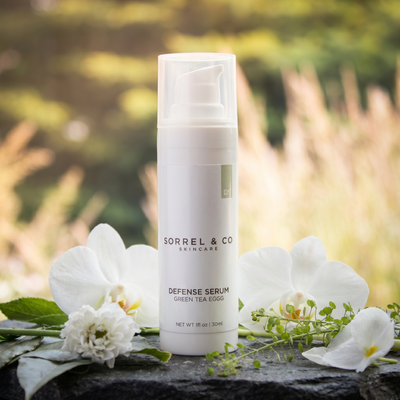
Defense antioxidants belong in the morning, because that’s when the exposure happens — UV and pollution are daytime problems, and you want the shield in place before the day, not repairing after it. Cleanse, apply your antioxidant defense, then moisturize and finish with sunscreen. Our Defense Serum is formulated around this AM-protection logic, and it layers cleanly under the brighter, more targeted work of a vitamin C product like the Glow Serum if you want both the pollution shield and the tone work in one routine.
The point isn’t that EGCG is magic — nothing here is. It’s that pollution is a specific, oxidative, daytime problem, and a well-formulated green tea antioxidant is a specific, evidence-supported answer to it.
Not sure whether daily defense is the gap in your routine or you’ve got that covered and need something else? The Skin Plan sorts it in thirty seconds, no email required.